
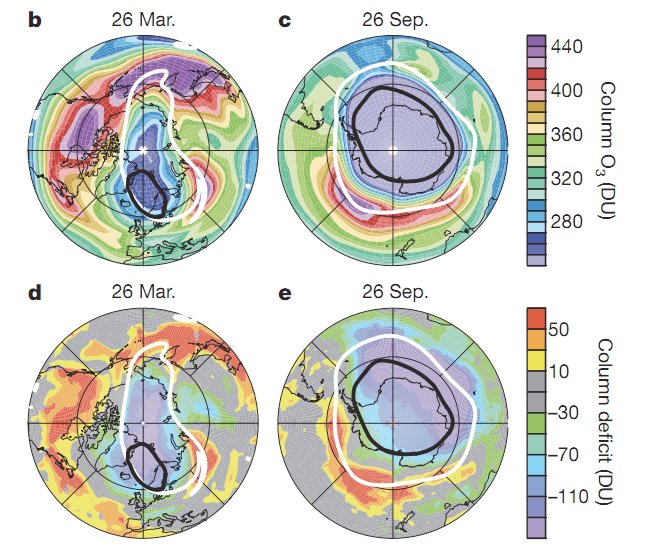
A prolonged chill in the atmosphere high above the Arctic last winter led to a mobile, morphing hole in the ozone layer, scientists report in a new paper. It’s just like the South Pole hole we all studied in school, but potentially more harmful to humans — more of us live at northern latitudes. Here are five things you need to know about it.
Most of the public probably knows about the infamous ozone hole over the South Pole, which became one of the great environmental recovery efforts of the 1980s. The Arctic loses some ozone every year, too, but not like this, said Gloria Manney, who works at NASA's Jet Propulsion Laboratory and the New Mexico Institute of Mining and Technology in Socorro.
“No previous year rivals 2011, when the evolution of Arctic ozone more closely followed that typical of the Antarctic,” Manney and colleagues write in the Oct. 2 online issue of Nature. For the first time, the Arctic loss was enough to be considered a hole.
Both holes are driven by chemical reactions involving chlorine. In cold air and sunlight, chlorine is converted into compounds that break down ozone (itself a harmful substance at the surface, but a protective one at stratospheric altitudes). Antarctica experiences an annual ozone hole as a result. The Arctic is cold, too, but usually not as cold as the Antarctic, and not for as long. But winter 2010-2011 was different. Scientists aren’t sure why.
“The processes that control temperatures in the stratosphere in the winter are so complex; it depends on various factors,” Manney said in an interview. “In December, we couldn’t have told you we were going to have this unusually long cold period.”
Without ozone, more radiation would get through to interfere with our DNA, and that of other life forms on Earth.The planet’s climate is an extremely complex system, so it’s hard to say what will happen if global surface temperatures rise as expected. But it’s generally accepted that an increase in surface temperatures will translate to a chill in the upper atmosphere, Manney said. So as the Arctic loses more of its ice sheet in the summer, the air will get even colder up above, meaning more of the chlorine reactions will take place.
“If the stratosphere cools as a result of the changing climate, we might see severe ozone depletion more often in the future,” she said.
Humans have already emitted enough chemicals to seed the process. The Montreal Protocol, which took effect in 1989, prohibits production of chemicals involved in ozone destruction. But human activity belched out plenty of those chemicals before international governments ever started noticing, let alone signing treaties. There’s still enough in the atmosphere for this effect to persist for decades, Manney said.
The air over the Arctic is extremely mobile and turbulent, forming a vortex that covers the entire region. It’s a massive area, equivalent to maybe five Californias, and it churns and moves about the Arctic Circle. In April 2011, the vortex — and the hole — moved over northern Russia and Mongolia, Manney said. The climate-monitoring scientists didn’t notice it at the time, but ground-level ultraviolet radiation monitors started to spike.
The ozone layer’s main utility is in protecting Earth from the sun’s UV rays. Without ozone, more radiation would get through to interfere with our DNA, and that of other life forms on Earth. A mobile ozone hole in the northern latitudes thus poses a risk to lots of people.
International groups of scientists monitor the Arctic with a suite of Earth-observing satellites, balloons, ground stations and more. But some of their instruments, especially the satellites, are not designed to last for much longer. The instruments onboard NASA’s Aura spacecraft, whose trace gas and cloud measurements were key to this study, were designed to last about 5 years and they’re now about 7, Manney said.
And as we’ve seen before, it’s tough to get a polar-observing satellite approved.
“There aren’t immediate plans for other satellites that give us the same kind of comprehensive measurements. So it is a concern as to whether and how much capability we’ll have to monitor not just ozone, but the other chemicals that contribute to destroying ozone,” Manney said.
Combating greenhouse gas emissions and reversing global warming will help — if surface temps don’t rise dramatically, the stratosphere may not cool dramatically, and the chemical reactions that cause ozone depletion may not occur over the Arctic. What's more, humans have already made some progress with the Montreal Protocol, Manney said.
“Having done that, we expect that we are now on a path to where eventually, in several decades, we will stop having enough chlorine to form ozone holes,” she said. “And things we might be able to do to mitigate climate change would also decrease our odds of seeing more severe future ozone loss.”
As a scientist, Manney wouldn’t speculate about other possible solutions — like geoengineering or cloud-seeding projects that would warm up the stratosphere and prevent more ozone depletion, which we'll just go ahead and throw out there. But she does believe with better data and better models, she and others will eventually be able to predict where and when it happens, leading to better warning systems for people on the ground.
“There is the possibility of saying, ‘We’ve had severe ozone loss this winter, and the ozone vortex is expected to be here [in Russia or elsewhere], so you guys should put your sunscreen on,'” she said.

140 years of Popular Science at your fingertips.
Each issue has been completely reimagined for your iPad. See our amazing new vision for magazines that goes far beyond the printed page
Stay up to date on the latest news of the future of science and technology from your iPhone or Android phone with full articles, images and offline viewing
Featuring every article from the magazine and website, plus links from around the Web. Also see our PopSci DIY feed
Engineers are racing to build robots that can take the place of rescuers. That story, plus a city that storms can't break and how having fun could lead to breakthrough science.
Also! A leech detective, the solution to America's train-crash problems, the world's fastest baby carriage, and more.


Online Content Director: Suzanne LaBarre | Email
Senior Editor: Paul Adams | Email
Associate Editor: Dan Nosowitz | Email
Contributing Writers:
Clay Dillow | Email
Rebecca Boyle | Email
Colin Lecher | Email
Emily Elert | Email
Intern:
Shaunacy Ferro | Email
o.o wow...
So...who *still* doesn't believe in Global Warming?
I fear since not one single person can feel the pain and harm of destroying our earths environment, humankind will always continue to exploit it and eventually the pollutants will one day suddenly become overwhelming and equal to the black plague. In short notice humanity will be reduced to 1% of the original population and society once again will be equal to the dark ages.
ozone disappearing, ice shelve shrinking and breaking. Water levels rising. Freak storms across the planet, droughts killing and displacing millions. Wars for resources.
Sounds like 2012 propaganda to me
The seeker of knowledge who seeks to reach beyond the stars to go where no mans gone before to see things no man has seen and bring these experiences back for the whole world to hear and see.
This is sad to see cause i know nobody will deal with this threat effectively till this becomes a global issue or the USA is threatened and so we will continue this perpetual cycle of destruction until we have reached the point of no return. it's sad how we destroy the only planet we can in inhabit as if it is indestructible. I think about what will happen to my children or my children's children oh how they will pay for our mistakes long after were gone. all because we are so short sited and tho they seem to be building more greener cars and finding alternative fuels sad thing is these things are from be feasible alternatives anything green so far is very expensive and are still premature in development it will take another few decades before they become even competitive enough to transfer from combustion or nuclear to all green tech.
They banned CFC's because they thought that was the problem. Now what's the problem? It's Bush's fault? Just another recycled story from the 70's! The stupid democrats just really have nothing new to blame!!!
The problem is, well, the CFC's. That other hole is still a consequence of us using them and other similar products. Since we now try to use them the least possible, we have a chance of seeing the ozone layer intact in a few decades according to Maney. Had ve done nothing, perhaps we'd have lost it completely already or perhaps it would be just a matter of time.
Meanwhile, we now have both poles unprotected, and nobody knows for sure what the consequences will be, so we should be prepared for the worst, just in case.
I don't really know how to face the attitude of wanting something new to blame. Do you wake up every morning asking yourself "Hmm what will I blame today ?". It seems to me all the stranger since you look like it's been a while you've been blaming the democrats for I'm-not-sure-what-they're-ending-up-doing-in-your-sentence. Cultural differences are fascinating !
Thing is though you're right it is a story from the 70's and 90's if I'm not mistaken. CFC's take something like a century to break down because they're very stable compounds. So this story is going to kind of keep happening for a while until either they naturally break down in another 70 years or so, or until we can physically filter or purge them from the atmosphere.
@DaBK global warming is completely different to the hole in the ozone. and the debate about global warming isn't so much as weather it exists, but to what extent we are contributing to it. myself, I confess to not knowing enough information to be decisive about it.
actually they are connected, the warmer surface temps contribute to lower temps in the upper atmosphere which contribute to accelerated ozone depletion, as the article states, but of course NASA's Jet Propulsion Laboratory and the New Mexico Institute of Mining and Technology in Socorro wouldn't have a clue (sarcasm), cheers
I've said it before and I'll say it again. We need to subsidize huge ozone-production factories on the poles. Just a few hundred giant Tesla-coils shooting off sparks and creating ozone 24/7.
World population will continue always to grow. World recourses will become scarcer. Finding clean fresh water will be harder to find. Continue acidification of the oceans with coral reefs dyeing and over fishing. Continue fossil fuel pumping pollution into the air with all the manufacturing companies of the world contributing too. As the world warms up so goes the permafrost and more methane is released. Typical humans trying to survive and exploiting whatever reasons they find. Oh, I am sure is much worse than this, but I have covered a lot.
Eventual massive world population death and suffering with a few humans just barely surviving.
I have a vision of Mad Max movie in my mind or a movie like the Postman for the future. Least with the Postman it ended with some kind of hope.
As dire as the world situation is with pollution, I feel a instinctive hope for our future. I even feel good about the day after December 21 2012! It is in our ability to care for each other, we humans are at our best!
1) This is not a new problem - it is a new symptom of an old problem that we have already dealt with, but is taking awhile to work itself out.
2) True, and likely will for several decades.
3) It has already been stopped, it is just highly delayed in recovery.
4) Not many people in the arctic - so the lack of ozone DURING WINTER is not going to be a big problem. Most people are covered and sheltered most of the time - if anything, getting enough UVs to produce vitimin D is such an issue that most northern color-morphs in humans tend to the pasty pale side for easier absorbsion.
5) So, when the equipment is about to die and funding is tight, suddenly an "emergency" arises that demands more funding?
The simple truth is this, even if global warming and ozone depleation take their worst possible predicted path, humanity will be fine. There are 7 BILLION of us, so even the loss of tens of millions to flooding, starvation, and water shortage is hardly a drop in the bucket.
Its probably amplified from the increased activity in solar flares.
You people are bigger sheep than the ones that supposedly went blind in the 80's from the Ozone going away then. How can you pretend to covet science when at the first blurb in the media about the sky falling you all run around screaming doom. Use some science people. Scientific method.
1.) Ask a Question: Is global warming real?
2.) Do Background Research: Can NOT prove existance of Global Warming
3.) Construct a Hypothesis: Global warming is caused by polution
4.) Test Your Hypothesis by Doing an Experiment: No need, it's real, Jon Stewart and Al Gore said so.
5.) Analyze Your Data and Draw a Conclusion: Jon Stewart is hysterical and Bush is the Devil
6.) Communicate Your Results: WE ARE ALL GOING TO DIE, the end.
Although it may be possible to get allot of these Ozone and atmosphere recovery policies in-place and enforced for the United Nations, I fear that there are just as many nations outside of this loop that are likely to not enforce such environmental protection schemes, many of which are reaching their industrial and commercial eras of development (ultra environmental destructive period).
End result will be likely a tough lesson for those affected (if not all). I don't think we will have any sort of mass human extermination like some people dream and fantasise about (really, grow up), but we will likely see some pretty striking health issues related to cancers and similar in the future which is only compounded by poor western (and other) diets.
All in all, at the end of the day, its going to be a while before we STOP saying 'we can't afford to fix it' excuse of the global community.
@prime2011...nice, call people childish that share an opinion with many scientists, backed up with solid scientific evidence just because you have a different opinion based on fantasy land that overpopulation of humans is not so bad, look up mass extinction events.
Let me see if I got this right.
1. We have only a few years of data on the arctic ozone hole.
2. Scientists don't know why the arctic ozone hole expanded so rapidly in 2010-11.
3. From this it naturally follows that we're certain that "it's too late to stop (it)" and "combating greenhouse gas emissions...will help."
Interesting conclusions based on...what? Nothing? A consensus (but no proof) that it's "generally accepted that an increase in surface temperatures will translate to a chill in the upper atmosphere"? Really? And how's that consensus on human CO2 output causing global warming matching up with the data? Oh, right, it's not.
Here's what we know. Ozone-depleting chemicals in the atmosphere have diminished by roughly 10% since 1992. During the course of the study period, according to the theory of ozone destruction by CFCs, as ozone destruction decreases, the ozone hole(s) should also be diminishing in size over time. But in 2010-11, the arctic ozone was suddenly depleted enough to be called a "hole" (who's definition?) for the first time; the opposite of what "should" be happening. No one can explain it. But wait!
Luckily, we have a conveniently broad and unproven hypothesis to rely on to "explain" every supposedly alarming natural event we record now: global warming. When it's unusually hot, it's global warming. When it's unusually cold, perversely, it's also global warming. When the earth warms over a decade, it's global warming. When it doesn't warm for a decade, it's also--guess what?--global warming.
Thanks for the humor, Ms. Boyle, but a little more science would be nice too. Try leaving it at "we don't know why yet, but we're studying it" occasionally. It's okay, we can handle it. We're grownups.
Oh, and mp, sorry to rain on your gloomy parade, but populations around the world in developed countries are already declining and it's estimated that sometime mid-century or so, total world population will begin to decline.
laurenra7,
I am happy that life will continue and so I can continue being a chocoholic longer. All is well in the cosmos, all is well!
Though, I still believe the world population will continue to grow unabated. I was offering an opinion earlier, not fact. I feel your words are just offering the same.
But, I appreciate the optimism! If we lost are in a small boat in the middle of the ocean; I prefer to be in yours! ;)
and so 2012 arrived....
people open your eyes. 2012 will be a rebirth of earth. dont get confused. it is not the end
_________________
The people of the world only divide into two kinds, One sort with brains who hold no religion, The other with religion and no brain.
- Abu-al-Ala al-Marri
Ah good ole politics. I love skeptical people that if things that aren't spelled out word for word and put right in front of their faces they simply wont open their minds to it. Take into acount that our universe is in state of equilibrium. Now relate an every day occurence of a miniscule scale to something of greater significance. If you go outside and urinate in the same patch of grass in the same area it dies. The amonia from the urine will be absorbed and soon turn the tips of the grass black. Continue doing this over the course of weeks or months and see how big the patch of dead grass will become. A somewhat larger scale relation of humans impact on environment. The cane toad is a native to Central america/South America. It has been introduced to many new regions around the world for many different reasons e.g. pregnancy tests and pest control. Since then 1/3 of our world's amphibian population has been wiped out due to a fungi the the cane toad carries. Regardless of how small humans "interference" in our environment is... we ARE having a direct impact on the world we live in. And anything in excess is not good. Just like if you eat to many sweets you get fat (just jk md, im a dark chocoholic if it has almonds). Everyone has their own opinion and is entitled to it but until everyone can get along and work together the human race will never fully reach their potential and will more than likely cease to be due to our own destructive nature. But try telling the Republicans to work with the democrats lmao (jk laurena i dont take a political sides im more of a neutral kinda guy with my own opinions) anyways i step off of my soap box.
We we feel were gonna die, if we know were gonna die, I want to die being nice to someone, before I catch my canoe and paddle west to the stars of Orion. ;)
@Blue
in regards to your dark ages comment~ I'm not really sure if that would be the most terrible thing... In an alarming number of countries it would actually take you less time and effort to hunt for an animal to eat every day and make a house out of logs rather than working your butt off for half of your life struggling, and still not owning your own home 30 years later. Did you know the average wage for a university graduate in china is $400 a month? and average rent is $500? don't forget student loans :3 It seems pretty backwards to me. With all of our technology, we technically havent made any progress?
It is true that just a few families benefit from most of the entire human race's efforts. At first I was kindof angry, then i realized, anyone who would do that is not sane, raised to hoard money in a psychotic way fueled by parrinoia perhaps... I kindof feel sorry for them if thats the case. I mean, I put myself in their shoes and I know I would be giving my money away because I would want to help the human race progress.
In the end one day money will be worthless because we will be able to have anything we want immediately without doing anything to get it. I honestly dont see anything wrong with that lol. If you can find a way to do that, id call that smart, but myself being the only one who can? That honestly seems like an awful waste. anyway im rambling now :3
cheers
bdot
@bdotalex
Thats a very interesting point, and one that is rarely given credence. Is modern society, technology, and "progress" really a good thing? Are we really any better off?\
Thousands of years ago, a man could catch his own food, build his own home, and have complete control over his destiny. Today most people are at the mercy of the rich and the government.
I once read somewhere that after the knife was invented, people could hunt many more animals and have more food. Population increased, game populations dropped, and suddenly there was less food than there was before they had knives. Was it really a good invention?
To make it short and sweet... in my opinion there is no such thing as a bad or good invention. Instead I would say it would be in the way man decides to use it would be good or bad. Man will always have the desire to understand our world and the things around us. We will also always look for ways of making our ways of living easier. The problem is people are very selfish as a whole. Our technology keeps advancing but our understanding of how we use it and the effect we have on our world seems to be something few seem to care about or comprehend. People are getting smarter and smarter, but they are none the wiser. Ultimately our blind pursuit of technology will either lead to our destruction or a world unified in working towards a greater civilization. But with our current world situation, it is looking pretty grim.
"A thirst that will never be filled and a desire that will never be killed." What do you see?
bdotalex,
I gave you a good clue to my value system. I hope to just be a good person and being nice to someone, prior to my demise. A person never really knows their time of death; I could die anytime, even while eating my fries. These are my choices you see, as I live my own life for me. ;)
@bdotalex
wow. amazing words. i agree. it might seem that living nowadays is better and easier than it was 1000 years ago but that's not 100 percent true.
_________________
The people of the world only divide into two kinds, One sort with brains who hold no religion, The other with religion and no brain.
- Abu-al-Ala al-Marri
I stopped reading at "Two Poles, Two Holes".
Humans won't solve the ozone problem (and thousands of other environmental issues)until & unless we learn to make money out of it! Our "greed gene" rules everything!
*╭╮ ╭╮ ╭╮
││ ││ │└╮
╭┴┴─┴Ⅲ╮~└─╯
│ ﹋ ﹋ │ ╭─────────╮
│ ∩ ∩ │ ╭╮ http://ygn.me/GI6E0z80
│ ▽ │O╰╯╰─────────╯
╰─m∞m─╯
http://ygn.me/GI6E0z80
http://ygn.me/GI6E0z8
THIS IS A VERY UNDEDUCATED AND AN UNINORMED ARTICLE
THIS HAS NOTHING TO DO WITH HUMANS, WE HAD A GLOBAL RECESION FOR TH PAST 10 YEARS, GREENSHOUSE EMISSIONS ARE DOWN SEGNIFICATLY COMPARING TO THE 90s. (this is a fact)
THIS OZONE CHANGE IS DUE TO EARTH MAGNTIC FIELD WIEEKENING, YOU CAN NOT ACCOUNT FOR SUCH A MASSIVE LOSS DUE TO HUMAN EMMISSIONS. (this is a fact)
N AND S POLLS FLIPED BEFORE ITS HAS BEEN CONFIREMED BY MAINSTREAM SCIENCE. WHEN N AND S ARE READY TO FLIP OZONE IS BURRNED OUT BY THE SUN FASTER THEN USUAL BC MAGNTIC FIELD IS NOT AS STRONG OR STABLE. (this is a fact)
WE ARE CURRENTLY OVER DUE FOR THE NEXT POLE FLIP (this is a fact)