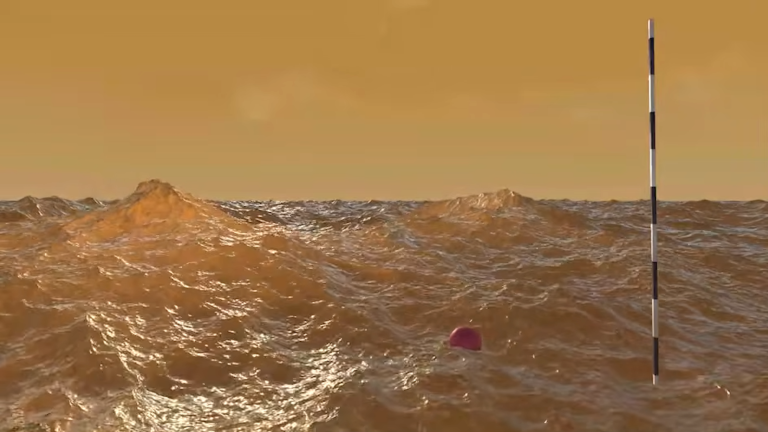
Along with methane lakes and ice volcanoes, Titan’s bizarre features could include a massive subsurface ocean similar to that of its cousin moon, Europa.
In an interesting twist, this could be one explanation for what’s been replenishing the Saturnian moon’s methane — maybe it’s not life, but a vast ocean of hydrocarbons that occasionally burps to the surface.
By crunching data from the Cassini mission, scientists have determined Titan orbits Saturn in a similar manner to our own moon — it always presents the same face toward its host planet, and its axis is tilted by about 0.3 degrees. This suggests Titan is more dense at its surface than at its core.This does not make much sense, unless you consider that Titan might not be solid. Researchers at the Royal Observatory of Belgium in Brussels say the data work out if Titan has a huge ocean under an icy crust.
They performed their calculations assuming it was a watery ocean, not a methane one, because of some assumptions about the ocean’s depth and how thickly it could be covered in ice. Technology Review's arXiv blog notes that this is an odd choice, given the prevalence of hydrocarbons on Titan.
This is not the first group to posit that Titan has an ocean of liquid water beneath the surface. Back in 2008, scientists studying Titan’s surface features noticed that things were drifting around, shifting from their expected locations by as much as 18 miles. That could be explained if a watery layer was sandwiched between the icy crust and the moon’s core, lubricating the crust and allowing it to drift.
At that time, scientists theorized such an ocean would consist of liquid water and ammonia, buried about 60 miles beneath the surface. This new study suggests a water ocean, buried beneath a thick crust of indeterminate depth. Several variables make it difficult to determine the ocean’s characteristics, according to the authors.
They also note that the moon’s odd orbital behavior could also be the result of some other disturbance, like a passing asteroid, and not a liquid interior. More calculations and probably further data would be needed to refine this theory.
Still, it’s an interesting study for its other Titanic implications. If the calculations hold up in the case of a methane ocean rather than a water one, that could help explain the persistence of surface-level methane. The hydrocarbon ought to be broken down by sunlight, but it's mysteriously replenished. Granted, that would be a lot less fun than the idea of hydrogen-breathing, methane-exhaling Titans.
Five amazing, clean technologies that will set us free, in this month's energy-focused issue. Also: how to build a better bomb detector, the robotic toys that are raising your children, a human catapult, the world's smallest arcade, and much more.


Online Content Director: Suzanne LaBarre | Email
Senior Editor: Paul Adams | Email
Associate Editor: Dan Nosowitz | Email
Assistant Editor: Colin Lecher | Email
Assistant Editor: Rose Pastore | Email
Contributing Writers:
Rebecca Boyle | Email
Kelsey D. Atherton | Email
Francie Diep | Email
Shaunacy Ferro | Email
the cassini probe is another example of how money spent on nasa is the best deal going, just think what it could do if properly funded
Europa's oceans are most likely water.
I wonder how nasa is going to explain the methane found in the martian atmosphere.
Are we alone in our solar system?
Life began in earth's oceans over 3.7 billion years ago it didn't take hold on land until 700 million years ago. Our outer solar system is where we found evidence of water ice, water geysers and organic chemistry on ice covered water worlds, all the necessary marker for life as we know it.
Europa ice covered ocean, and the water geysers of Enceladus are just a beginning of more discoveries to come. As been suggested Titan is now being considered as yet another one of those ice covered water worlds that exist in our outer solar system, the list goes on and on which may also soon include a couple of planet size moons of Jupiter's, Ganymede and Callisto.
We are looking for life on a habitable worlds similar to Earths near a star which is a mistake. We are now finding out that a ice covered water-world can exist anywhere in space. Life exist at the bottom of our oceans where there is less light reaching this area than there is light from the sun in deep space far beyond Pluto.
We now know where there is a large gravitational field such as exist at our gas giants that give these worlds enough heat through the friction of the constant tidal tugging over billions of years such that exist at Io, the most volcanic world in our solar system that has been linked to tidal forces. There could be life under a thick layer of ice with the right rich organic compounds that exist in a much greater amounts in the frigid parts of our solar system.
Aliens visiting our planet may be from one of our outer solar systems ice covered water worlds. The aliens may not be looking for a nice warm spot to land on the surface but are looking for a nice comfortable spot that exist only at the bottom, abyss, of our oceans such as in the movie the "Abyss." The flying alien spaceships are only seen coming and going then classified as a UFO's, but our surface dwelling world is too toxic to spend much time because they are, fish out of water -- it's like humans spending time outside their shell in the vacuum of space orbiting the earth.
Also see reclassifying the term Habitable zone here:
www.shineinnovations.com/19312.html
Ron Bennett
I think life on the moon titan be cool, but have u guys ever thought of how much it'll cost humans to get there. I also want to conclude that how will it be 'till we find a way to get humans there.
Continued from above,
Our first contact with one of these ancient aquatic life forms may have already happened we just don't know it. As soon as we learn how to communicate with dolphins and whales we may be told by them some amazing stories of there more intelligent brothers. Kirk and Spock used a pair of whales—"George" and "Gracie" in the 1986 movie 'Star Trek IV: The Voyage Home," to save the earth. Maybe they were onto something as the movie placed our worlds existence on our ability to communicate with our own intelligent aquatic life forms.
Ron Bennett
Instead of hoping we find intelligent life forms away from this planet we should be creating intelligent life forms here on planet earth. Completely designed from the ground up. Life 2.0 Take all the smart stuff like creativity and compassion. And leave out superstition and hate and revenge.
@boka Best comment on this site so far.