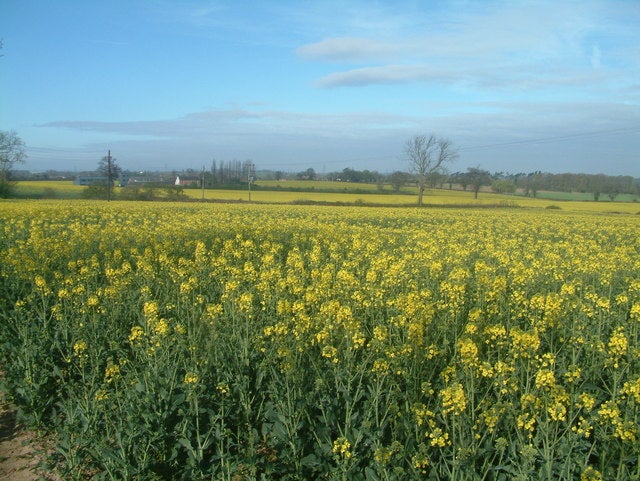
Rapeseed, Grown for Biofuel Production Mark Walton via Wikimedia

The Department of Energy’s ARPA-E (Advanced Research Projects Agency--Energy) has just doled out its fourth round of funding, and $30 million is going toward the ambitious goal of trimming the cost of biofuels by 50 percent. PETRO, or Plants Engineered to Replace Oil, looks to breed or genetically modify plants that boost energy-per-acre by boosting their abilities to capture and convert solar energy.

The problem with biofuels is that they can actually cost more in energy to produce than they end up yielding in BTUs, delivering a poor return (sometimes a negative return) on energy investment over the course of a given acre’s life cycle. Then there’s food prices that must be taken into consideration; crops like corn, when used to make ethanol, are removed from the food supply. That can cause price spikes, which tend to cause problems ranging from famine to civil unrest.

PETRO will try to optimize plants for energy capture and conversion, so more energy is absorbed, stored, and converted to final fuel products than is being extracted from current biomass crops. To quote ARPA-E:

ARPA-E seeks to fund technologies that optimize the biochemical processes of energy capture and conversion to develop robust, farm-ready crops that deliver more energy per acre with less processing prior to the pump. If successful, PETRO will create biofuels for half their current cost, finally making them cost-competitive with fuels from oil.

If it works, new breeds of plants (and GM biofuel crops) could help the U.S. meet its mandate to manufacture 36 billion gallons of biofuels by 2022 (up from about a third of that today).

[IEEE Spectrum]

10 Comments

Notwithstanding the problem of negative yield the following part is very funny: "Then there’s food prices that must be taken into consideration; crops like corn, when used to make ethanol, are removed from the food supply."

So, to make it straight, using corn is bad because it impacts the food supply while using the land previously dedicated to grow corn isn't.

Now, we might use land not currently dedicated to agriculture but it will increase costs and will have other negative environmental effects.

Perhaps this bio fuels idea is not that good after all....

I always wondered why they don't take sewage, and pump it down into old oil wells, treated to perculate into "biofuel" so that it can be pumped back out in a few years when done.

Think of it, they use sewage and garbage to perculate in containers to make biofuel. They pump water down into oil wells that have no more oil. Why not treat garbage and sewage to be pumped into the dry oil wells, even if it takes dozens of years to turn into some sort of biofuel or create a supply of methane, it's got to be better than pouring treated sewage into rivers, and filling "dry" oil wells with water.

They have had a way better solution to this problem for quite some time now. It’s called Algae. I doubt we will ever see that used unfortunately, since it’s so easy to grow it would drive the prices down and possible cause the oil company's not to have record breaking quarterly profits almost year after year.

- Darth Lithicus

I can't believe that even with the massive fuel crunch we are seeing on the horizon that we can't just face facts and look beyond what we've been told (lied to) about a certain pair of plants that consistantly out grows conventional crops, out performs paper and cotton while retaining cheaper per acre growth AND processing costs. It's seeds contain higher omega-3's and essential fatty acids than any other seed around. But no, it's still illegal because it has the horrible side effect of being used to get high, even though it causes less side effects on the user than tobacco or alcohol.

It was law when Washington was president that a certain acreage of this crop MUST be grown for rope and paper use as well as helping add nitrogen back into used soil when used as a rotation crop.

The ONLY reason we still have our founding fathers documents is because of the paper they were written on. And that paper wasn't made from trees.

Lets grow up America, the benefits far outweight the precieved and conjured up negatives.

The reality is that all fuel is biofuel, including fossil fuel.
The second reality is that corn fuel will never be cost-effective to produce or efficient to burn and no studies have yet been conclusively executed on the resultant effects of massive burning of such fuel on the ecosystem.
The third reality is that the ice caps melt from time to time in cyclic global rhythms, regardless of whether we ever existed on the planet.

I also think they should do more research into plants that are not food stock(jatropha). Butanol sounds very pormising too.

"Butanol is formed by ABE fermentation (acetone, butanol, ethanol) and experimental modifications of the process show potentially high net energy gains with butanol as the only liquid product. Butanol will produce more energy and allegedly can be burned "straight" in existing gasoline engines (without modification to the engine or car),[12] and is less corrosive and less water soluble than ethanol, and could be distributed via existing infrastructures. DuPont and BP are working together to help develop Butanol. E. coli have also been successfully engineered to produce Butanol by hijacking their amino acid metabolism."

Really popsci? Food is removed from the food chain? How about the fact that 33% of the corn used for ethanol is returned as DDG's for livestock feed? How about the fact that without ethanol helping to make farming profitable again you'd have millions of acres left in CRP which is where the government pays farmers to plant productive ground back into "native" environments. The corn you see going to ethanol (yellow dent #2) is not the same stuff you see people using for tortillas, or corn on the cob, or canned corn. As far as feeding humans with corn its a round-a-bout path through livestock that we finally eat it. The only other things its used for is high fructose corn syrup and corn flakes. farmers here in the midwest are good at growing corn, better and better every year, so just let us grow it and use it for whatever we want. It is speculation in the market that is causing the rising corn prices, not a lack of supply. They are predicting that there will be 900 MILLION bushels of corn leftover come this fall. Thats 24,300,000 TONS of corn left come this fall. And what are we gonna do? Grow even more of it. The reality is that corn prices were dismally low for decades and now we've finally found a way to raise our families, make some money, and not have to accept government subsidies to keep the faimly farm running and everyone gets mad. With the budget crisis you'd be mad at farmers if they were taking the LDP payments and CRP payments like they had to for years to stay afloat so how do we win? We can't, we're either beggars and goverment welfare addicts or we're accused of starving the world.

As for the rest of the article, I love the idea of cellulosic biofuels. Its a huge untapped supply that can fuel this nation, and many others, forever. Or at least until sufficient battery technology comes along. Its great to finally see some of these technologies arriving.

If the government would stop the $6 billion subsidy of wasteful corn ethanol we would hit that 36 billion gallon biofuel target long before 2022. Free market innovation would quickly generate a solution if it weren't so profitable to produce corn ethanol under the current subsidy. It's well known that corn is a very inefficient feedstock for ethanol.

@CodeZero, I guess you missed out on the news that over 13,000 people are killed each year in auto accidents by people high on that legal drug, alcohol. How would legalizing marijuana help this situation?

Plus using it makes you stupid.

@laurenra7...growing hemp for other purposes doesn't produce smokable herb, cure you ignorance before you post

oops your


June 2013: American Energy Independence

Five amazing, clean technologies that will set us free, in this month's energy-focused issue. Also: how to build a better bomb detector, the robotic toys that are raising your children, a human catapult, the world's smallest arcade, and much more.


Online Content Director: Suzanne LaBarre | Email
Senior Editor: Paul Adams | Email
Associate Editor: Dan Nosowitz | Email
Assistant Editor: Colin Lecher | Email
Assistant Editor: Rose Pastore | Email

Contributing Writers:
Rebecca Boyle | Email
Kelsey D. Atherton | Email
Francie Diep | Email
Shaunacy Ferro | Email

circ-top-header.gif
circ-cover.gif
bmxmag-ps