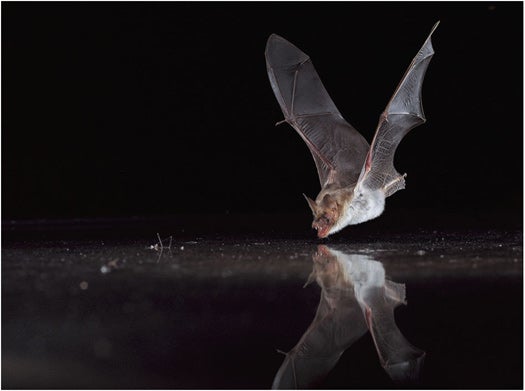
Coming on the heels of the 40th annual National Symposium on Bat Research is this amazing video from Nature demonstrating how bats use echolocation to find bodies of water. PopSci has seen a lot of depressing research about the state of our winged mammal brethren over the course of our time at the symposium, so a breakthrough like this is refreshing, exciting and right in line with next year's Year of the Bat.
While scientists have understood for some time how bats use echolocation to find insects, this study by Stefan Greif and Björn Siemers of the Max Planck Institute for Ornithology suggests that bats rely more on echolocation to assess their environment than other senses.
Both captured wild bats and juvenile bats that had never previously encountered large bodies of water were placed in a room with smooth and textured wood, metal and plastic plates. Bats of all species repeatedly attempted to drink from the smooth plates, but never from the textured plates. This is because the smooth plates replicate the mirror-like echo reflection exhibited by bodies of water. Such surfaces reflect most of the bats’ echolocation energy away from it, but some energy hits the surface perpendicularly, sending an echo back directly beneath the bat. Water is the only such surface that behaves this way found in nature, so when the bats encountered similar properties in this artificial environment, they assumed the smooth plates were water.
In some tests, bats would try to drink from the smooth plates even after having accidentally landed on them shortly before. Seemingly, the echolocation instinct overrode the tactile information that the object was not, in fact, water.
Check out the bats in action below:
[Nature]
Five amazing, clean technologies that will set us free, in this month's energy-focused issue. Also: how to build a better bomb detector, the robotic toys that are raising your children, a human catapult, the world's smallest arcade, and much more.


Online Content Director: Suzanne LaBarre | Email
Senior Editor: Paul Adams | Email
Associate Editor: Dan Nosowitz | Email
Assistant Editor: Colin Lecher | Email
Assistant Editor: Rose Pastore | Email
Contributing Writers:
Kelsey D. Atherton | Email
Francie Diep | Email
Shaunacy Ferro | Email
Nice, Awesome,ohh,ahh,in ter es ting.
our website :[ http://www.shoeboxs.us ]
(b..r..a..n..d.)s.h.o.e.s.(34u.s.d),,
==J. a .m .e )) shoes
< j o r d a n> (1-24) shoes
< j o r d a n> 2010 shoes
c.l.o.t.h.i.n.g,,j.e.a.n,,h.a.n.d.b.a.g(35u.s.d),,
==c .o. a .c .h )) handbag
(f.r.e.e)s.h.i.p.p.i.n.g
[ http://www.shoeboxs.us ]
[ http://www.shoeboxs.us ]
So this means bats are crashing into poles, concrete, glass buildings, walls, cars, and other city objects thinking it's water? This must aid in their extinction. Sigh..
I believe that this "false water" might be utilized to administer oral medications to sick bats ...
... ALSO ...
Using a 2-way mirror, oriented horizontally (flat & level), might be a good way to lure bats in for (IR)photo close-ups.
This website is being ruined by spam.
@cghgjg, sdfsdfds, liuhuyu
WTF?
Why is PopSci, SciAm, and PopMec allowing all this spam in the comment section? Why don't they stop this from happening. It ruins the comment section.
I wanted to comment about the bats, but I forgot what I was going to say after I got through all the spam.
First off it must not have been to important if you forgot. Next I don't believe while related those magazines sights are controlled by this magazines owning company... Bonnier Corporation.
While popsci and popmech share the word popular, Bonnier does not list them as one of their own. Same can be said about Sciam, it is also not listed as a Bonnier Corporation property, entity, publication, et cetera.
The only way they could eliminate the spammers is to ban links altogether. That might inhibit useful links that do come up from time to time. Seriously though focus more, and ignore the spam remarks. Once you have learned the format they use it is not hard to just skip right past them.
They are not so shinny that you can't look away.
On topic now. While this may open up something new to explore about the loss of bat population it is an awesome photo. In all honesty it never occurred to me that they would drink on the fly. the picture with caption alone was very educational. At least for me.
Noctilio leporinus and Myotis vivesi are fish catching bats. Google for videos.
This reminds me when I was in my yard and saw a bat on the ground that had crashed into my flag pole lol. It was perfectly fine, just was knocked out for a while from the crash. He woke up a few hours later and took care of it over night then released it the next night. funny times lol good times =)
*D Ace Lee*____Domin8or, V3RTIGO ftw____