Reshaping the Cornea with Contact Lenses Image courtesy of Universitat Politècnica de Catalunya

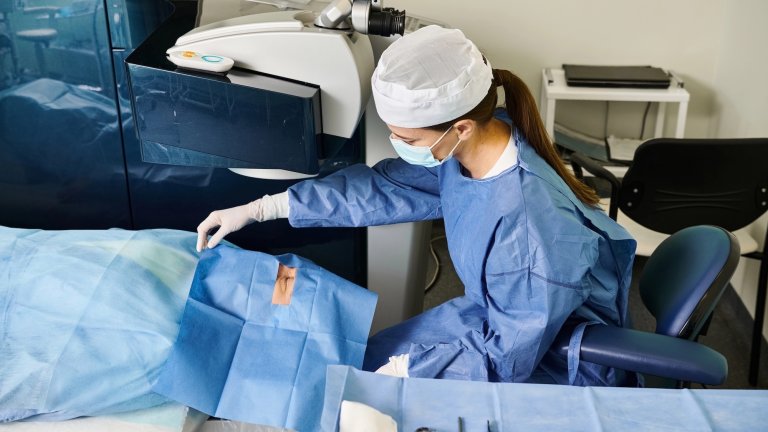
What if you could go to sleep with a vision problem and wake up with a crystal-clear view of the world? A Spanish optometrist not only says this is possible, but he actually wants you to sleep in your contacts. His patented contact lenses, designed to achieve the same effect of corneal reshaping surgery, can correct vision defects like myopia (nearsightedness) and stigmatism – and now hyperopia (farsightedness) – without taking sharp instruments or lasers to your eyes.

Reshaping the cornea is a tricky business, of course, and generally requires a surgical procedure to permanently fix the problem. But Jaume Paune’s corrective lenses don’t aim to permanently reshape the corneas at all, but rather to temporarily reshape them each night while you sleep.

Every cornea deformation is a bit different, so there’s no one-size-fits-all approach to fixing the problem – hence the usual need for surgery if a patient doesn’t want to be stuck with glasses or contacts. But Paune’s system involves custom designing a pair of rigid, gas-permeable contact lenses for each patient based on his or her particular deformities, a process known as orthokeratology or ortho-k.

During the night the lenses gently reshape the cornea by pressuring the film that coats the outside of the cornea, changing its shape by about half the width of a human hair. The next morning, the lenses come out and the patient has perfect vision – at least for the duration of the day. The changes are not permanent so the patient must repeat the process each night, which could prove a tedious chore. But the farsightedness is gone, allowing the patient to get through the day without constantly squinting or groping about for his or her glasses.

The cost of the system might sway patients back toward surgery though – $1,350 up front to custom-design the lenses, plus another $550 or so each year thereafter to replace them. Then again, no one needs to put a laser to your iris either, so there’s certainly a give-and-take.

[Science Daily]

18 Comments

Correct me if I'm wrong but it should be astigmatism, not stigmatism

Astigmatism is abberant stigmatism. You are correct.

Completely off topic...

Lets say there were space elevators and humans want to be colonizing mars,
The problem is that mars does not have a gravitational field because of its slow spin.
No gravitational fields does mean that the planet is bombarded by solar winds and radiation which are known to take away a lot of Mars' atmosphere and radiation levels are for too high for our life.

Can we take our martian space elevator and deeply secure one end deep within mars (or maybe we can wrap a carbon tube around mars for more security,
and have the other end attached to a nearby asteroid from the nearby belt.

Then we take lasers that slowly burn away the layers of the asteroid to create thrust to start making the planet rotate faster.

Maybe a couple of elevators under these conditions and quite a few large asteroids later, and years and years,

Could Mars rotate faster?

Maybe crash other asteroids into the planet to increase its mass.

I completely understand that this all would require tons of money and innovation,
But hypothetically, its possible, right?

And this contact thing is sweet!

I'd way rather have this.
You all should get it so it will become cheaper for me to have.

Also,
Lets go Blackhawks!
Beat the preds

Did you go to high school? Was it in Kansas?

Gravity is dependent on mass not speed of rotation.

Javor jav, I believe you are reffering to a "magentic field" not gravitional field. The core of a planet is what largely decides what kind of field it generates, the Earth has a molten nichkel-iron core that rotates very fast. Mars' core is most likely to be solid.

Isn't this technology old news? The article doesn't really mention how this is different from existing orthokeratology methods. I know someone overseas who had ortho-k lenses in the late 90's, and I believe they've been approved for use in the US for several years now.

----------Off Topic----------------
@ javor jav
for some odd reason I was blocked. Terraformation would be simple, meteors to add greenhouse gasses/melt ice for exponential heating, lichens, grasses, shrubs, trees, animals, with humans watching over the whole process. You can see a nice gradualist picture at wikipediea/the_terraformation_of_mars or something. Anyway it's my belief that this could be accomplished in a life time and what the hell does it have to do with fixing far-sightedness?
----------On Topic-----------------
Anyhow I think this WOULD be a good idea if it didn't cost thousands of dollars more than laser eye over several years. It's just not worth it until we could use our OPEN SOURCE 3D printers to print 'em out whenever, wherever. Seems like all technology that's come out recently is just converging on to something...

@Dustin2127: Javor Jav did say he was off topic, I think all the talk about laser surgery set him off on one.

Anyway back on topic I think this idea is terrible. Considering the price, you might as well get average 'day' contacts. Add to that the fact you'll probably wake up bloodshot to hell and possibly suffer from eye irritation for much of day, I know I did when I fell asleep drunk with my lenses on.

Nope, I'll be a harrypotalike for a long time yet.

I KNEW IT THEIR TRYING TO RECREATE THE HULK!

Wow, that is incredible. What a discovery.

Lou
www.fbi-logging.tk

This is extremely old news. I got these contacts when I was 14 (I'm 22 now and just stopped using them 2 months ago). And I never had any eye irritation during the day after I popped them out in the morning. I know people who actually wear them during the day (when they haven't slept enough the night before) and say they do not experience any discomfort.

Granted, the first week or so was hell the adjust, but after that it was fine.

The article fails to mention the best benefit: My eyesight was terrible due to genetics and was projected to get much worse, but my prescription has not changed one bit since then.

And for the costs, my lenses cost $250 each to replace every TWO years, not every year and my insurance covers the bulk of it.

Sleeping in contacts so you can go all day without wearing them? Interesting concept. I have to wear contacts or glasses all the time and this really seems too similar to make me feel any better about advancement in technology. Not to mention the cost!! Maybe this seems like a great idea...but I would rather get lasic, fix the problem, and just be done with eye problems altogether.

This really isn't all that amazing, nor safe. I'd imagine sleeping with your CTL on at night (gas permiable at that..) would eventually lead to corneal abrasions, and eventual scarring and corneal opacities.

These problems usually can only be corrected by undergoing a corneal transplant (PKP) which is far more dangerous and more tedious than any kind of refractive surgery.

I did something that everyone told me was bad for my eyes. I wore my plain run-o-the mill CTL's for about 4 months straight day and night. After four months I would change them and this went on for 2 years. When I went to get my lasik surgery the examination revealed that my cornea had literally no abrasions. However I did have blood vessels growing into my cornea (I had no idea) this was remedied by wearing glasses for two weeks prior to the surgery.

Long story short, sleeping in your contacts is no big deal.

I don't understand why PopSci published this article. Ortho-K has been around for years; this article states nothing new. I'm kind of annoyed now because I have myopia and thought that the article was going to describe some new technology to treat vision problems. Seems like the content editor fell asleep at the wheel.

And in other news, researchers have developed a drug that allows couples to have sex without a condom and not worry about pregnancy. The pill, to be taken daily by the female, is over 99% effective if used correctly. Researchers caution however, that the drug will not protect against sexually transmitted diseases.

Well, so it's old news... I had never heard of it and
never once been offered it by my opthomologist....not even
when I was wearing contacts.

Sometimes a good idea is still news --

if nobody is using it.


June 2013: American Energy Independence

Five amazing, clean technologies that will set us free, in this month's energy-focused issue. Also: how to build a better bomb detector, the robotic toys that are raising your children, a human catapult, the world's smallest arcade, and much more.


Online Content Director: Suzanne LaBarre | Email
Senior Editor: Paul Adams | Email
Associate Editor: Dan Nosowitz | Email
Assistant Editor: Colin Lecher | Email
Assistant Editor: Rose Pastore | Email

Contributing Writers:

Kelsey D. Atherton | Email
Francie Diep | Email
Shaunacy Ferro | Email

circ-top-header.gif
circ-cover.gif