Since then, a loose federation of researchers from NASA, the Air Force, the Navy, Darpa and the University of Queensland, working on a variety of projects, has conducted a number of tests outside the lab. So far, no engine has pulled off more than a few seconds of sustained flight. But there have been major breakthroughs along the way. In 2004, NASA's unmanned X-43A—a disposable, rocket-boosted craft that was launched from a moving airplane—reached Mach 9.6, setting the world speed record for a jet-powered aircraft. It took only 10 seconds of scramjet power to get it up to that speed. And HyCause, the program that succeeded HyShot, conducted tests in Australia last summer that reached Mach 10, but only for three seconds.
A scramjet that can stay lit for several minutes could power a hypersonic long-range missile. That, at least, is the idea behind a joint Darpa and Navy project called Hypersonics Flight Demonstration, or HyFly. Last fall, the program carried out the latest in a series of test flights in which a scramjet was dropped from an F-15 fighter jet off Point Mugu in California and boosted to operating speed by rocket. The goal was to reach Mach 6 and keep the scramjet going for 100 seconds or more. (It didn't make it that time, but the tests will continue, program officials say.)
A payload-carrying, piloted craft that can take off and land under its own power will need an engine that can produce power for a lot longer than 100 seconds, though. Breaking that barrier is the goal of the X-51A Flight Test Program, whose engineers spent much of last year torching its X-1 engine design in Langley's high-temperature test tunnel. So far, the X-1 has had to take more punishment than any scramjet engine ever built. It's made of a steel-nickel alloy that stays strong up to 2,100°F, and its leading edges are coated in a heat-resistant carbon mesh. Even these materials aren't enough, though, so the X-1's engineers borrowed a technique from rocket designers, who typically circulate fuel—in this case, the same petroleum-based jet fuel that powered the SR-71—along channels within the engine's walls before it enters the combustor. This both cools the 3,000°F-plus combustor and preconditions the fuel, turning it into a hot gas that packs 10 percent more energy than it does in liquid form.
The X-51A's target is five minutes of uninterrupted scramjet-powered flight. If it works, longer-burning scramjets should quickly follow. "The five minutes of flight we're talking about is not limited by the propulsion system," Berger says. "That's just how much gas we have in the tank." On a modified vehicle with a bigger gas tank, that five minutes could easily turn into an hour or longer. And that, says Mike McKeon, PWR's manager of Hypersonic and Advanced Programs, is key. "This engine has demonstrated that the propulsion technology is ready for application," he says of the X-1. "It's no longer in the research-technology mode." Next-generation engines based on the X-1 are already being built at PWR's plant in Florida.
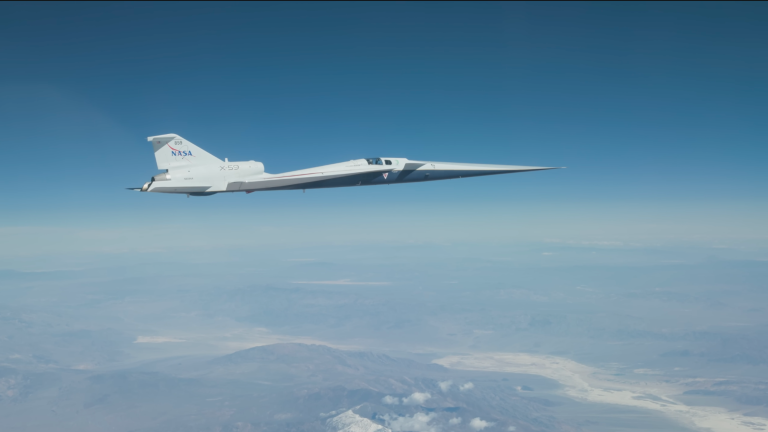
With any luck, sometime in 2009, the X51-A will shatter all previous records for sustained scramjet ignition. The PWR team imagines that a B-52 bomber will take off from Edwards Air Force Base in California's Mojave Desert, head toward the coast and, at 45,000 feet, drop the X-51A from the plane. A solid-fuel rocket attached to the X-51A will fire, blasting it up to 60,000 feet and past Mach 4.5, and then drop off to let the scramjet ignite. For five minutes, the scramjet will accelerate the X-51A to a peak speed past Mach 6 and an altitude above 80,000 feet. Then it will fly into the Pacific, its data safely telemetered to engineers on the ground.
The test will also mark the moment when scramjets move from flash-in-the-pan science experiments to useful tools. "This is an airplane," Berger emphasizes, "not just something where you light a scramjet and fire it and see where it goes. This is really beyond something you might do for a weapon application. The whole idea is to prove the practicality of a free-flying, scalable, scramjet-powered vehicle."
Stay up to date on the latest news of the future of science and technology from your iPhone with full articles, images and offline viewing
Featuring every article from the magazine and website, plus links from around the Web. Also see our PopSci DIY feed
Share links with friends, comment on stories and more
In our December issue, Popular Science names the 100 best innovations of the year: bombproof wallpaper, self-parking cars, the fastest helicopter, and 97 more. Plus inventor profiles and videos.
Check out the best of what's new here.
does anyone know what this concept is called?
Hello,
Pictured: the HTV-3X "Blackswift" (HTV means Hypersonic Technology Vehicle), a fighter-sized hypersonic aircraft part of the newest Air Force hypersonic program FALCON (Force Application and Launch from Continental United States), joint with DARPA, Lockheed Martin Skunk Works for the design and Pratt & Whitney for the engines. The final goal of the project is the Hypersonic Cruise Vehicle (HCV), a long-range reusable hypersonic space plane.
Nice Article
العاب-العاب بنات-العاب فلاش-العاب اطفال-العاب تلبيس
العاب طبخ-العاب ذكاء-العاب بنات فقط-صور حب-صور بنات
Thanks
Love the X-1 scramjet engine. Can't wait to see more pictures of Blackswift. Talk about an enhancement to jet technology. Amazing stuff.
from South eulcid, Ohio
scram-jet warfair is going to be intersting. also i cant wate see how milltaries will addapt to the hyper sonic age
right people, nite time studios is devoloping a new aged gas turbine scramjet not given to much info out right now but would like to get some info on ramjet ignition and investors to build a proto type to sell
please contact killertertal@hotmail.com
thank you