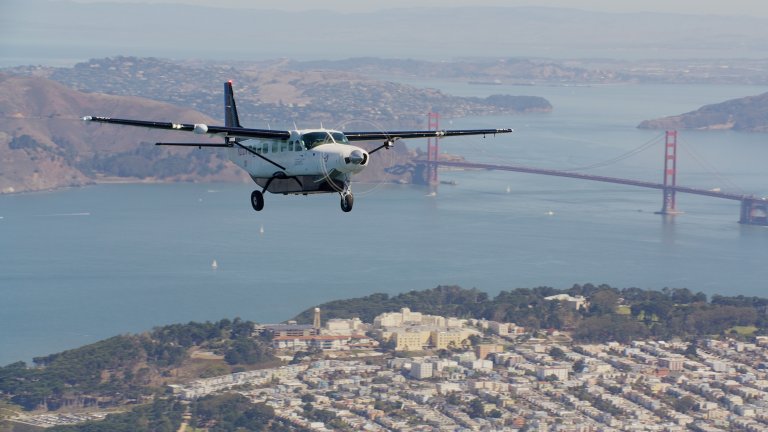
This is a story about software, but bear with me. At the moment, we're hanging sideways in a rented Cessna 172, slipping from 7,000 feet toward the patchwork fields and forest of central South Carolina. A lanky 32-year-old aeronautical engineer named Austin Meyer holds the controls. "Ready?" he says. "Three, two, one-now!" He whips the yoke around, and we lurch into a belly-twisting bank to the right. I click my stopwatch as the attitude indicator swings past 0 degrees, then 30. I look up to see that the sudden bank has left us pointing nose-down toward the distant earth, a perfect setup for a fatal spin. Fortunately, Meyer, who has not flown a real plane in a while, remembers to level the wings before he pulls back on the yoke. G-force hauls us into our seats as the horizon disappears behind the instrument panel.
"Time?" he asks.
"One point two-two seconds," I answer, swallowing my nausea. He scrawls the figure on a scrap of paper.
"OK," Meyer says. "Let's do it again."
Using a hand stopwatch to measure the performance of a half-century-old airplane may not be the most efficient or sophisticated way to go about building a computer flight simulator. But extraordinary missions call for extraordinary means. And when you're single-handedly taking on the world's largest software corporation on its home turf, there's no taking shortcuts. Over the past 15 years, Meyer has devoted his existence to building the world's most realistic PC flight simulator. Working from a small room on the top floor of his suburban Columbia, South Carolina, home, Meyer has built what started as a few lines of impromptu Pascal code into X-Plane, the second most successful flight sim on the market after Microsoft's mighty Flight Simulator.
So far, Microsoft, which just released Flight Simulator 2004: A Century of Flight, may not have much to fear—more than 10 million copies of its Flight Simulator have been sold, compared with X-Plane's 100,000. But the kid is on a roll. Meyer's efforts have attracted a fanatically devoted customer base that includes real pilots and aviation companies employing it for serious aeronautical modeling—not to mention legions of dedicated armchair pilots, for whom X-Plane is the closest they'll ever get to a cockpit. Like the Wright brothers 100 years
earlier, Meyer has shown what the little guy, working far from the centers of mainstream industry, can accomplish with enough determination, imagination and skill.
"X-Plane is extremely accurate," says aviation entrepreneur Jay Carter, who uses a version of the program for previewing test flights of the CarterCopter, a revolutionary gyrocopter he is developing. "It does a very good job teaching our pilots how to fly the aircraft." Back on the ground at Columbia's Metropolitan Airport, Meyer explains the madness behind his method. "I'm obsessed with accuracy," he says. "The Microsoft guys, they don't need an accurate flight model. All they need is for the Sears Tower to look pretty, and they'll sell their copies. I'm a pilot and an engineer, and X-Plane is written to be useful for pilots and engineers. So I have to get that flight model right. It's not a matter of sales, it's a matter of integrity. I have a moral duty to make it fly as realistically as I can."
single pageFive amazing, clean technologies that will set us free, in this month's energy-focused issue. Also: how to build a better bomb detector, the robotic toys that are raising your children, a human catapult, the world's smallest arcade, and much more.


Online Content Director: Suzanne LaBarre | Email
Senior Editor: Paul Adams | Email
Associate Editor: Dan Nosowitz | Email
Assistant Editor: Colin Lecher | Email
Assistant Editor: Rose Pastore | Email
Contributing Writers:
Rebecca Boyle | Email
Kelsey D. Atherton | Email
Francie Diep | Email
Shaunacy Ferro | Email