Have Bubble Will Travel via The Day

In a world of rapidly evolving threats, every branch of the military is looking for a way to respond as quickly as possible. But whereas the Air Force, Army and Marines can simply fly to whatever hot spot flares up next, the Navy, by its very nature, still needs to sail. That's where the Underwater Express comes in.

Currently, the Navy's fastest submarine can only travel at 25 to 30 knots while submerged. But if everything goes according to plan, the Underwater Express will speed along at 100 knots, allowing the delivery of men and materiel faster than ever.

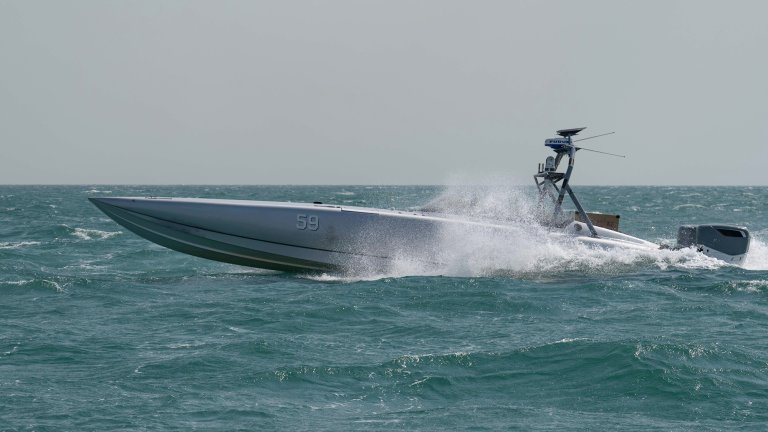
The DARPA program, first announced in 2006, has finally reached the testing phase. Electric Boat, the company contracted to design the Underwater Express, is producing a quarter-scale model of the speedy sub, to be tested next year off the coast of Rhode Island.

The sub utilizes the phenomenon known as supercavitation. Supercavitation is the process wherein an object moves so fast through the water that it creates a gas bubble around itself, nearly eliminating drag. Unencumbered by the high drag of water, the object is free to speed along at much higher speeds than otherwise possible. Supercavitation has been known since the end of World War Two, and the Soviets succeeded in creating a torpedo that utilizes supercavitation for high-speed travel, but so far no one has succeeded in scaling the effect up to the size of a whole submarine.

If next year's tests work out, Electric Boat will begin assembly on a full-sized, 100-foot-long Underwater Express.

[via The Day]

Want to read more articles on the military, aviation, and space? Subscribe to Popular Science today, for less than $1 per issue!

19 Comments

This is actually very interesting. It has been awhile since I have seen something that has really made me think of what could possibly be made with this technology.

Unfortunately this would make surface warships basically obsolete especially if they can perfect steering on these projectiles.

Although anti-supercavitation projectiles such as the anti-mine weapons currently being developed would be able to stop torpedoes with sonar/radar guided systems.

--GTO--

wow 100 knots now thats more like it.

Why scale them up? I mean I big boats are good and all, but I have never understood why there hasn't been development of small one to two man "Fighter" subs. with the inability of modern torpedoes to make rapid coarse corrections as well as chase a target that can move like a house fly, it would make them much more dangerous. Deploying three or four of the fighter subs armed with weaponized depth charges to take on an enemy, as well as torpedo fire from the main sub would be an impossible enemy to destroy.

The little boat they have built to "Test" the new drives should be mounted on the the sides of every carrier and loaded into ever nuke sub. That would be cool.

I was involve with the technology assessment phase of a new torpedo concept in the late 60's. One of the technologies dealt with shaped hydrodynamic bodies. No supercavitation concept was being considered because of the high noise levels generated by such a body. Another issue was the decoupling of the body from the acoustic medium. Hence, no sonar.

@seatellite

I think one of the main reasons that smaller attack/fighter subs never became a prevalent weapons platform for large scale use would have to be its major limitations.

Longer-term life support systems require a large amount of space as well as weapons platforms, communications gear & other equipment.

As a silent, short-mission insertion vehicle; small subs that support 1/2 dozen crew or less like the SEALS use is more than adequate.

Keep in mind subs are meant to be an omnipresent, invisible, and hugely deadly deterrent these days, not an open-battle platform.

Long past are the days of submarine battles I would hope.

Silent insertion and silent deterrent.

--GTO--

Very limited role as a mini-sub. Perhaps the concept is a long range seal/specfor delivery vehicle, launched from a mother submarine at greater range than is currently possible.

It would take a very large submarine to carry the amount of troops and cargo required to support a MEU, and then you have to get the cargo out of the sub and onto the beach. Massive watertight hatches, vast cargo holds, are just a few obstacles to overcome.

Take for example the LSD-49 HARPERS FERRY class LSD. 610 feet long, 84 foot beam, 177 feet tall (including mast). This ship transports about 500 troops, their ammuntion, and equipment (vehicles, conex boxes, artillery) along with the 2 LCAC's and 2 helicopters used to get it to the beach. An LSD has a crew of about 350.

In contrast, an OHIO class SSBN is 560 feet long with a 42 foot beam, and a crew of about 155. In order to build something torpedo like, the length of such a vessel might be over 1000 feet. To put that in perspective, that is a submarine as long as a NIMITZ class aircraft carrier.

In a commercial role I expect there would be less obstacles, since the cargo is normally containerized in standard sizes and would be hoisted out by pier cranes. It would eliminate the loss of cargo in heavy weather as the submarine would pass below areas of heavy winds and rough seas. Commercially, the goal is to safely move cargo from point A to point B in the shortest time at an affordable price.

This isn't practical for a warship. As Banks mentioned, it's too noisy, so this cancels the main reason for having a submarine - stealth. A plane is always going to be faster.

It would be fun though. So while it's of no use in a warship, there could be a market for small high speed racing subs.

Just to follow up on this. Back in the 50's, the USN proposed building a 10,000 ton submarine transport. 720 feet long with a beam of 124 feet. I don't recall the specified propulsion plant for the project. It was hoped to carry 2,240 marines and transport them ashore using a yet to be specified high speed "flying platform."

The Soviets probably spent more time on submersible transport projects. One in the 60's would be an 11,000 ton nuclear powered vessel with two vehicle decks. It would carry 20 tanks and APC's and 470 troops. The design would have a main pressure hull flanked on each side by a second hull that contained the vehicles. All three hulls would be encased in an outer hull. Look for project 748 for details.

Here is a link to an image of project 748:

http://sub-log.com/files/images/sovietgiants_Project-748.gif

The Russians were talking about merchant submarines into the 90's. Look for Malachite design bureau for discussion on merchant submarines transporting petroleum or freight under the polar ice caps. The capacity of such a vessel was proposed to be 30,000 tons of petroleum or 912 x standard 20ft shipping container.

@nom

Noisy at 100 knots, sure, but it's not going to be doing that kind of speed all the time. Supercavitation might be thought of as the submarine's version of a fighter jet's afterburners.

Dido James2. Get there fast then slow down to super quiet mode when you get close. Way cool.

How many of you noticed it said "scale model"?

and the Navy wouldn't accept something that announces it's own presence, though we could learn a whole lot from this

Proud Sailor of the USN

So in essence, the sub will be moving along at 100 knots BLINDLY? It can't use sonar, and you can't exactly put a windshield on the bridge or front part of the sub (visibility would also diminish greatly with range and depth)...

I can see the headlines now...

Navy sub crashes into endangered blue whale, all hands lost. Blue whale ripped in two by violent collision. Surfers report seeing giant sea monster beneath ocean surface moving at extraordinary speeds before loud crash and explosion.

On the question of sonar not working, this was a problem from the 1960's according to "Banks".

I am sure that they have resolved this issue.
Possibly a transducer that works by pinging the bubble at a resonant frequency. This way, the entire bubble encasing the sub would become the transducer.

Also, I imagine that the sub has something on the front that causes the cavitation bubble to be created, such as a high-power transducer at the nose. It is a well-known phenomenon that radio waves and even sound can create a cavity in water. Modulate the cavitation transducer to create the "ping"

i need, a water heater, oil barrels, welding supplies, steel, and a motor, oh and torpedoes.
www.youtube.com/watch?v=hEUWrj7SyPk

Malhond

I have to disagree with GTO. These units are not designed to replace surface ships. Not very many fighter/bombers would fit in them. I would bet the Seal Team would be excited about it though.

It is hard to believe that any object could travel 100 MPH in the water without hitting some fish that would be large enough to damage it. Slower moving vessels allow the fish, say a very large shark, to move out of the way safely. I suspect that this would not work at any large scale.

ive always wondered how i can make a canyon in water while im moving my hand thru hte water at a hi speed.

i see what theyre doing.

I was under the impression that the Soviet Union (back when there was one) had supercavitation torpedoes that were barely (if any) subsonic. And that was DECADES ago.

Hmmmmm. Turn Boomers into subsurface 'carriers' and maybe Amphibs, too, and have two-man high-velocity minisub "fighters".


June 2013: American Energy Independence

Five amazing, clean technologies that will set us free, in this month's energy-focused issue. Also: how to build a better bomb detector, the robotic toys that are raising your children, a human catapult, the world's smallest arcade, and much more.


Online Content Director: Suzanne LaBarre | Email
Senior Editor: Paul Adams | Email
Associate Editor: Dan Nosowitz | Email
Assistant Editor: Colin Lecher | Email
Assistant Editor: Rose Pastore | Email

Contributing Writers:
Rebecca Boyle | Email
Kelsey D. Atherton | Email
Francie Diep | Email
Shaunacy Ferro | Email

circ-top-header.gif
circ-cover.gif