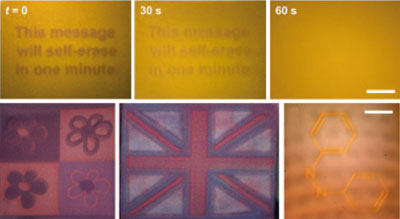
Remember when, as a kid, you would pass “top-secret” notes written in lemon juice that your friends could only read in the right light? Well, in light of new nanotechnology research, this now sounds absurdly antiquated, like cave painting in the modern era. Instead, the youth of tomorrow (and adults too) could have the option to communicate via documents that self-erase at a preprogrammed time.
The idea comes from Northwestern University, where a team of researchers led by Bartosz Grzybowski is making use of a unique property of certain nanoparticles-–their ability to change color based on how close they are to one another. So, when spread out, gold nanoparticles are red, but once you pack them together, they become violet, blue and then colorless. To change the distribution of the particles, you can coat them with MUA molecules, which will relocate when struck by ultraviolet light.
In their lab, Grzybowski and his colleagues have taken to shining UV light at a thin film made of nanoparticle gel tucked between two plastic sheets. The result? They were able to display images and text that disappeared after a predetermined period of time.
This now-you-see-it-now-you-don’t concept isn’t entirely new: back in 2006, Xerox came up with a type of paper whose print would fade after about 16-24 hours, making it possible to reuse photocopies. That design, however, came with neither a color option nor the possibility to control the timing of the text’s disappearing act. The Northwestern version has both.
Future uses of this research could include anything from limited-time bus tickets to military documents that wipe themselves clean. Imagine the possibilities! I bet the Bush administration wishes it could have gotten its hands on this.