
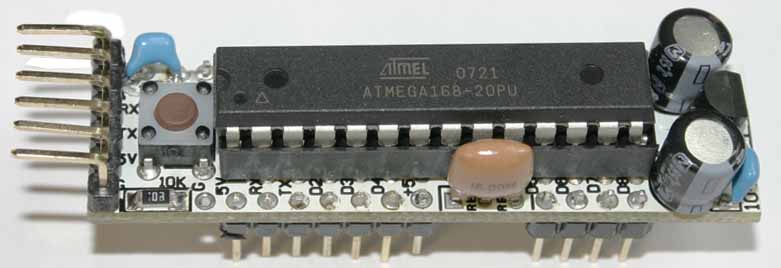
Build a matchstick-sized Freeduino kit and add a 5V battery for microcontroller power in a tight space

RBBB - Rev A Populated Modern Device Company

Do you need a microcontroller for a project (maybe, ahem, our Mood Cube project?) but case space is at a premium? Well, fret no more. The Really Bare Bones Board (RBBB) Freeduino PCB is the perfect fit.

Derived from the totally open Arduino-compatible hardware development system, or Freeduino, the RBBB is an Arduino clone that is almost anorexic in comparison to the already-tiny Arduino Diecimila.

Slightly longer than a standard “AA” battery, the RBBB can be built in two versions:

Best of all is the price of the RBBB: $2 for Rev A and $2.50 for Rev B. Oh, and if you want a complete DIY kit including all of the needed components, the price remains a palatable $10 for Rev A and $11 for Rev B.

Add this 5V DC to DC Step Up AA battery pack from SparkFun Electronics and you have a complete Arduino-like PCB that can be easily inserted into an project. Likewise, you can add your own power supply or even tap into a USB port for the required 5V.
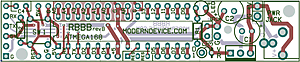
RBBB - Rev B Parts Layout:  Modern Device Company

How can RBBB be so inexpensive and diminutive? Those smart folks at Modern Device Company and Wulfden at Hawk’s Mountain, segregated the USB programming connection from the Arduino circuit schematic. You then use a low-cost FTDI TTL-232R USB-to-TTL Level Serial Converter cable for programming all of your RBBBs. This $20 cable becomes a singular investment with reusable application. Very smart and very practical.

Want to read more articles like this, plus tips and tricks, home hacks, DIY projects, and more? Subscribe to Popular Science today, for less than $1 per issue!

4 Comments

How about some additional tech specs on this board? How fast is the processor? How much memory (RAM, ROM, & FLASH)? Digital vs. analog inputs / outputs?

I'd like to see more projects using this (or similar) boards.

It's a ATMEGA168 so, It has:

16K of FLASH
1k SRAM
512 EEPROM
8 Pins of A/D
runs at 20 mhz (max)

Every week I seem to be writing about how someone has used an Arduino to fashion an interesting gadget, and today’s - while not as obviously useful as, say a Pong-playing wristwatch - is still impressive. Using an Arduino, a Hall effect sensor and an electromagnet, the microprocessor board can keep a floating magnet perfectly positioned.
http://www.hold-emtournament.com

Interesting information. thanks

Maxson
-----------
www.emailextractor14.com/
www.emailextractor14.com/?page_id=121

Popular Tags

Regular Features


138 years of Popular Science at your fingertips.

Innovation Challenges


Popular Science+ For iPad

Each issue has been completely reimagined for your iPad. See our amazing new vision for magazines that goes far beyond the printed page


Download Our App

Stay up to date on the latest news of the future of science and technology from your iPhone or Android phone with full articles, images and offline viewing


Follow Us On Twitter

Featuring every article from the magazine and website, plus links from around the Web. Also see our PopSci DIY feed


February 2012: The Future of Fun

Science is reinventing play, from extreme sports to gamification to ridiculous roller coasters to the playgrounds of tomorrow, and this issue is chock full of fun. Also, on a less fun note: Did global warming destroy my hometown?


circ-top-header.gif
circ-cover.gif
bmxmag-ps