dark matter

Fastest Supercomputer in the World Models Dark Matter, HIV Family Tree Simultaneously

Petaflop power in action

In November of last year, scientists at Los Alamos National Laboratory switched on Roadrunner, the world's fastest computer. IBM and the Department of Energy built the machine to model nuclear explosions, but two new studies, both released today, are proof that the computer's massive power has been at least as devoted to peaceful science as to simulating thermonuclear weapons.

[ Read Full Story ]
Feature

Ten Young Geniuses Shaking Up Science Today

Meet PopSci's annual Brilliant 10--a selection of the brightest young researchers in the country. They're helping to keep us healthy, prevent disasters, and make green energy cheaper than coal. Lucky for us, our future is in their capable hands

Three of the Brilliant Ten:  John B. Carnett
We have a credo around here: The future will be better. It may sound optimistic in light of our wheezing environment and limping economy, but then you haven’t met the Brilliant 10, PopSci’s annual selection of the nation’s most promising young researchers.

[ Read Full Story ]
Feature

Instant Expert: Dark Flow Revealed

The Big Question: Why are galaxies moving toward the same point, as if pulled by an unknown force?

As if the universe weren’t strange enough, scientists have recently discovered that entire galaxy clusters—the largest known structures in the universe, consisting of thousands of galaxies—are moving toward the same area. And we have no idea what mysterious phenomenon is drawing them along. Whatever it is, it’s huge. So far, cosmologists’ best guess is that it’s the gravitational pull from something beyond the visible universe. NASA scientist Alexander Kashlinsky and a team of researchers discovered the mystery motion, dubbed “dark flow,” last year.

[ Read Full Story ]

Searching For Dark Matter In the World's Deepest Underground Lab

Will scientists find dark matter 4,850 feet below the surface of the earth? If not, maybe at 8,000 feet

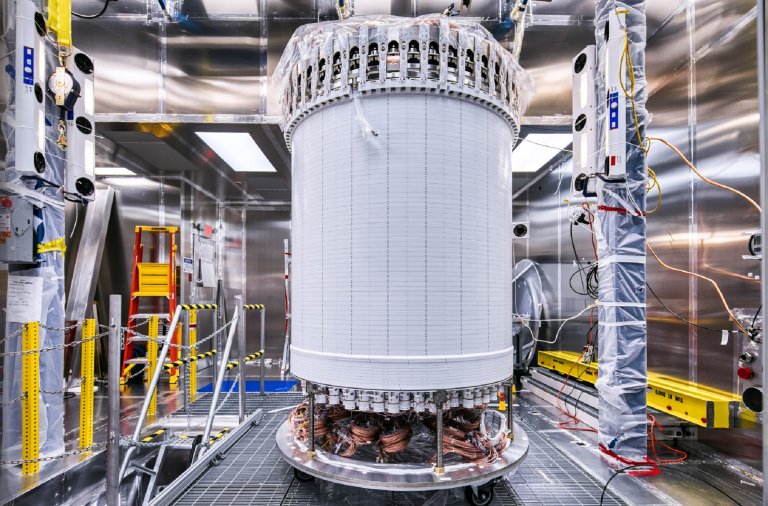
Scientists at Case Western Reserve University, Brown University, and several other collaborators are building an underground science lab where, in a 300-kilogram tank filled with liquid xenon, they hope to find dark matter -- the material that scientists believe was instrumental in helping to form the universe.

[ Read Full Story ]

New Evidence for Dark Matter

New space telescope discoveries spark dark matter debate

For astrophysicists, evidence of dark matter has always seemed to dangle just beyond the grasp of their evidence. Their theories predict it, the motion of galaxies implies it, but direct observation of this caliginous material remains elusive.

Now, new data from NASA's latest space telescope has sparked debate about whether or not dark matter has finally been observed.

[ Read Full Story ]

Dark Matter Hits Close to Home

A new simulation finds the stuff in our own backyard: Time to move to New Jersey

A new simulation has mapped out the way dark matter—the invisible heft of the universe—could be distributed in a galaxy like our own Milky Way; showing that dark matter could be much more present in our neighborhood than previously thought, and suggesting that we may soon be able to detect it (and understand it) close to home.

[ Read Full Story ]
READ MORE ABOUT > , ,

Astronomers Discover Missing Mass

A sensitive, space-based X-ray observatory focuses between galaxies at low-density gas

Granted, it might not seem like such a big deal when astronomers find some of the missing mass in the universe, since there's very little that isn't missing. Roughly 95 percent of the cosmos is either dark matter or dark energy. About five percent of the universe is made up of the normal mass we're familiar with—baryonic matter. Yet by adding up the known stars and galaxies and gas, astronomers have only accounted for about half of that five percent.

[ Read Full Story ]

The Building Blocks of Dark Matter?

Scientists take a step closer towards discovering what makes up the most mysterious stuff in the universe

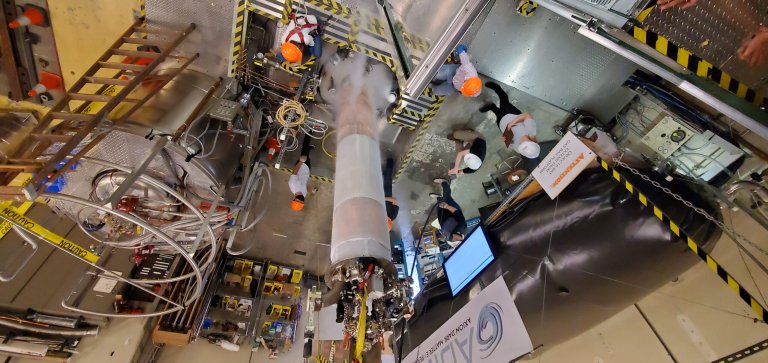
The title of the paper might not jump out at the average science fan—Search for Axionlike Particles Using a Variable-Baseline Photon-Regeneration Technique—but the big idea behind the research certainly should. Physicists at Fermilab have designed an experiment to look for the particles that may make up dark matter—the elusive material that may make up most of the matter in the universe.

[ Read Full Story ]
READ MORE ABOUT > , , ,

Our Dark Materials

Scientists forge the darkest matter ever created by humans

Dark Stuff:  RPI
Scientists at Rice University and RPI have created a thin, nanotube-laden coating that they say is the darkest material ever made by man. Radiation essentially gets lost in a miniature wilderness of carbon nanotubes that lets light in, then traps it. The coating absorbs 99.9 percent of incoming light; the previous best measured around 99.84 percent.

[ Read Full Story ]


Download Our iPhone App

Stay up to date on the latest news of the future of science and technology from your iPhone with full articles, images and offline viewing


Follow Us On Twitter

Featuring every article from the magazine and website, plus links from around the Web. Also see our PopSci DIY feed


Become a Fan On Facebook

Share links with friends, comment on stories and more


December 2009: Best of What's New

In our December issue, Popular Science names the 100 best innovations of the year: bombproof wallpaper, self-parking cars, the fastest helicopter, and 97 more. Plus inventor profiles and videos.

Check out the best of what's new here.

Popular Science Photo Pool


Share your photos in the Pop Sci pool at www.flickr.com!
tags_sprite.png
POP_embeddedForm_cover_May09.jpg