
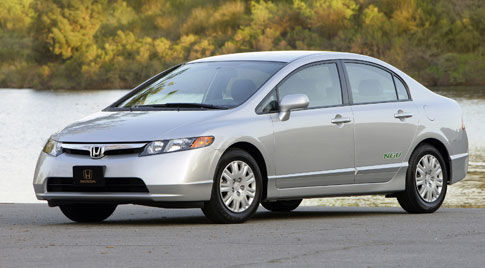
A PopSci contributor's experiment with a Honda Civic GX natural gas vehicle turns into a high-return investment on eBay

Honda Civic GX Honda

We reported last week on how feebly powered, fuel-sipping 1990s-vintage hatchbacks have been lighting up the used car market recently due to skyrocketing gas prices. In an interesting twist to this phenomenon, I actually benefited myself somewhat from this hysteria when I had to sell my beloved natural-gas-powered 2006 Honda Civic GX last week on eBay, turning it into one of the smarter investments I made all year.

You may remember this car from a long-term evaluation PopSci did in 2006-2007 to test the viability of a natural-gas vehicle in daily driving. We also evaluated the Phill home refueling station that taps into your natural gas line to fuel the car overnight. We praised the car's environmental benefits and its low fuel costs—about $1.20-$1.40 per gallon.

Coincidentally, the end of the evaluation period happened to coincide with the introduction of a 65-mile daily commute (each way) into my life. With gas prices through the roof, my wife and I bought the Honda, and I've been driving it ever since.

Until, that is, we decided to take back those two hours of family time and move closer to work to eliminate the commute. Sadly our new house doesn't have natural gas, so without an at-home fueling station, the Honda had to go. I did some research, and found that compressed-natural-gas vehicles are fetching big premiums online in places like Utah and Oklahoma where natural-gas prices are ridiculously low—as low as 60-cents per gallon. When I listed the car on eBay, it sold three days later to someone in Oklahoma for $18,600, about $4,000 more than what I paid for the car when I purchased it from Honda less than a year before, and $2,000 above its Kelley Blue Book value. (The sale price to me reflected various state and federal tax incentives that Honda took when they owned it.)

Who'd have thought that the highest-performing investment of my entire year would be a used Honda Civic? We loved owning the car, and will miss its greenest-car-on-earth cache. But we realized that living five miles from work is probably better for the environment than living 65 miles from work, no matter what you drive.

Want to keep track of the latest concept cars, automotive innovations, and more? Subscribe to Popular Science today, for less than $1 per issue!

8 Comments

Why has there not been larger push to use natural gas?
It's methane and it burns clean. It doesn't hurt the environment.
More (American) car companies should be looking into this and other green alternatives.

You mean, "doesn't hurt the environment as much." Natural gas is still a hydrocarbon although much cleaner than gasoline

Time flies like the wind,
Fruit flies like bananas.

Great story--

You did something good for the environment and made a cool profit in the end.

Vehicles (especially fleets) that operate on natural gas help reduce harmful greenhouse gases and since it's domestically abundant it will reduce our dependence on fossil fuels as well.

UPS operates the transportation industry's largest private fleet of alternative-fuel vehicles and they've been using Compressed Natural Gas (CNG) for more than 70 years. Recently, they added to their ever-growing fleet and received the "Green Fleet Award" for, well, being the "greenest."

Their trucks are expected to reduce emissions by 20 percent and improve fuel economy by 10 percent when compared to the cleanest blend of diesel engines. The Environmental Protection Agency would certainly agree that Natural Gas Vehicles (NGVs) are the cleanest (and cheapest) alternative there is.

If more people only knew....

The US Government is so stupid! We wasting so much money in alternative fuels like hydrogen and natural gas. The thing that our government does not realize is that, these "alternatives" are none renewable. Try looking for alternatives that are renewable. Look for alternatives that don't make the Saudi's richer!

Hi,

In fact there is potentially a better solution to the economic and environmental issue, and it's achievable right now.

Not many people know that you can convert your car to use HHO gas released from water as an additive to regular gas. This can reduce fuel consumption by as much as 60% - and it really works.

You can find out more here: http://waterforfuel.zanderboon.com

Of course it's not in the interests of the govt OR the oil cos to publicise this, for obvious reasons. Of course, once the cat's out of the bag they'll be taxing - errrmmm - water???

Best Wishes,
Zander

Thanks for the theme dear
---------------------------------------

Download Free Software and Sharewaresأفضل المواقع العربيةدليل المواقععيادة الطببرامجبرامج نتالعاب فلاشiphone آيفون منتدى برامج نت

Hi,

I also found these articles which are quite informative too.

How Does a Water Powered Car Work?

Run Your Car On Water

Gary.

How does hydrogen and natural gas make the Saudi's richer? The US is one of the biggest producers of natural gas in the world. We do not need mid-east natural gas to meet our needs and are not likely to in the future. It still releases hydrocarbons when burned but it better the gasoline. Hydrogen is the most abundant chemical element in the universe, again we would not need middle east production. It can be produced in a variety of different methods some of which are clean and green. We need alternatives and we need them ASAP. If there is an expectation that the alternatives have to be completely clean and green before we introduce them then we are in for a long wait. Both hydrogen and natural gas technology for vehicles are already available and being used, although limited, today. The beauty is they are already cleaner fuels than gasoline and the can be produced in the US. What we need the govt. to do is incentives in helping put the infrastructure (fueling stations) needed for mass prodcution of the vehicles in place.


June 2013: American Energy Independence

Five amazing, clean technologies that will set us free, in this month's energy-focused issue. Also: how to build a better bomb detector, the robotic toys that are raising your children, a human catapult, the world's smallest arcade, and much more.


Online Content Director: Suzanne LaBarre | Email
Senior Editor: Paul Adams | Email
Associate Editor: Dan Nosowitz | Email
Assistant Editor: Colin Lecher | Email
Assistant Editor: Rose Pastore | Email

Contributing Writers:
Rebecca Boyle | Email
Kelsey D. Atherton | Email
Francie Diep | Email
Shaunacy Ferro | Email

circ-top-header.gif
circ-cover.gif