
Robot fish have come a long way from the novelty Big Mouth Billy Bass of the late 90s. Today, marine life researchers worldwide embed various types of more advanced robots into fish habitats (instead of on basement walls). These sophisticated fish-bots do everything from monitoring at-risk coral reefs to waging war on invasive species.
But there’s a core limitation to most of those designs. Each fish robot is just one size. That means researchers who want to conduct parallel observations of fish in a small pond or a large lake typically need to seek out multiple distinct robots. A team of engineers from the Swiss Federal Institute of Technology (EPFL) and Queensland University of Technology says they have a solution, and it involves making one robot fish nearly five times its original size.
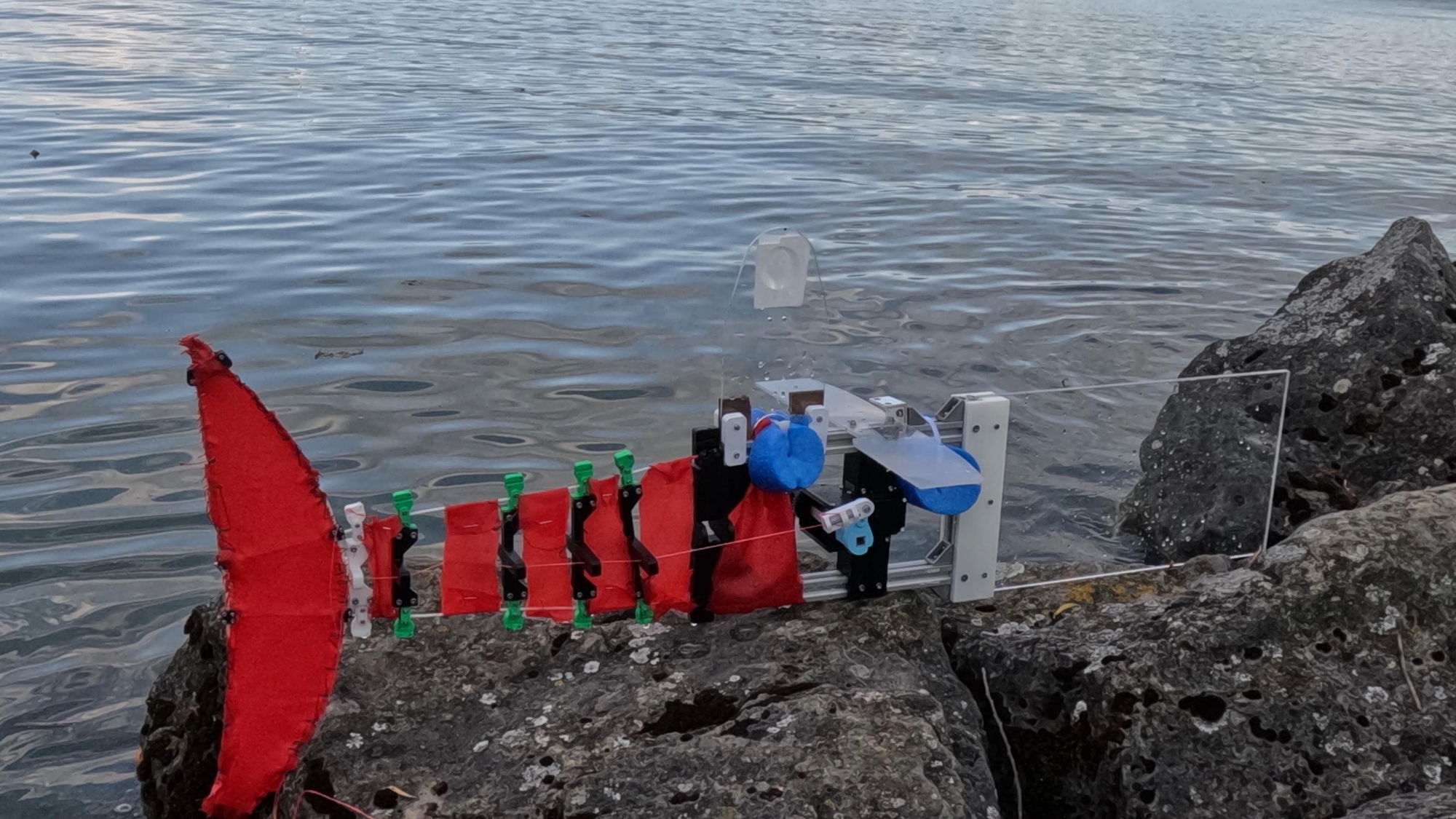
They call this body-morphing robo-fish ScaFi. Inspired by the swimming movements of Atlantic cod (Gadus morhua) and mackerel (genus Scomber), the robot features a rigid front section and a flexible tail made of fabric-covered fiberglass rods. A single motor drives a pair of internal tendons to flex the tail back and forth in a natural, fish-like S-pattern.
What makes ScaFi unique is that the team designed it from the ground up to be built at different sizes without changing how it swims. They were able to build three separate robots from the same fundamental blueprint: the smallest measures just shy of two feet long, a mid-size version stretches 3.6 feet, and the largest is a massive nine-footer. All three models share the same motor and tendon setup. The only thing that changes when it “grows” is the diameter of the rods in its tail.
What would have once required three robots engineered separately for monitoring a creek, pond, and lake can now theoretically be produced from a single design, simply by thickening rods.
“The environments we care about don’t come in one size, so we don’t think the tools should either,” NYU Tandon School of Engineering Associate Professor Nana Obayashi, who led the research while finishing a doctoral degree at EPFL, said in a statement. The research findings were published in the journal npj Robotics.

ScaFi, a robotic fish
Is it a mackerel or a tuna? Yes.
By building three different-sized robots based on the same base model, the team was able to observe some of the trade-offs that occur when a real fish grows larger, something that naturally occurs over many generations. They tested all three robots in a controlled pool setting outfitted with overhead cameras to monitor their movement and attached sensors to monitor the motors’ performance.
The smallest robot was the most agile of the three, and the largest one was the best at maintaining its trajectory when faced with disturbances meant to throw it off course. The two smaller robots were noticeably more energy-efficient compared to the larger one. According to the team, each of those characteristics plays out similarly in real fish of various sizes across different ecological niches. Speed, however, didn’t scale up. The largest fish had a considerably lower absolute speed than its smaller cousins.
“This divergence demonstrates the challenges in replicating the complex scaling of biological systems in compliant robots,” the team writes in the paper.
After completing the pool tests, the team had each robot swim in real-world settings that matched those of real fish of its size. The small robot sputtered around in a tiny, shallow creek, whereas the medium one was sent out in a Swiss stream. The largest one got to spread its fins out in Lake Geneva, where it may have terrorized its considerably smaller organic neighbors. Catfish are among the largest fish living in that lake, and are still only about half the size of the nine-foot robot giant.
This unique approach to robot crafting could help free up resources for marine researchers and reduce overall time spent searching for various models. The team is also optimistic that the same general approach could be used for other kinds of biomimetic robots that imitate animal movement.
