

Auguste Rodin’s The Thinker is one of the art world’s most recognizable images. The monumental depiction of a man hunched forward, right hand resting against his chin, is synonymous with humanity’s capacity for deep contemplation, abstract thinking, and self-reflection. But while Rodin crafted his work of art in hopes of highlighting our unique cognitive abilities, the sculpture inadvertently highlights another facet that sets us apart from all other species: Homo sapiens are the only primates to boast chins.
Consider humanity’s family tree. Our closest relative, the chimpanzee, lacks a jutting jaw line. The same goes not only for every other living ape, but extinct ancestors like the Neanderthals and the Denisovans. It’s easy to assume that humans evolved bony chins because they offer some form of additional facial protection—but the theory underscores a common misunderstanding when it comes to natural selection. Although Homo sapiens are the planet’s current dominant species, not every part of our anatomy necessarily contributed to the “survival of the fittest” idea.
“The chin evolved largely by accident and not through direct selection, but as an evolutionary byproduct resulting from direct selection on other parts of the skull,” University of Buffalo biological anthropologist Noreen von Cramon-Taubadel said in a recent profile.
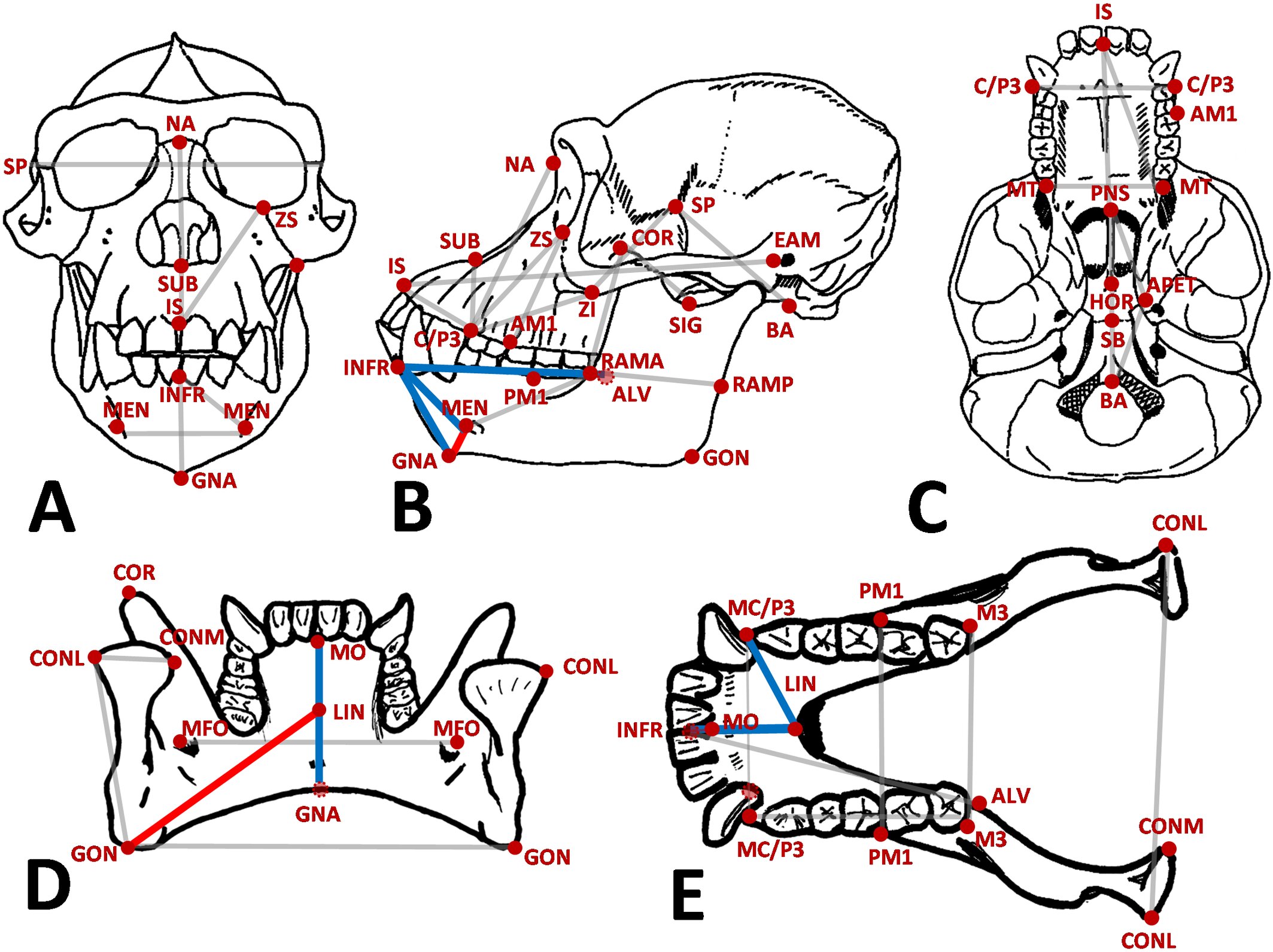
As von Cramon-Taubadel and her colleagues contend in a study recently published in the journal PLOS One, the chin is a perfect example of an evolutionary spandrel. In architecture, a spandrel refers to the roughly triangular spaces created between the side of an arch and its frame. The resulting empty areas are unavoidable due to the design itself. A similar variant on the concept also frequently appears underneath staircases. While often repurposed into a storage nook, the hollow area only exists because of the stairs themselves.
In 1979, paleontologist Stephen Jay Gould and geneticist Richard Lewontin adapted the spandrel for evolutionary biology. Instead of empty building space, countless species exhibit physical spandrels thanks to the summation of other useful anatomical features. And when it comes to humans, the clearest example of a spandrel is our chins.
Von Cramon-Taubadel’s team isn’t the first group to hypothesize about the pointlessness of the chin. However, past theories generally rest on natural selection as the main influence on lower jaw evolution. In this case, the study’s authors approached the chin using a “null hypothesis” framework. Essentially, they examined the cranial anatomy of apes and humans to show that correlation does not always equal causation.
“While we do find some evidence of direct selection on parts of the human skull, we find that traits specific to the chin region better fit the spandrel model,” said Cramon-Taubadel, who again points to chimpanzees as evidence. “The changes since our last common ancestor…are not because of natural selection on the chin itself but on selection of other parts of the jaw and skull.”
It’s not that chins are entirely useless. They may still provide some support for chewing and offer stronger lower jaw protection. It’s also difficult to imagine a dashing action movie hero without one. But the evolutionary journey of Homo sapiens likely didn’t alter its trajectory thanks to the chin. If anything, we simply picked it up on our way to our final biological destination.
“Just because we have a unique feature, like the chin, does not mean that it was shaped by natural selection to enhance an animal’s survivability,” argued Cramon-Taubadel.
