A mushroom recently discovered in Florida looks unassuming, but this fungus
packs a serious and surprising punch. According to mycologists writing in the journal Current Biology, Galerina indica is the first-known “dark magic mushroom,” a species featuring hefty doses of both psychedelic and poisonous compounds.
Depending on their chemical makeup, many mushrooms will do one of two things. Fungi packed with psilocybin can send users on an extensive psychedelic trip, while varieties laden with amatoxins can be poisonous. Although mycologists have long assumed a single species could hypothetically feature both traits, no one had ever documented such an example. A recent field survey changed that, however.
“I could hardly believe it. We knew it was possible, but tried not to get too excited until we did a more rigorous analysis,” Andrew Kunik, a former University of Florida plant pathologist and study co-author, said in a statement.
Evolutionary biologists suspect certain mushrooms developed their poisonous amatoxins as a protection against foraging animals, although hallucinogenic psilocybin’s emergence and purpose in fungi remains unclear. Regardless, both compounds found their way into G. indica. University of Utah mycologist and study co-author Bryn Dentinger believes that a process called horizontal gene transfer is likely to blame—although it’s a completely novel discovery.
“Horizontal gene transfer is like if we shook hands and some of my DNA incorporated into your genome,” he said. “[But] two independent horizontal gene transfer events for these specialized metabolites in one mushroom genus are unheard of.”
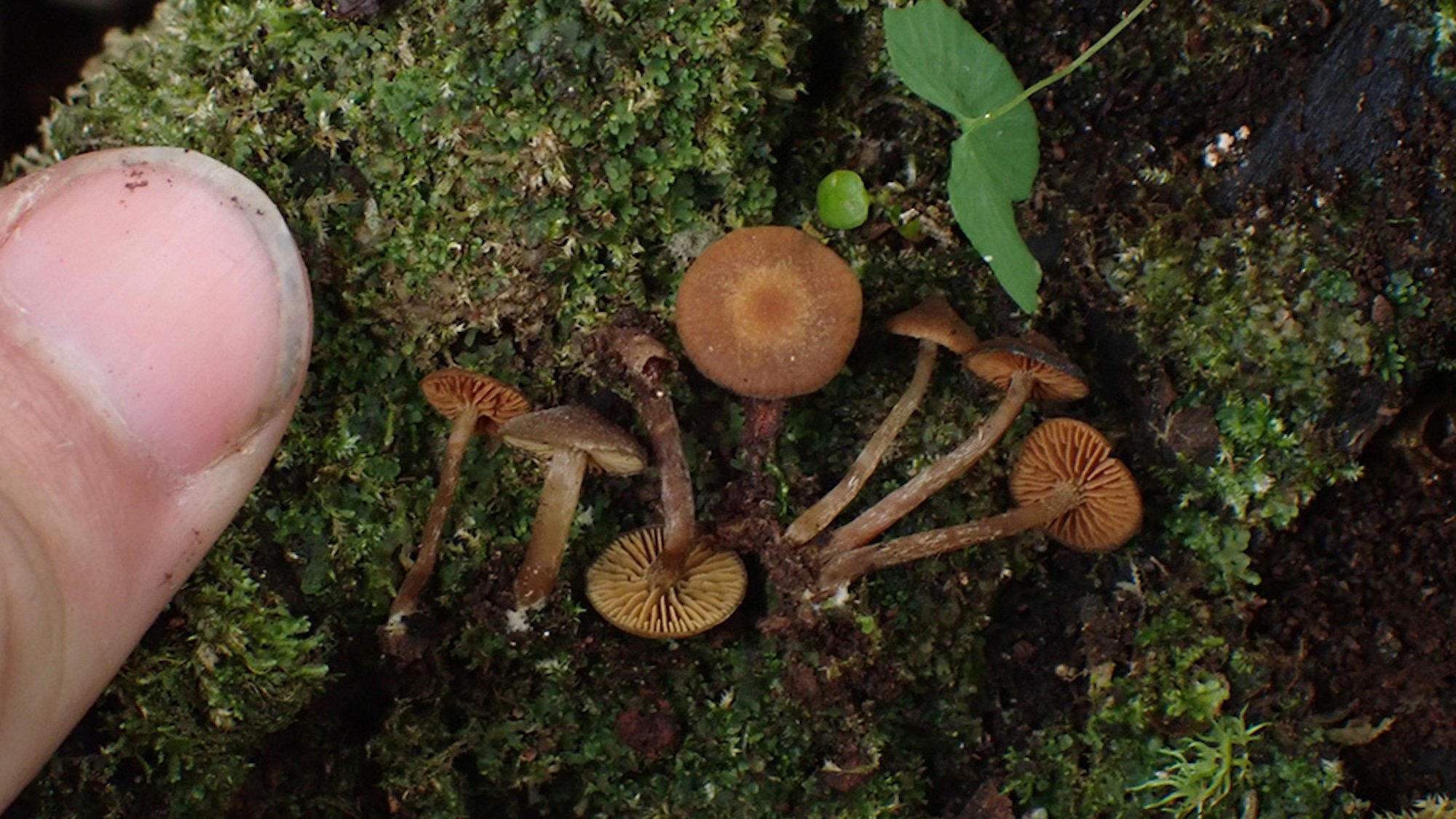
For as unique as G. indica is, it is very easy to miss. The small, innocuous brown mushrooms are barely the size of a thumbnail, and resemble countless other fungi.
“These mushrooms are really hard to find,” added study co-author, University of Florida plant pathologist, and state mycologist Matthew Smith. “It’s hard to differentiate them from others, even for a trained expert.”
Although difficult, documenting the specimens is not only vital to the field of mycology. It can help save lives.
“Part of my job as Florida’s state mycologist is to identify poisonous or potentially poisonous species,” explained Smith. “So it is important to know what species we have and whether they might cause problems for people or pets.”