
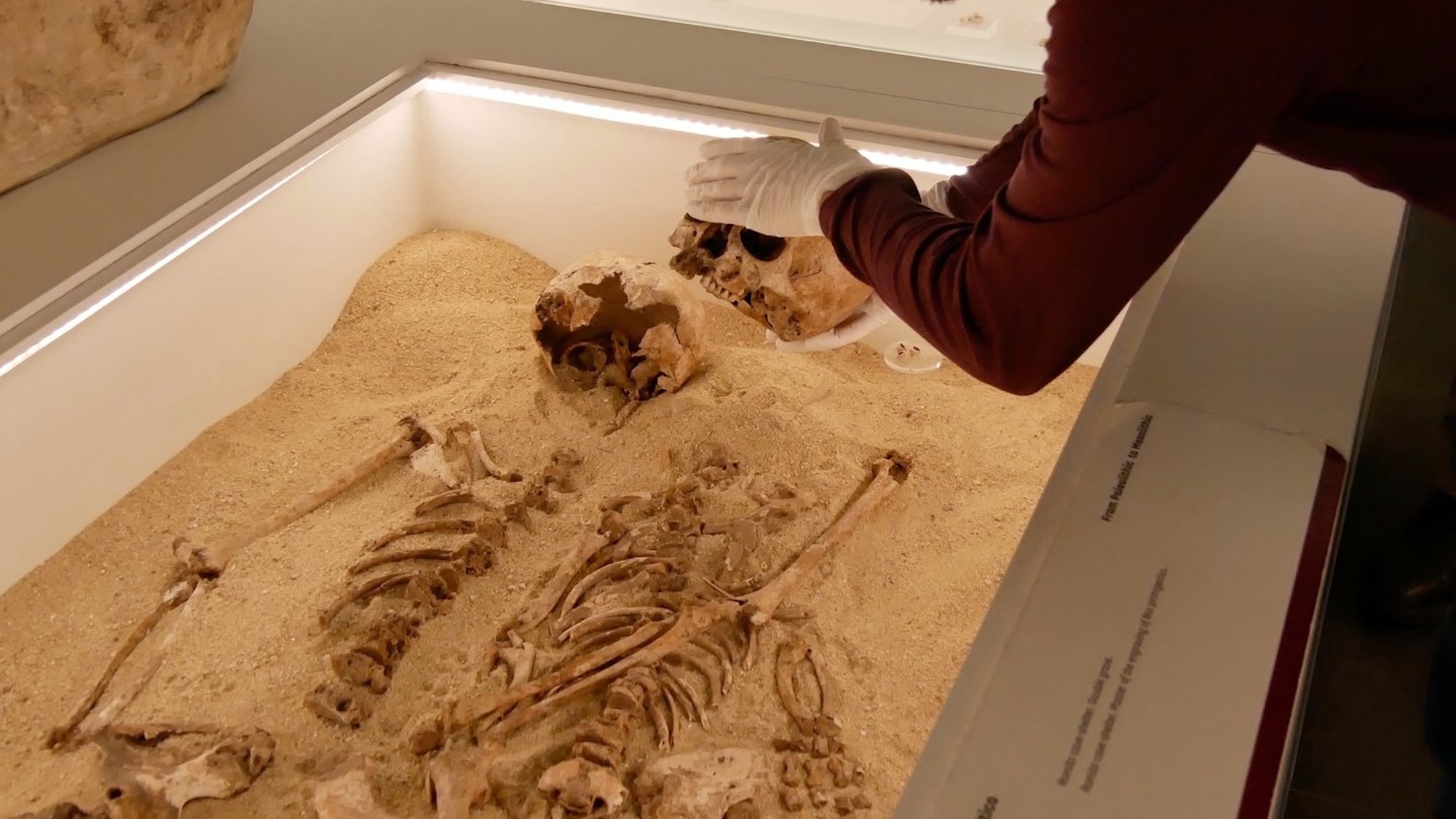
In 1963, paleoarchaeologists working in southern Italy discovered a unique and puzzling burial scene within an ancient cave known as Grotta del Romito. Inside the cavern, researchers excavated the bodies of two Paleolithic individuals buried in an embrace over 12,000 years ago with no signs of outward trauma. Designated Romito 1 and Romito 2, both subjects had clearly shortened limbs, each with a respective height of around 4.75 and 3.6 feet tall.
In the six decades since, experts have argued at length about the pair’s relationship, sex, as well as an explanation for their unique physical features. Many have posited that the two exhibited some form of dwarfism, but direct evidence has eluded them. Now, researchers believe they have definitive answers. According to a study recently published in the New England Journal of Medicine, Romito 1 and 2 were most likely a parent and child born with a rare genetic disorder called acromesomelic dysplasia.
AMD is one of the rarest documented genetic disorders. Only around 10 million people in the world carry the altered NPR2 gene, and of those, just 3,500 are estimated to display the physiological conditions including shortened limbs, spinal curvature, and stiff joints.
To reach their conclusions, the team collected samples from both subject’s temporal bones at the base of the skull, an area that is particularly well suited for preserving genetic material. Subsequent examination revealed a first-degree relationship between the two individuals. More specifically, Romito 1 was the mother and Romito 2 was her daughter.
Read more about the Stone Age
“Identifying both individuals as female and closely related turns this burial into a familial genetic case,” said Daniel Fernandes, a study co-author and University of Coimbra anthropologist. “The older woman’s milder short stature likely reflects a heterozygous mutation, showing how the same gene affected members of a prehistoric family differently.”
Fernandes and colleagues also identified the homozygous variant of the NPR2 gene in Romito 2, which is critical to bone growth and likely explains her slightly taller stature. Taken altogether, the team concluded both Paleolithic women had acromesomelic dysplasia (AMD), Maroteaux type—a condition that stunts a person’s height and shortens their limbs.
Despite the physical limitations of shortened limbs, people with AMD generally maintain a normal life expectancy today. That said, it’s easy to imagine how the condition could severely hinder someone in a Paleolithic hunter-gatherer society—but that does not seem to be the case for Romito 1 and Romito 2. If anything, they experienced the exact opposite. Both survived well into late adolescence, if not full adulthood before they died. This implies a concerted, regular support system from those around them.
“We believe her survival would have required sustained support from her group, including help with food and mobility in a challenging environment,” explained study co-author Alfredo Coppa from Rome’s Sapienza University.
Beyond helping the contextualize ancient human societies, understanding and identifying genetic conditions in Paleolithic individuals could also help present-day medical research.
“Rare genetic diseases are not a modern phenomenon but have been present throughout human history,” said Adrian Daly, a study co-author from Liège University Hospital Center in Belgium. “Understanding their history may help [recognize] such conditions today.”
