

The ancient pyramids at Giza in Egypt are some of the most recognizable architectural feats in the world. The Great Pyramid itself was completed 4,600–4,450 years ago, yet remains largely intact despite spending millennia exposed to not only the harsh desert environment, but multiple major seismic events. Earthquakes in 1847 and 1992 rocked the region with respective magnitudes of 6.8 and 5.8, while other earthquakes have undoubtedly occurred in the generations before reliable measurements.
So, how has the famous structure survived to the present day? It’s a question seismologists like Asem Salama at Egypt’s National Research Institute of Astronomy and Geophysics have pondered for years.
“What makes the pyramid particularly fascinating is that it combines monumental architecture with remarkable structural stability over millennia,” Salama tells Popular Science. “Our work aimed to provide quantitative measurements that help explain part of that resilience.”
Salama and his colleagues believe they now have the answer. After conducting extensive investigations while recording ambient onsite vibrations, they believe that Egyptians perfected their earthquake-resistent engineering techniques over centuries of innovation. Their evidence is laid out in a study published today in the journal Scientific Reports.
“Ancient Egyptian builders possessed a remarkably long tradition of experimentation and continuous improvement. Many early attempts failed, but they carefully learned from each setback, refining their techniques to arrive at more stable and effective design,” he explains.
Good vibrations
Salama cites the historical evolution of Egyptian pyramids, which began with comparatively simple mastabas sometime before 3100 BCE before advancing to stacked variants like Djoser’s Step Pyramid (around 2650 BCE) in Saqqara. Iterations like the Bent Pyramid at Dahshur (circa 2500 BCE) showcase later experimental forms, while multiple collapsed buildings indicate that not every project was a success.
“These examples illustrate how the builders iteratively refined the ideal slope angles through practical trial and error,” Salama says.
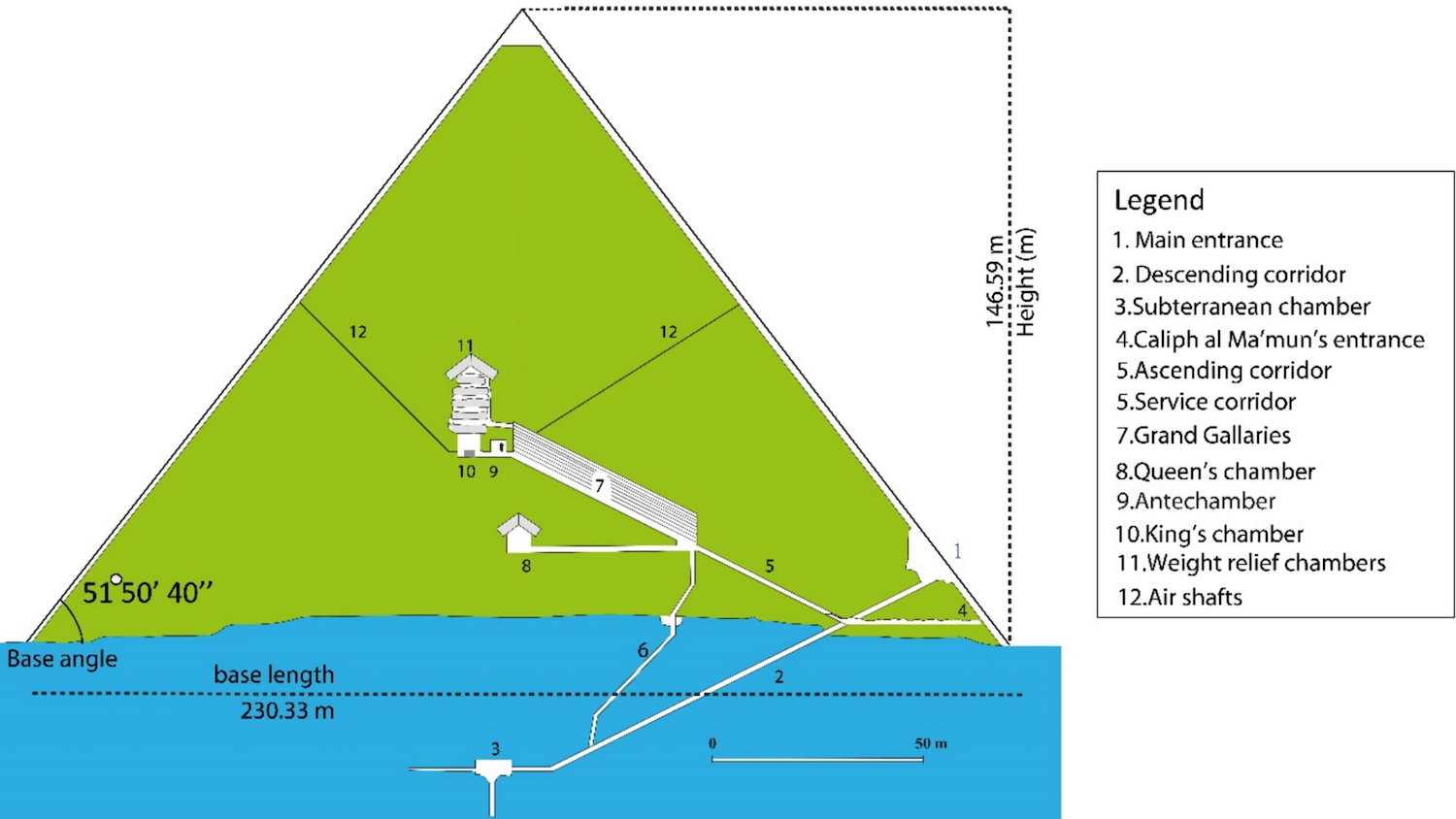
By the time of the Great Pyramid’s construction, Egyptian architects had largely perfected the methods for erecting massive, awe-inspiring monuments to their royal dynasties. To get a better sense of the structure’s overall strength, Salama’s team measured vibrations at 37 locations in and around the pyramid. These included surrounding soil layers, construction blocks, and internal chambers.
They discovered the vast majority of vibrations (76 percent) inside of the pyramid registered between 2.0–2.6 hertz, revealing that mechanical stress is evenly distributed throughout the structure. Meanwhile, nearby soil displayed a frequency of about 0.6 hertz. Salama’s team theorizes that these vast frequency differences likely help bolster the pyramid during seismic events by limiting vibration amplifications between the soil and structure itself. The Great Pyramid is also built on limestone, which decreases risk of seismic damage.
What’s more, the pyramid is impressively resilient against any potential underground amplifications of seismic activity. The Great Pyramid’s Subterranean Chamber is carved into its bedrock foundation, and does not have any boosted frequencies. These readings usually increased with height, reaching their maximum in the King’s Chamber. That said, the amplification factor of the Relieving Chambers is actually lower than the King’s Chamber beneath it. This suggests that builders arranged the topmost Relieving Chambers as a safeguard against structural damage.
Resilience meets design
But just because the Great Pyramid is extremely well suited for seismic challenges doesn’t mean its designers did this on purpose.
“From a scientific standpoint, we must be careful to distinguish between this observed resilience and intentional seismic design in the modern sense,” Salama cautions. “While their structures exhibit characteristics associated with excellent seismic performance, it is difficult to prove that they possessed a formal earthquake engineering theory.”
Instead, it’s likely that the Great Pyramid’s strength against seismic catastrophe was a byproduct of its architects’ many other intentional designs. But this certainly doesn’t diminish the landmark’s engineering achievements, many of which wouldn’t be replicated in other cultures for millennia.
“Personally, I view these as highly effective best practices that evolved over generations, consistently improving the overall performance, balance, and long-term durability of their structures,” adds Salama. “What [ancient Egyptians] undeniably had was exceptional engineering intuition and a tradition of continuous improvement that produced extraordinarily resilient monuments.”
