
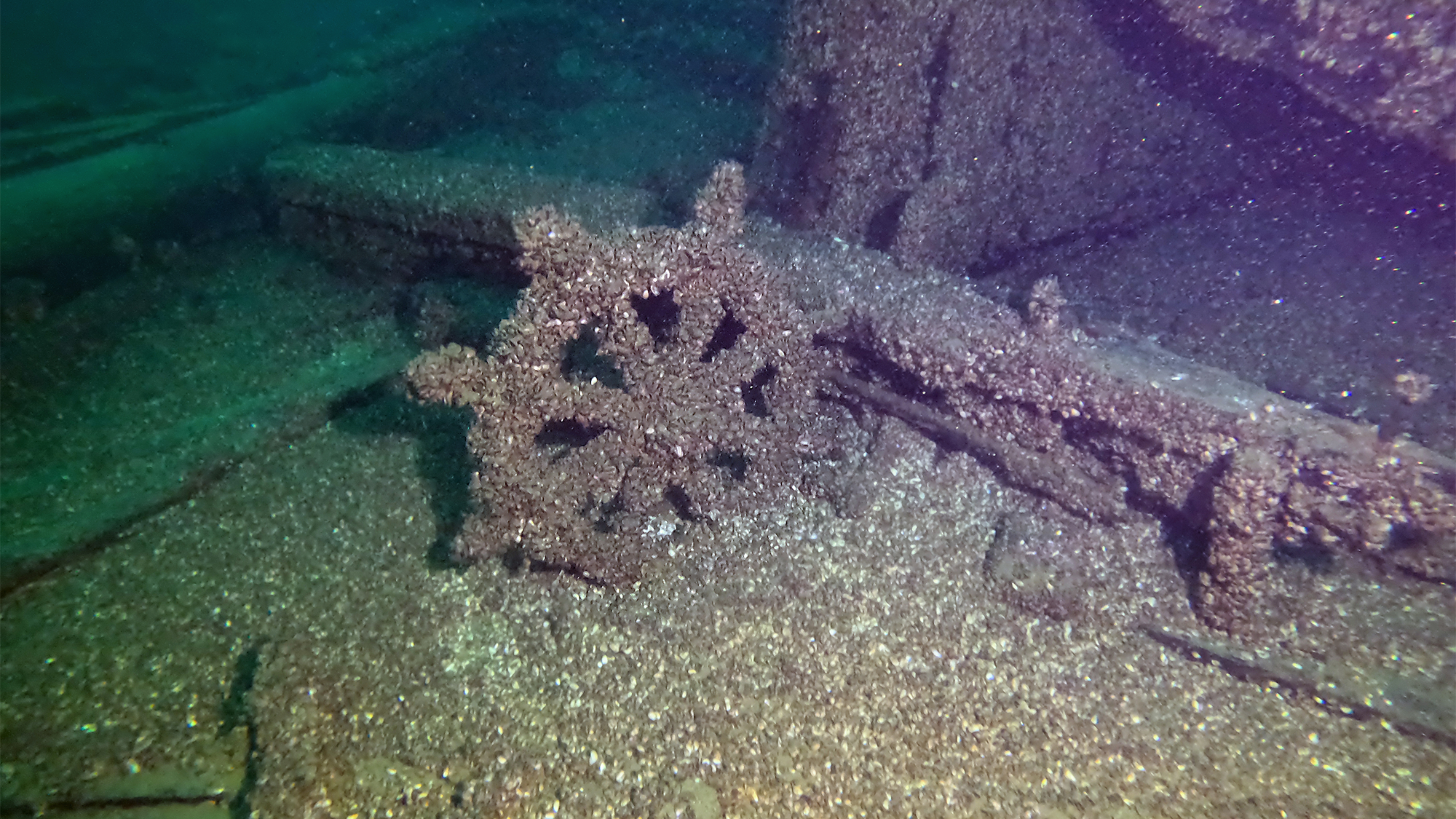
A group of Wisconsin maritime historians and citizen scientists uncovered a Lake Michigan shipwreck “hidden in plain sight” for nearly 140 years. The team uncovered the waterlogged wreckage of the three-masted wooden schooner F.J. King in the waters off Bailey’s Harbor, Wisconsin.

The wreck of the 'F.J. King'
The wreck of the F.J. King
On September 15, 1886, the 144-foot F.J. King left Escanaba, Michigan, bound for Chicago with 600 tons of iron ore onboard. It sailed into a gale off eastern Wisconsin’s Door Peninsula. Wicked winds and 10-foot waves ripped apart the ship’s wooden seams and the crew couldn’t pump the water out fast enough. Captain William Griffin eventually ordered the eight person crew to abandon ship.
At 2 a.m. on September 16, the crew reported that the F.J. King’s stern (or back) rose into the air. That shift sent the iron ore crashing forward so hard that it blew off the ship’s deckhouse. The ship went down bow first, plunging 137-feet down into Lake Michigan. All crewmembers were later picked up by the schooner La Petite and brought to Bailey’s Harbor.
Weeks later, Cana Island Lighthouse keeper William Sanderson reported that the masts of the F.J. King were coming out of the water and into the shipping lane.
Since then, the F.J. King’s wreckage has developed a reputation as a “ghost ship” due to the vessel’s elusiveness. Neptune’s Dive Club in Green Bay had even issued a $1,000 reward for its discovery during this decades-long quest for this “ghost ship.”
[ Related: Fisherman discovers century-old Great Lakes shipwreck. ]
‘A few of us had to pinch each other’
Principal investigator and Wisconsin Underwater Archeological Association (WUAA) president Brendon Baillod led the project. Twenty citizen scientists and community historians from around the Midwest participated in the exciting discovery. They used hundreds of original documents that Baillod has collected over the years and corresponded with previous searchers.
“We reasoned that the captain may not have known where he was in the 2 a.m. darkness, but the lighthouse keeper’s course and distance to the masts were probably accurate,” said Baillod.
About two hours into their search, a large object appeared on a video screen. The WUAA’s new DeepVision sidescan sonar showed the vessel’s hatches. Baillod then used this image to measure the object. It was 140-feet-long, matching the King.
“A few of us had to pinch each other,” said Baillod. “After all the previous searches, we couldn’t believe we had actually found it, and so quickly.”
The team deployed remote operated vehicles for a closer look at the wreckage.
“Two of our citizen scientists piloted remote operated vehicles down to the wreck and were the first people to lay eyes on it since 1886,” said Baillod.
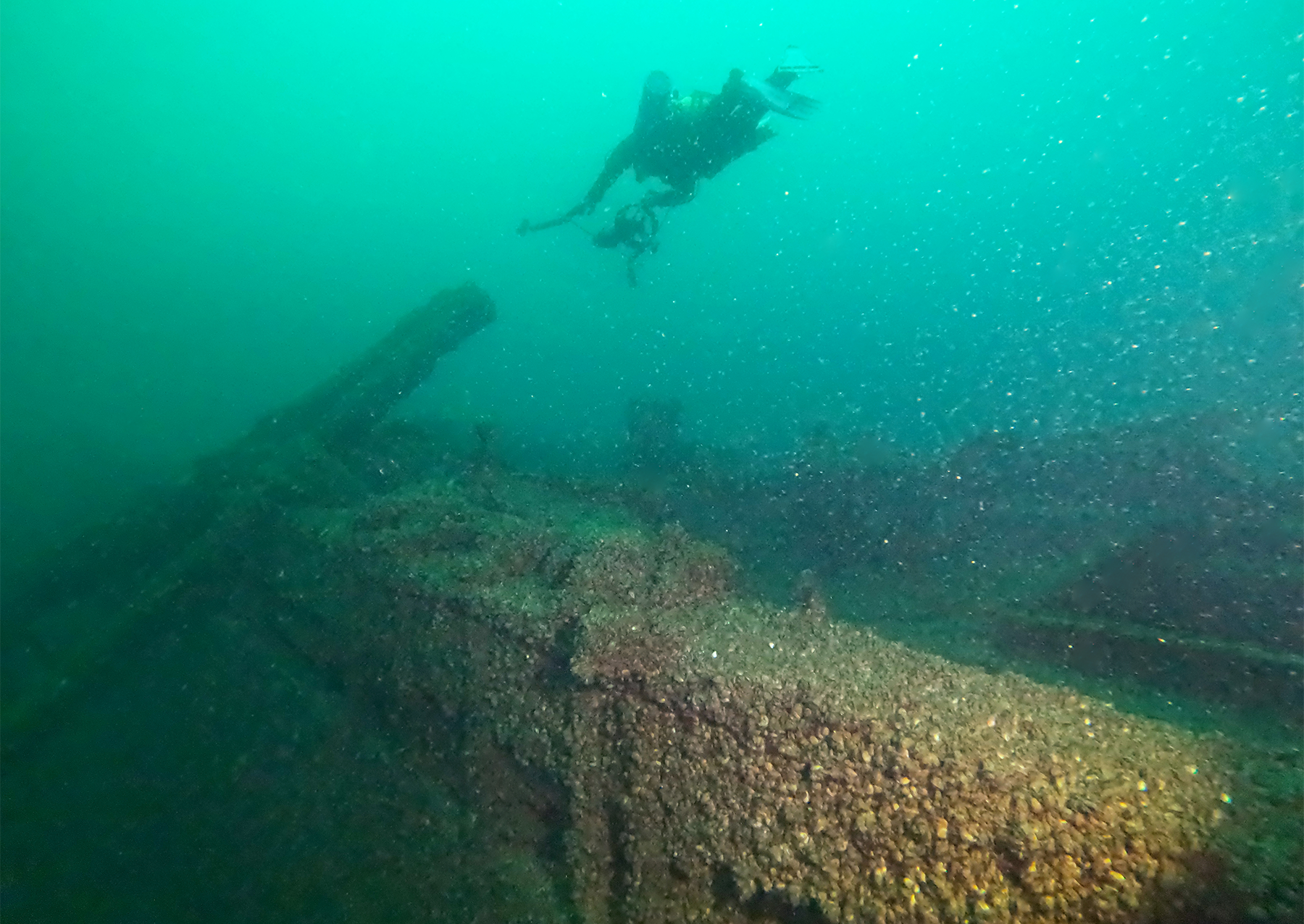
According to Baillod, it is unusual that the F.J. King is intact and sitting upright and the hull remains “remarkably intact.” Usually, ships that were carrying such a heavy load break into pieces once they hit the bottom of the lake.
The F.J. King also turned out to be less than a half mile from the lighthouse keeper’s original account, highlighting the importance of primary source documents in searches like this.
[ Related: What to do if you find a shipwreck. ]
Responsible next steps
The team reported the discovery to the Wisconsin Historical Society’s Maritime Archaeology program. Their staff has since also visited the wreck to document it and to create a 3D photogrammetry model.
Future plans for the site include nominating it to the State and National Register of Historic Places. Once it is listed on the National Register, the official location should be released. Importantly, the site is protected by both state and federal laws and removing, defacing, displacing, or destroying artifacts or sites is a crime.
“Finding an historic shipwreck brings with it a great responsibility,” said Baillod. “People may not think twice about taking an artifact from an anonymous old shipwreck, but once the vessel has a name, a story and links to the community, it becomes a part of the community’s history and even a source of tourism.”
