
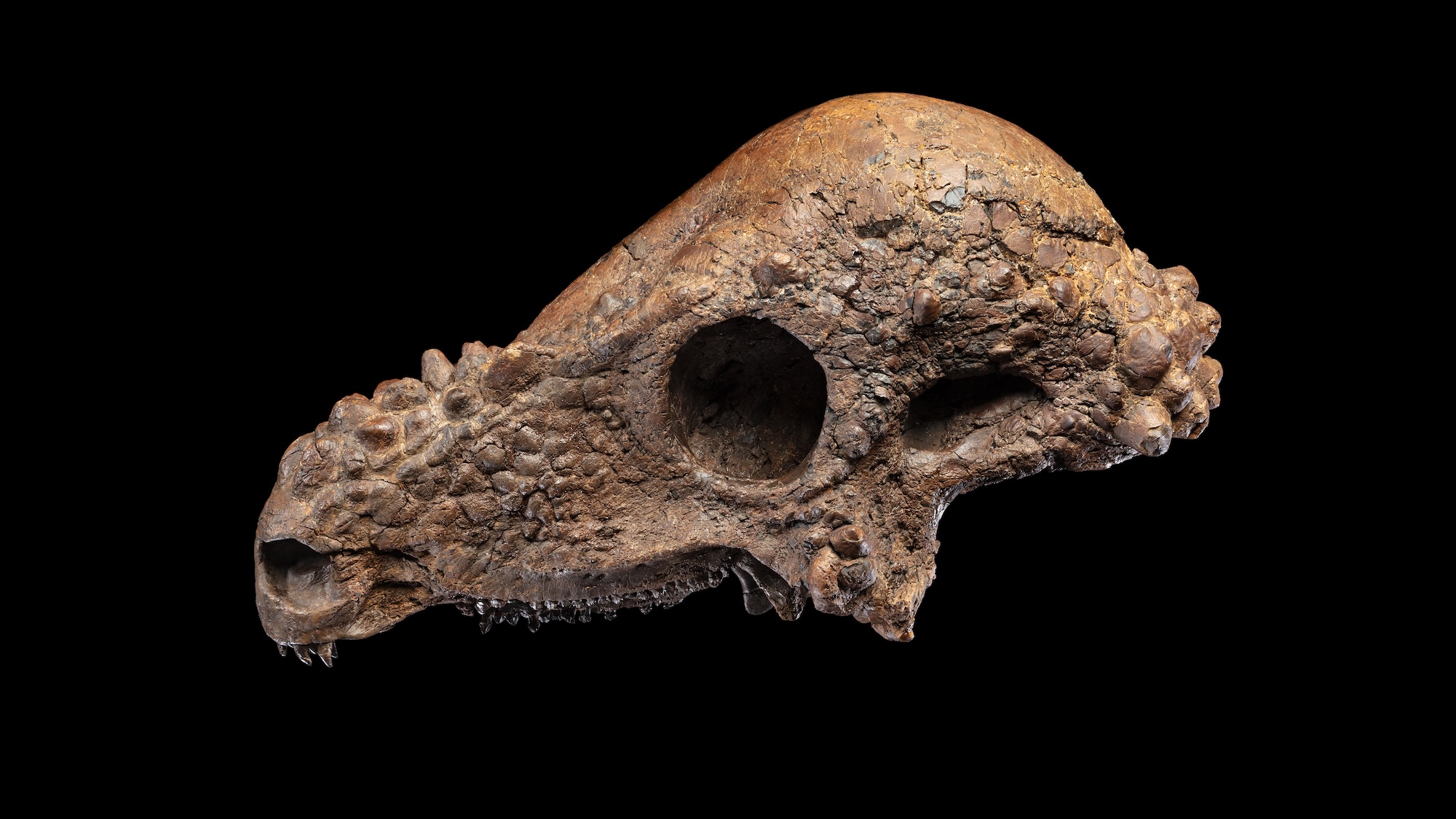
A remarkably well-preserved dinosaur fossil has arrived at the Smithsonian’s National Museum of National History. According to the institution’s announcement, the nearly complete skull of a Pachycephalosaurus is set to make its public debut on December 22 in the FossiLab–the museum’s working specimen preparation laboratory.
“This skull is by far the most spectacular specimen of this type of dinosaur that we have at the museum,” said Matthew Carrano, a paleontologist and the museum’s Dinosauria curator. “We almost never get to see the animal’s face or the teeth or other parts of the head because they usually have broken away.”
Pachycephalosaurus is among the most recognizable herbivorous dinosaurs from the Late Cretaceous period, and shared the ancient landscape with fellow titans like Tyrannosaurus rex and Triceratops. With an extremely dense, rounded bone mound at the top of their cranium, Pachycephalosaurus lived up to its scientific name that translates to “thick-headed lizard.” But despite its behavior depicted across numerous books and movies–including appearances in the Jurassic Park franchise–paleontologists aren’t certain the dinosaur actually used this anatomical feature for headbutting rivals or threatening predators.
The largely intact skull is a relatively recent discovery. In 2024, paleontologists unearthed the specimen in South Dakota at the Hell Creek Formation. The region is famous for a diverse fossil array spanning the 1.5 million years leading up to the Cretaceous-Paleogene extinction event asteroid strike.
Despite the range of species preserved in Hell Creek, Pachycephalosaurus bones compose less than one percent of all excavated fossils so far. Paleontologists theorize this may be due to the dinosaur’s size. Although adults likely grew upwards of 15 feet long, they still remained much smaller compared to bulky contemporaries like Edmontosaurus and Triceratops. However, Pachycephalosaurus may also simply have occupied a small subsection of the overall ecosystem.
The Smithsonian’s specimen features nearly its entire skull, including 32 separate cranial bones. Of those, multiple are fused to form its namesake dome. Numerous teeth also remain in the skull, as well as replacement teeth in its jaws. Combined with its size, paleontologists think the dinosaur had yet to reach adulthood. In the near future, Carrano and his colleagues will conduct CT scans of the skull to compare it with other examples, possibly learning more about how the species developed over the course of its life.
“We can understand the shape and size of the brain and the position of each individual bone, which is really difficult to do when the outside looks basically like a bowling ball,” he explained.
The specimen isn’t the first Pachycephalosaurus at the National Museum of Natural History. The institute also houses the species’ holotype (name-bearing) dome fossil first scientifically described in 1931.
