
This article was originally featured on Knowable Magazine.
Richard David Heekin’s long career as an orthopedic surgeon ended catastrophically. Heekin retired at 65, in 2020, after patients accused him of continuing to operate while impaired by a progressive neurological condition that affected his balance and speech. Within three years of his retirement, at least 522 lawsuits had been filed against Heekin and Ascension St. Vincent’s Riverside Hospital in Jacksonville, Florida. Plaintiffs charged that the hospital knew of the surgeon’s declining condition but allowed him to keep operating anyway.
The damage described in the lawsuits was severe. One patient died, after Heekin allegedly fractured her femur during a hip replacement; others accused him of fracturing other bones or rupturing tendons and severing nerves. Heekin died in May 2026. The hospital has accepted liability in some but not all of the cases.
Extreme as Heekin’s case may be, it reflects a fear preoccupying healthcare administrators, patient advocates and researchers: What happens when aging doctors continue practicing as their abilities decline?
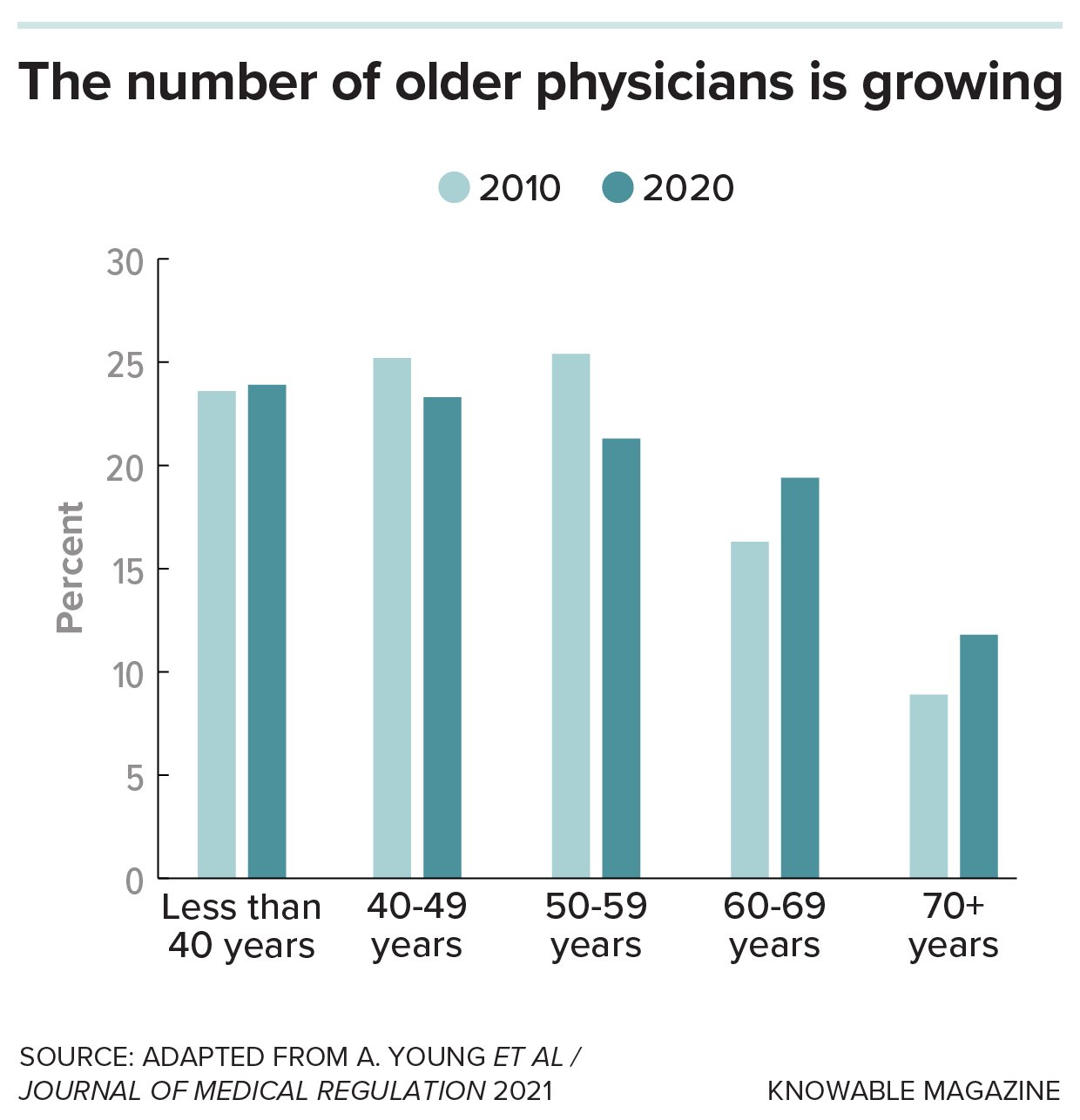
“It’s becoming a bigger issue with each passing year,” says clinical neuropsychologist Victor Del Bene, of the University of Alabama at Birmingham, who has warned of a “looming public health crisis” as an aging physician workforce combines with a persistent undersupply of doctors. Nearly 47 percent of active US physicians are now 55 or older — up from about 38 percent in 2007.
There are sound reasons for concern. On average, many aspects of cognition decline as people age. Processing speed, working memory and attention are particularly vulnerable. Diseases that can affect someone’s ability to function well are also more common with advanced age: The frequency of mild cognitive impairment rises with age, from 8.4 percent among adults between ages 65 and 69 to 25.2 percent among those age 80 to 84, according to the American Academy of Neurology.
Many serious neurological diseases, such as Parkinson’s, Alzheimer’s and the rarer disease from which Heekin reportedly suffered, progressive supranuclear palsy, are also more prevalent in older people.
Yet people vary dramatically as to when these changes begin and how rapidly they progress.
“There are people who show very few of the hallmarks of brain structural aging into their 70s and who show relatively shallow rates of aging-related cognitive declines when measured across their 70s and 80s,” says Simon Cox, a University of Edinburgh expert leading a large study on cognitive and brain aging in older adults. “But there are also folks who decline a bit more steeply.”
This variability — and what some researchers describe as “under-reporting” — may help explain the lack of conclusive evidence that age itself leads to worse performance by physicians.
A widely cited 2005 systematic review found that 45 of 62 studies that were examined associated increasing physician age or years in practice with poorer performance on some or all measures, including, in three of the studies, higher patient mortality. Their results “suggest that physicians with more experience may paradoxically be at risk for providing lower-quality care,” the authors wrote. Yet they drew no conclusions about the effect of advanced age itself.
In 2023, researchers at several leading US and Japanese medical schools who analyzed data from more than 2.6 million emergency department visits found that Medicare patients ages 65 to 89 who were treated by doctors under 40 had lower adjusted seven-day mortality than those treated by doctors in older age groups. Still, this study showed correlation with advanced age, but not causation.
Something somewhat closer to a smoking gun emerged from a study later that year, when Canadian researchers found a link between cognitive impairment and professional complaints against the oldest doctors under review. Researchers drew on 67,566 civil legal cases and complaints to regulatory bodies and hospitals closed between 2012 and 2021. Of the 10,599 cases involving physicians age 55 or older, they identified only 65 in which concerns about a physician’s cognitive ability were implicated. Such concerns appeared in only 0.2 percent of cases involving physicians ages 55 to 60, yet they rose to 7.7 percent among those over 80. While the researchers could not conclude definitively that cognitive changes caused the clinical events at issue, they raised concerns that cognitive impairments among older physicians are a potential risk to patient safety.
Despite a lack of clearcut evidence, the debate about older doctors’ competency has continued, and led to two different policy responses. One treats age itself as disqualifying, while the other uses age as justification for closer scrutiny.
Mandatory retirement policies for doctors are generally rare around the world, although some countries impose age limits on physicians employed by the government. India requires many government physicians to retire at 65, while in China, public hospital doctors are subject to the country’s broader statutory retirement system, which is currently being phased upward from age 60 for men and 55 for women. In the United States, one unusual example of mandatory physician retirement is Kaiser’s Southern California Permanente Medical Group, where physician partners — co-owners rather than employees — must retire from the partnership at 65, although they may subsequently be rehired and continue treating patients.
Since the 1970s, US law has required air traffic controllers to retire at 56, explicitly due to the cumulative effects of stress, shift-work fatigue and “age-related cognitive changes.” Yet as with physicians, the scientific basis for the rule is questionable. A 2005 Federal Aviation Administration analysis of more than 3,000 operational errors found that controllers 56 and older, hired before the law went into effect, were no more likely to be involved in an error than younger controllers.
An alternative approach, age-triggered screening, is more common in the United States, typically requiring doctors who reach a designated age to undergo an assessment before their clinical credentials or privileges can be renewed. Such tests vary widely from system to system, from short, computerized exams to several hours of physical, neurological and psychological tests.
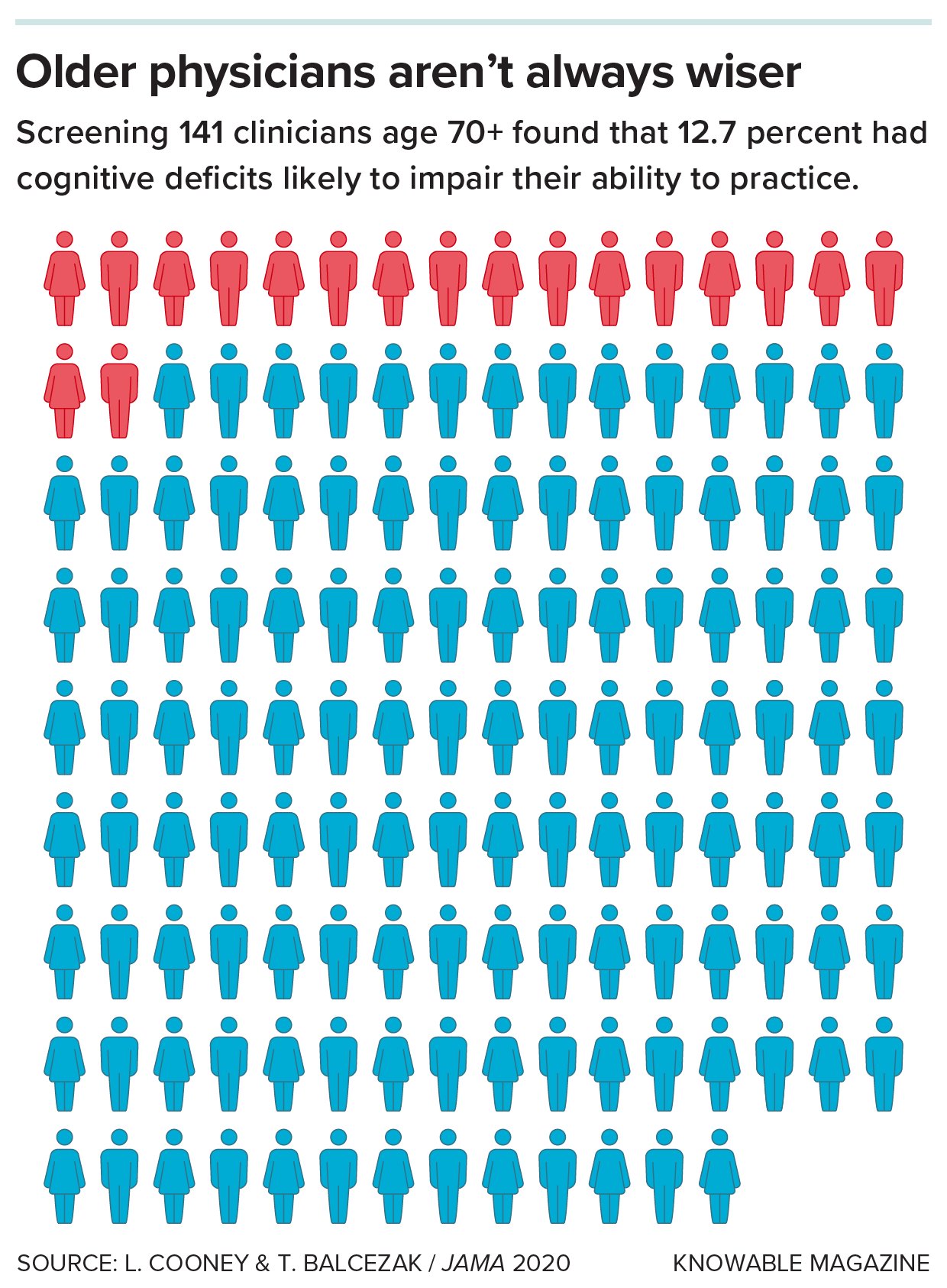
Initial results from several programs show that screening sometimes detects serious concerns. Among the first 141 practitioners assessed with a battery of 16 tests at Yale New Haven Hospital, 18 — or 12.7 percent — showed deficits judged likely to impair their independent performance. Nine of those doctors were 80 or older. And Hartford HealthCare reported that 14.4 percent of its first 160 practitioners screened at age 70 or older showed some degree of cognitive impairment.
What happens after such findings depends on the institution. At Yale, the 18 either voluntarily chose to retire or accepted proctoring. (In 2020, the federal Equal Employment Opportunity Commission sued the hospital, alleging that the policy violates both the Age Discrimination in Employment Act and the Americans with Disabilities Act. Yale has continued the program while contesting the case.)
To be sure, even preliminary scrutiny can feel threatening to older physicians. Some voluntarily retire rather than take the tests.
“This really makes some doctors furious,” says Thomas Gallagher, a University of Washington bioethicist and physician who studies healthcare quality and late-career medical practice. “It comes from the sense of stigma and maybe even humiliation around feeling like you’re being labeled as no longer an effective clinician because of your age.”
Following the EEOC’s litigation with Yale, several other institutions have backed off. According to an early 2026 article by KFF Health News and the New York Times, Hartford HealthCare and Driscoll Children’s Hospital in Texas paused or ended their programs. Today, Gallagher estimates there may be up to 200 US late-career screening programs — a tiny fraction of the more than 6,000 hospitals.
At the 2026 meeting of the American Psychiatric Association in May, a panel discussed the best way to regulate and support aging doctors. (A disclosure: The author’s brother, a psychiatrist, was on the panel.) “Many age-based screening policies assume that a test which picks up on cognitive differences can also predict who’s actually unsafe to practice,” says Sehba Husain-Krautter, a psychiatrist at the Icahn School of Medicine at Mount Sinai in New York City, who chaired the panel. “That’s a risky assumption for doctors in particular, and when these tools are used as gatekeepers for credentialing, they can lead to unfair restrictions, reputational damage and legal exposure.”
The American Medical Association has also stated that age alone should not trigger an assessment, and Cox, who coauthored a report on the science of cognitive aging in the 2024 Annual Review of Developmental Psychology, reaches a similar conclusion. “Age in isolation is not likely to offer an adequate or efficient criterion for implementing blanket testing at a given age,” he said.
Still, advocates for age-based policies contend that today’s default policy at most hospitals, which may act only after a complaint, discounts patient safety. Doctors don’t reliably recognize when it’s time to step back, as even the American College of Surgeons acknowledged in 2024. And colleagues also often fail to raise alarms. In a national JAMA survey, only 69 percent of physicians reported being prepared to effectively deal with impaired colleagues in their medical practice. The most common explanations by doctors who said they had knowledge of an impaired colleague but didn’t act on it included assuming someone else would handle it, believing nothing would happen and fearing retaliation.
That leaves patients responsible for filing complaints — and by then it may be too late, warns Gallagher. “The last thing you want to do is wait for a major medical error to happen before you take action,” he says. “Because by that point, unfortunately, someone’s already been harmed.”
Some experts believe there’s room for compromise between age-triggered policies and waiting for disaster. In 2024, the American College of Surgeons endorsed whole-of-career assessment for surgeons of every age. Its model would combine clinical outcomes, physical and mental-health assessment and standardized cognitive measures. If concerns arose, an institution could add chart reviews, observation or video review of procedures, feedback from coworkers, and proctoring. Cognitive test results, the organization said, should not be used in isolation to grant or withdraw privileges. The organization notes that surgery facilities will need to figure out how to implement the policy in ways that best fit their finances and applicable regulations.
Such an approach would address a central criticism of age-based screening: Strokes, head injuries, psychiatric illnesses, substance problems, medication effects and other threats to competence can occur at any age. Repeated assessments throughout a career could also establish an individual baseline, making it easier to detect meaningful change later. Alberta, Canada, has won praise from researchers for its program that assesses physicians of all ages every five years.
Of course, instituting such a program for all US physicians would be costly and time-consuming. Such an effort would require far more staff than testing only those over 70. It could also subject thousands of capable younger doctors to unnecessary examinations.
Even so, Husain-Krautter favors broad regular assessments for physicians of all ages, which would include eyesight, hearing and balance tests, feedback from colleagues and patients, and questions or even simulations tied to the doctor’s actual work. The goal, she argues, should be to identify what a physician can safely do — not to use one score to decide whether a career is over.
Possible accommodation for aging doctors might include shorter hours, assistance during procedures, a reduced caseload, limits on particularly complex work or transitions into teaching, mentoring and consulting.
Gallagher agrees with all of this — to an extent. “The most successful programs are not the ones that see this as a reason to kick doctors off the medical staff,” he says, “but rather try to understand: How can we help physicians continue to practice safely?”
Yet Gallagher remains in favor of age-triggered testing, arguing that current policies, or rather the prevailing lack of them, are no longer defensible.
“When physicians are really angry with me for working on this topic, I’ll ask them, ‘Would you feel comfortable with a 90-year-old surgeon operating on you?’” he says. “And they say, ‘Of course not.’
“Then I’m like, ‘OK. So there is an age where you think maybe this is not such a good idea. Now let’s just try to agree on what is the appropriate number to start doing the screening.’”
This article originally appeared in Knowable Magazine, a nonprofit publication dedicated to making scientific knowledge accessible to all. Sign up for Knowable Magazine’s newsletter.