
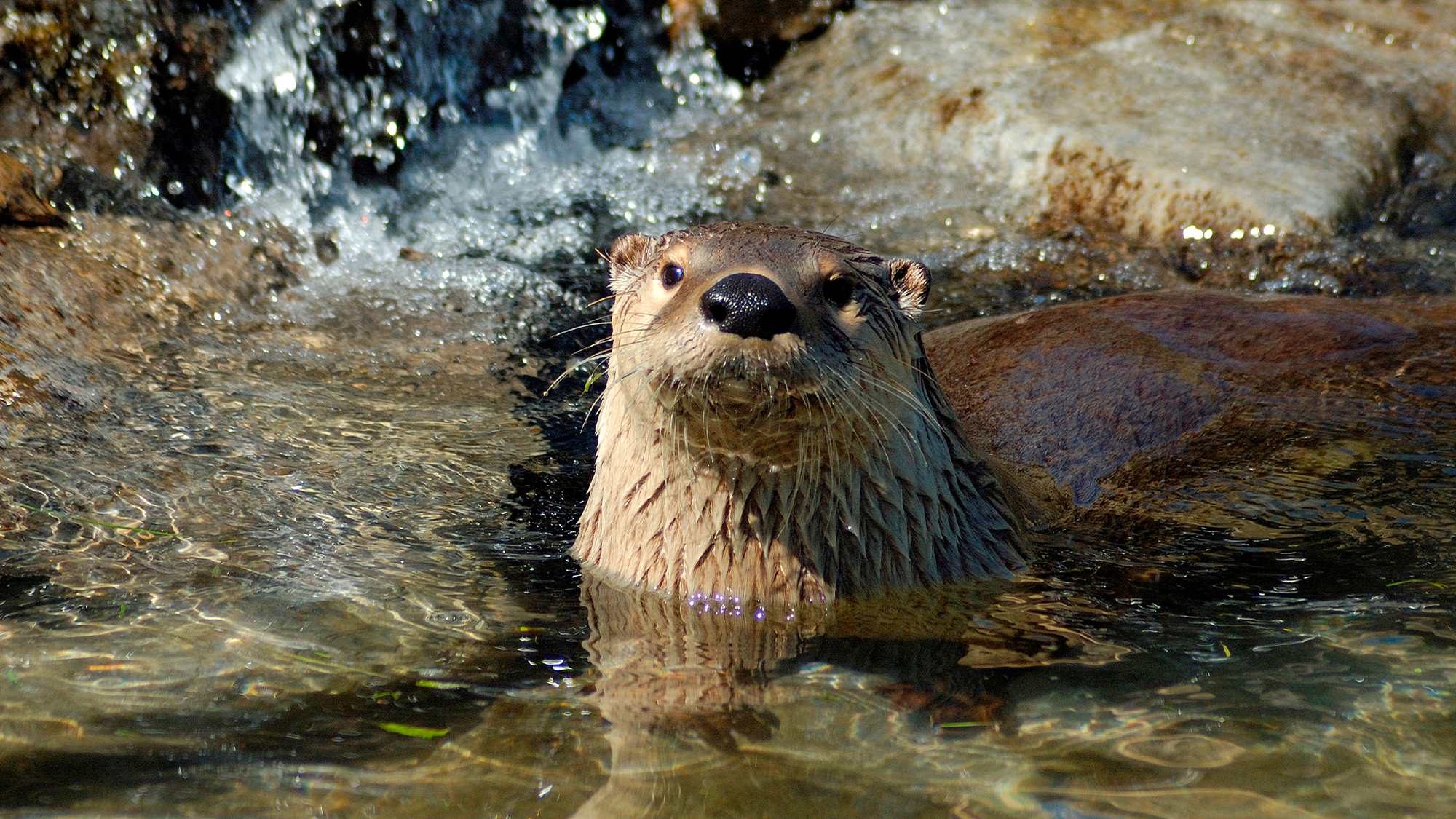
The phrase “this place is a pigsty” might need to be replaced with “this place is an otter latrine.” Particularly the busy latrine of a North American river otter (Lontra canadensis). The small mammals have some questionable hygiene when it comes to food, eating, playing, and defecating all in the same place.
However, studying their less-than-pristine habits (and particularly what is in their poop) can help scientists detect future environmental health threats. Their scat reveals that they often eat food that is teeming with parasites, which may help the larger ecosystem and be a warning signal of what types of parasites lurk out there. The findings are detailed in a study published August 14 in the journal Frontiers in Mammal Science.
“River otters are impressive apex predators that play a vital role in ecosystems,” Calli Wise, a study co-author and research technician at the Smithsonian Environmental Research Center, said in a statement. “The parasites consumed by river otters may also teach us about the health of the environment.”
Rockin’ around the otter latrine
This study looked at the river otters along the Chesapeake Bay in Maryland. They are one of the region’s more elusive critters: nocturnal, semi-aquatic, and typically shy around people. River otters have muscular, streamlined bodies (they can grow up to four feet long), short legs, and fully webbed feet that perfectly suit life in and out of the river.
Once abundant across North America, their numbers plunged due to habitat degradation and the fur trade. During the mid-1990s, the state of Maryland began a reintroduction program that helped their populations rebound statewide. Even with this success, scientists do not have precise estimates as to their population numbers in the roughly 64,000-square-mile wide Chesapeake Bay watershed. Many other aspects of their behavior, diets, and day-to-day lives remain secretive.
“It is shocking how little information there is about their biology and ecology,” added Smithsonian parasite ecologist and study co-author Katrina Lohan.
Since the otters are difficult to observe in the wild, living their otter lives, scientists rely on their feces for clues. Periodically, otters will leave the water to congregate at latrines. These latrines are sites on land where they socialize, eat, and leave fresh droppings as scent markers for other otters to sniff. Studying the feces (aka scat) from otter latrines can give scientists a sense of what they are eating.
A red worm in a strange poo
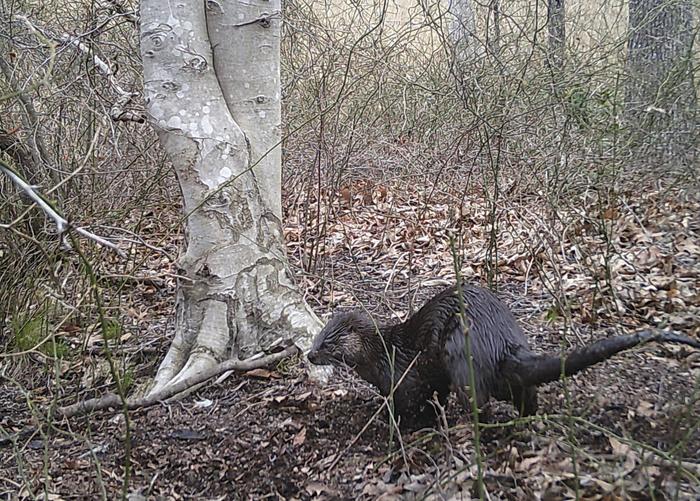
The study began after a colleague reported some strange watery poo to Lohan. It was found on a dock near the Smithsonian Environmental Research Center’s campus in Edgewater, Maryland and a “fire engine red worm,” was inside of it. The wildlife cameras in the area eventually spotted a river otter defecating on the dock. Since Lohan believed that the worm was likely a parasite, the team decided to take more samples.
Over 11 months, they collected scat from 18 active latrines around the campus. They recovered 28 scats per latrine on average. Beaches, riverbanks and other natural sites were the majority of the latrines, but a few manmade structures (boardwalks, docks, etc.) hosted active otter latrines.

River Otters in Snow
“Scats usually smelled strongly of fish and were full of scales or crustacean shells,” Wise said. “We wore gloves and used sterile tools and tubes to collect scat samples, to avoid contamination with other DNA.”
After collecting the samples, the team took them back to the nearby lab. They studied the scat under a microscope and ran DNA analyses using a technique called metabarcoding, a quick method for identifying the species of animals, plants, microbes, etc. within a scat sample.
The feces revealed that crabs and finfish were the staples of otter diets, making up 93 percent of all prey items based on the DNA analysis. The otters also dine on amphibians, worms, and the occasional bird. The small mammals were even eating two invasive fish: the common carp and the southern white river crayfish.
However, the DNA analyses also uncovered a host of parasites from six different classes in the otter feces. Most of these parasites were trematodes, or parasitic flatworms also called flukes. The other parasites included microscopic dinoflagellates and other flatworms that are known to infect fish gills, skin, or fins. The majority of the parasites likely infected the otters’ prey, and not the otters themselves.

Ecosystem engineers and ‘disease sentinels’
The presence of parasites in the otter scat could mean that they are important ecosystem engineers. According to Lohan, the otters may be helping the overall prey populations by eating these animals infected with parasites, since this weeds out sicker fish and crabs. The parasites themselves may also be helping the otters catch more elusive prey.
“While parasites have negative impacts on individuals, they are extremely important in food webs,” Lohan said. “It is possible that river otters, like other top predators, wouldn’t be able to find enough food to eat without parasites.”
A few of the parasites in the study are known to infect mammals, namely roundworms and single-celled apicomplexans. The team believes that these parasites can directly infect the otters themselves instead of their prey.
They did not immediately detect any parasites in river otters that can infect humans. However, some of the parasites were closely related to ones that can cause human disease. These include the gastrointestinal disease cystoisosporiasis. As river otters are appearing more often in urban and suburban areas, the likelihood of them encountering something that could affect human health is also rising.
“Some of the parasites that infect river otters could potentially also infect humans, who also are mammals,” Lohan concluded. “Thus, we could use river otters as ‘disease sentinels,’ and study them to learn about what public health threats occur in certain areas.”
