
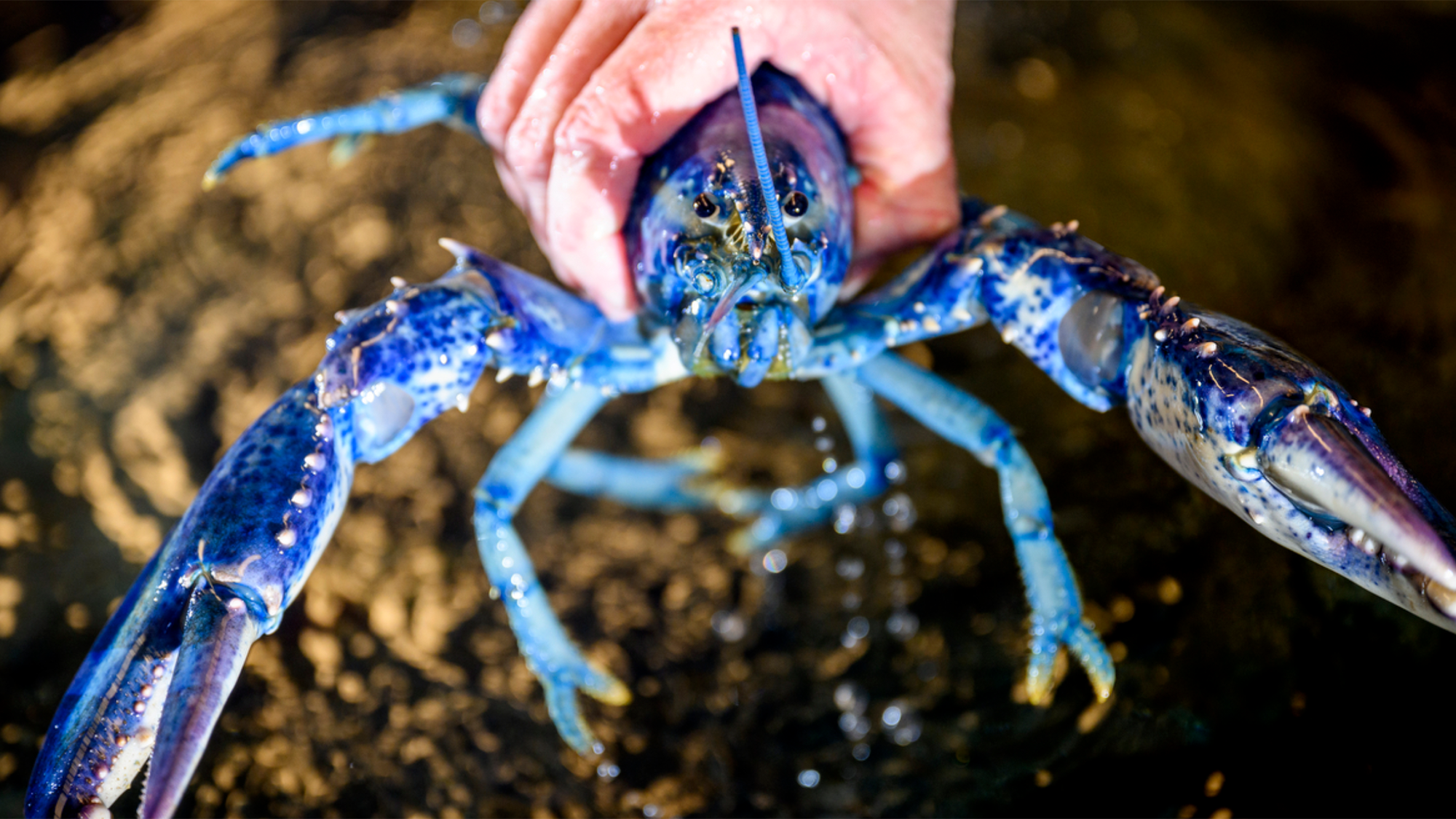
A new resident is making a splash at Northeastern University’s Marine Science Center—Neptune, the blue lobster. Neptune is a super special shellfish: The odds of catching a lobster with Neptune’s hue are one in 200 million.
The cerulean crustacean is a seven-year-old American lobster (Homarus americanus) that weighs about two pounds. In July, lobster fisherman Brad Myslinski caught Neptune in Salem, Massachusetts. Myslinksi then contacted Dave Winchester, a local marine biology teacher, who connected him with the team at the Marine Science Center in nearby Nahant.

Meet Neptune, a One-in-Two-Million Blue Lobster at Northeastern
“It took my breath away seeing this bright blue lobster,” Sierra Munoz, the outreach program coordinator at the Marine Science Center, told Northeastern Global News. “I’ve seen a few lobsters that have a little blue on them, but I’ve never seen one that’s this electric blue.”
A group of high school students attending the center’s Coastal Ocean Science Academy earlier this summer were there when the lapis lobster was delivered in July. Together, they voted on the name Neptune after the Roman god of the sea, Munoz says.
What makes lobsters blue?
American lobsters like Neptune are generally a greenish brown in order to better camouflage in rocky subtidal waters. Lobsters have several layers of a pigment called astaxanthin. This pigment shows up as layers of red, yellow, and blue. When all of those color layers are stacked up, they give lobsters a mottled blotch pattern of oranges, reds, blues, pinks, purples, yellows, and browns.
In colorful crustaceans like Neptune, these color pigments are either not expressed or overexpressed resulting in blue (about 1 in 2 million), red (1 in 10 million), split-colored (1 in 50 million), albino (1 in 100 million), and cotton candy (1 in 100 million) lobsters.
The color blue is very rare in nature, partially because a true blue color or pigment doesn’t really exist in the wild. According to biologists at the University of Adelaide in Australia, organisms that appear blue must absorb very small amounts of energy, while reflecting high-energy blue light at the same time. This process is fairly complicated, so organisms that perform costly “genetic tricks”to appear blue can impede their growth, especially plants. It isn’t fully clear why some flora go to growth-impeding trouble to be blue, but it’s possible a unique color may help them attract pollinators like bees.
[ Related: Why blue animals are so rare in nature. ]
What’s next for Neptune
Luckily, Neptune will not find his way to a dinner plate like many of his brethren. But if he were cooked, Munoz says that he’d turn the typical boiled red color. Instead, Neptune will live in the center’s rocky aquaria touch pool, with some small cunner and sculpin fish, spider crabs, and a few green sea urchins.
“Neptune is doing a really great job adjusting,” said Neida Villanueva, a second-year Ph.D.student at Northeastern University. “We recently built him a hut so he can hide away if he wants. We’re also limiting the time that visitors spend with him. Lobsters usually are very solitary, so it’s important that he has a space to retreat to.”
American Lobsters also have a long life expectancy. They can live upwards of 100 years, so Neptune could be a staple at the science center for years to come.
“We’re really, really thankful to both Brad and Dave for facilitating this donation for us, so hundreds and thousands of people can get to meet Neptune,” Munoz says.
