
Valentine’s Day means that love and coupling up is in the air. Yet for the rest of the animal kingdom, it’s just another day. While our idea of romance may be lacking when it’s time to reproduce, some species make up for it with fascinating strategies to pass their genes on to the next generation and ensure survival.
My two dads
Sloth bears (Melursus ursinus) are more bear than sloth, but do like to hang from tree branches sloth-style. Native to the Indian subcontinent, they are currently listed as Vulnerable by the International Union for Conservation of Nature (IUCN).
“Sloth bears are also ridiculously smart,” Stacey Tabellario, a zookeeper at the Smithsonian National Zoo and Conservation Biology Institute, tells Popular Science. “We often joke they’re apes in a bear suit! Sloth bears can estimate quantities, they show object permanence, they recognize 2D pictures as equivalents of 3D objects, they use referential gestures, and we’ve even seen evidence of tool use.”
Sloth bears typically have two cubs at a time, like other bear species. However, if a female breeds with two or more males, the cubs may have different fathers. Two sloth bear cubs were born at the Smithsonian’s National Zoo in December 2025, and their scientists will run DNA tests to determine which male sloth bear sired the cubs. In the meantime, keepers will keep an eye on their developmental milestones.

“They’re now walking, although they’re a little wobbly, and they’re starting to explore the birthing den,” says Tabellario. “Next we’ll be looking for them to climb on mom Molly’s back because sloth bear moms carry their cubs around on their backs. This piggyback ride is a form of protection for the cubs and it’s helpful for the mom as she has to go out to find food – she can just bring her cubs with her so she always knows where they are! Sloth bears are the only bears that carry their cubs like this for extended periods.”
All in the family
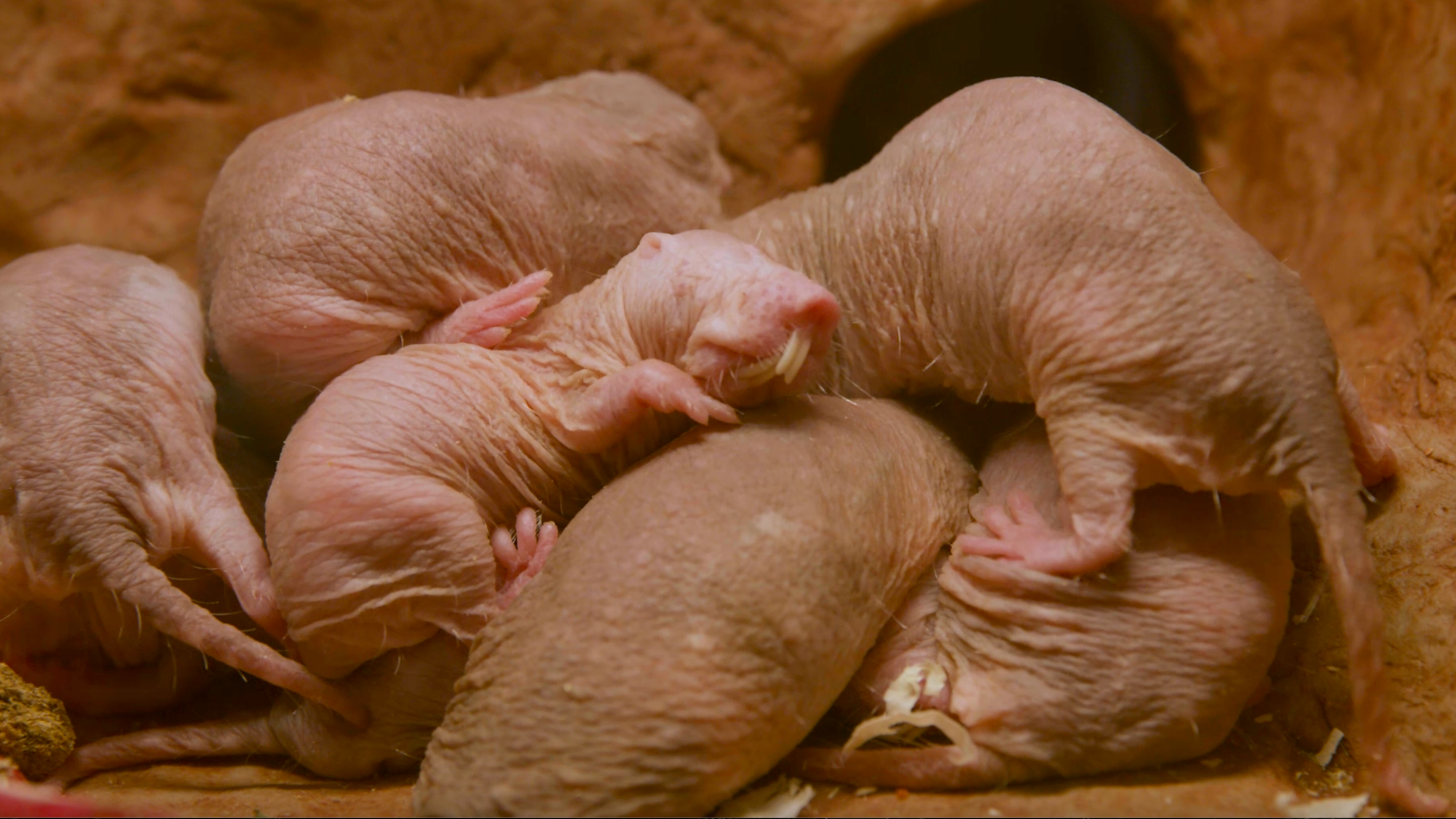
Naked mole-rats (Heterocephalus glaber) are the longest living rodents on the planet, and can live upwards of 30 years. They are also considered an eusocial species like termites, ants, and bees.
“Eusocial means living in a colony, prioritizing the group more than prioritizing yourself,” Kenton Kerns, a curator and biologist at the Smithsonian National Zoo and Conservation Biology Institute, tells Popular Science. “They all have a role to play to keep the colony a living unit. There are workers who build tunnels and chambers and find food. There are soldiers who protect the Queen and fight neighboring colonies. Eusocial individuals have lost some of their independence in order to be part of a bigger unit who provides better benefits.”
This queen then reproduces by breeding with several different male mole-rats. She can even suppress the sexual development of other female mole-rats, by using her size to her advantage and even altering their hormone levels, potentially through feces. This ensures that she wins every time. However, she is kind of in the best and worst position at the same time.

“The Queen gets to tell everyone what to do, and she chooses a few males to breed with, we believe,” says Kerns. “However, she can have one of the largest litters of any mammals, over 30 babies at a time. She has 12 nipples to feed all those babies.”
She may also have to fight off other females while she is pregnant to defend her title.
Unlike other species where young will leave their family group to find mates, naked mole-rats generally stay in the colony that they were born into. As a result, it is not uncommon for queens to breed with their brothers—and her sons if she reigns long enough.
Sala-master of the house
For Japanese giant salamanders (Andrias japonicus), size matters.
“While most salamanders can fit in the palm of your hand, Japanese giant salamanders reach lengths of up to 5 feet and can weigh over 50 pounds,” Kyle L. Miller, a zookeeper and herpetologist at the Smithsonian National Zoo and Conservation Biology Institute, tells Popular Science. “The Chinese giant salamander is the only other amphibian that grows to a larger average size.”
That size comes into play when it comes to breeding, but in a surprising way. During their breeding season (late summer and early fall), they migrate up river in search of a den with a single underwater entrance. The largest and most dominant male in a territory will occupy that den and defend it.

“The dominant male at each den site is coined the ‘Den Master,’”says Miller. “Multiple females will enter the dens to lay eggs, which the male fertilizes externally.”
Each female typically lays a clutch of 400 to 600 eggs. However, once the female lays the eggs and the male has fertilized, the female hits the road.
“The male provides care of the eggs,” Miller says. “This care includes protecting them from predators and using his tail to fan them for oxygen over the 2-3 month period before they hatch.”
Breeding season? Who needs one!
There’s no time like the present for reproducing. Especially if you’re among the roughly 6,000 species of coral in the world’s oceans.
“Corals are fascinating because they challenge many assumptions about animals. They look plant-like but are animals, they don’t move yet build massive reef structures, and they function both as individuals and as colonies,” Thomas Wippenbeck, a marine biologist and coral keeper at Smithsonian National Zoo and Conservation Biology Institute, tells Popular Science. “They are also incredibly ancient, having survived hundreds of millions of years of environmental change through unique biological strategies and partnerships, particularly with photosynthetic algae.”

They also reproduce both sexually and asexually. Corals typically bud year-round, but they reproduce sexually by broadcasting their spawn during the warmer months. Corals will shoot out a swarm of sperm and egg cells and then sort of just hope that they are fertilized. The fertilized larvae will float around until they settle down in a suitable place to attach and begin a new colony.
“A major benefit of mass spawning is genetic diversity, which helps corals adapt to disease and environmental stress,” says Wippenbeck. “Releasing large numbers of eggs at once also reduces losses to predators. The downside is that this strategy is highly sensitive to environmental conditions. If temperature or seasonal cues shift, spawning can become unsynchronized, greatly reducing fertilization success.”
Happy Valentine’s Day!
