
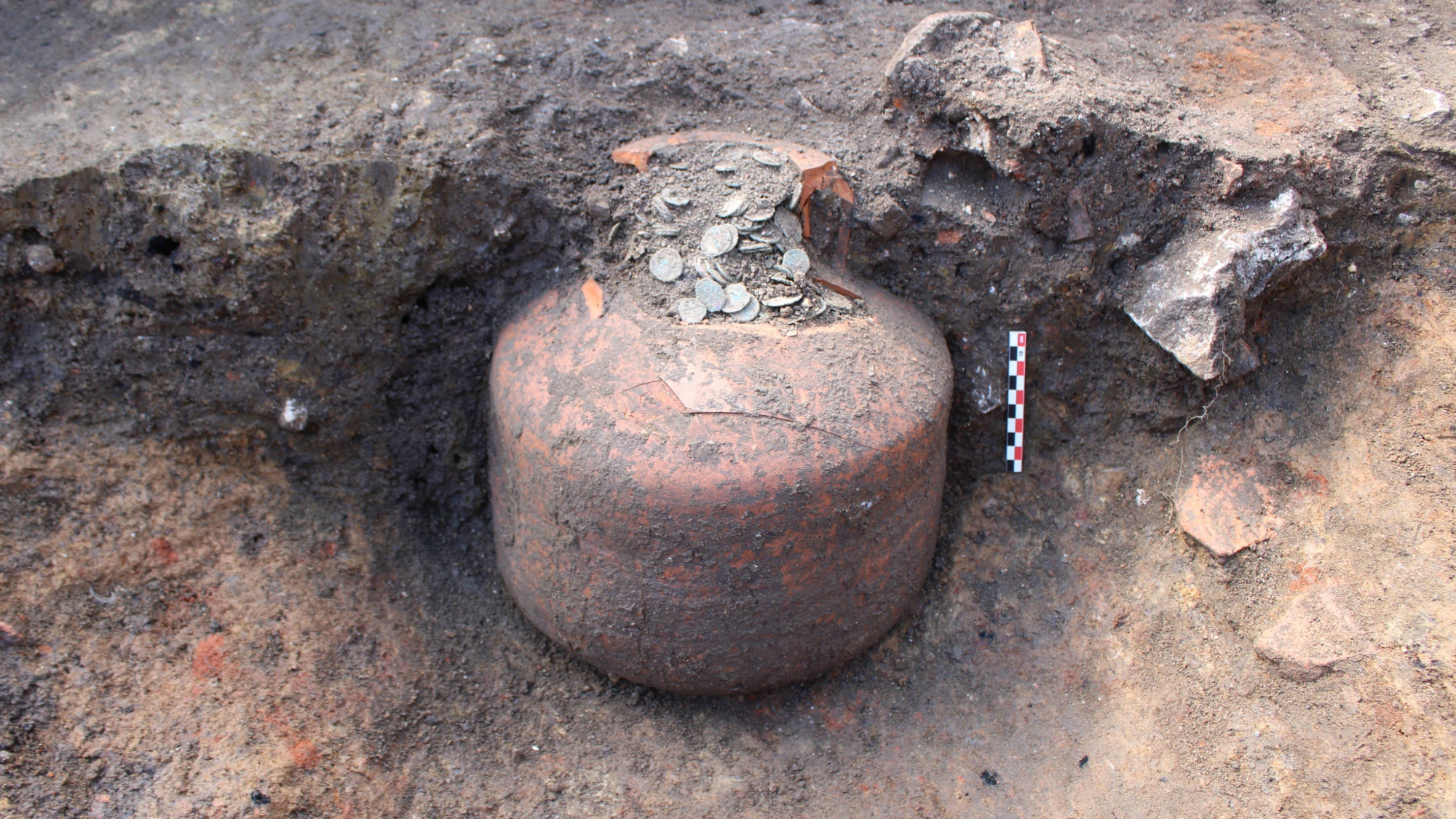
Archeologists recently discovered over 40,000 Roman-era coins during a dig in a French village. The treasure trove of ancient coins were found in three ceramic storage vessels that had been buried between 1,700 and 1,800 years ago.
The team from the National Institute for Preventive Archaeological Research (INRAP) was digging in the village of Senon in northeastern France, roughly 60 miles from the Luxembourg border. Senon was one of the main cities of the Mediomatrici tribe. This Celtic tribe lived in and around northern France during the Gallic Wars, when Julius Caesar conquered parts of present-day France, Belgium, and Switzerland between 57 and 50 BCE.
The coins were buried in three large ceramic coin jugs called amphorae. INRAP believes that the thousands of coins uncovered in France date from the last quarter of the 3rd century to the first decade of the 4th century CE, but the exact dates are still unknown.
INRAP numismatist Vincent Geneviève told Live Science that the first hoard held an estimated 83 pounds of coin, or about 23,000 to 24,000 coins. The second jug and its contents weighed in at about 110 pounds (potentially 18,000 to 19,000 coins) and the third jug contained only three coins.
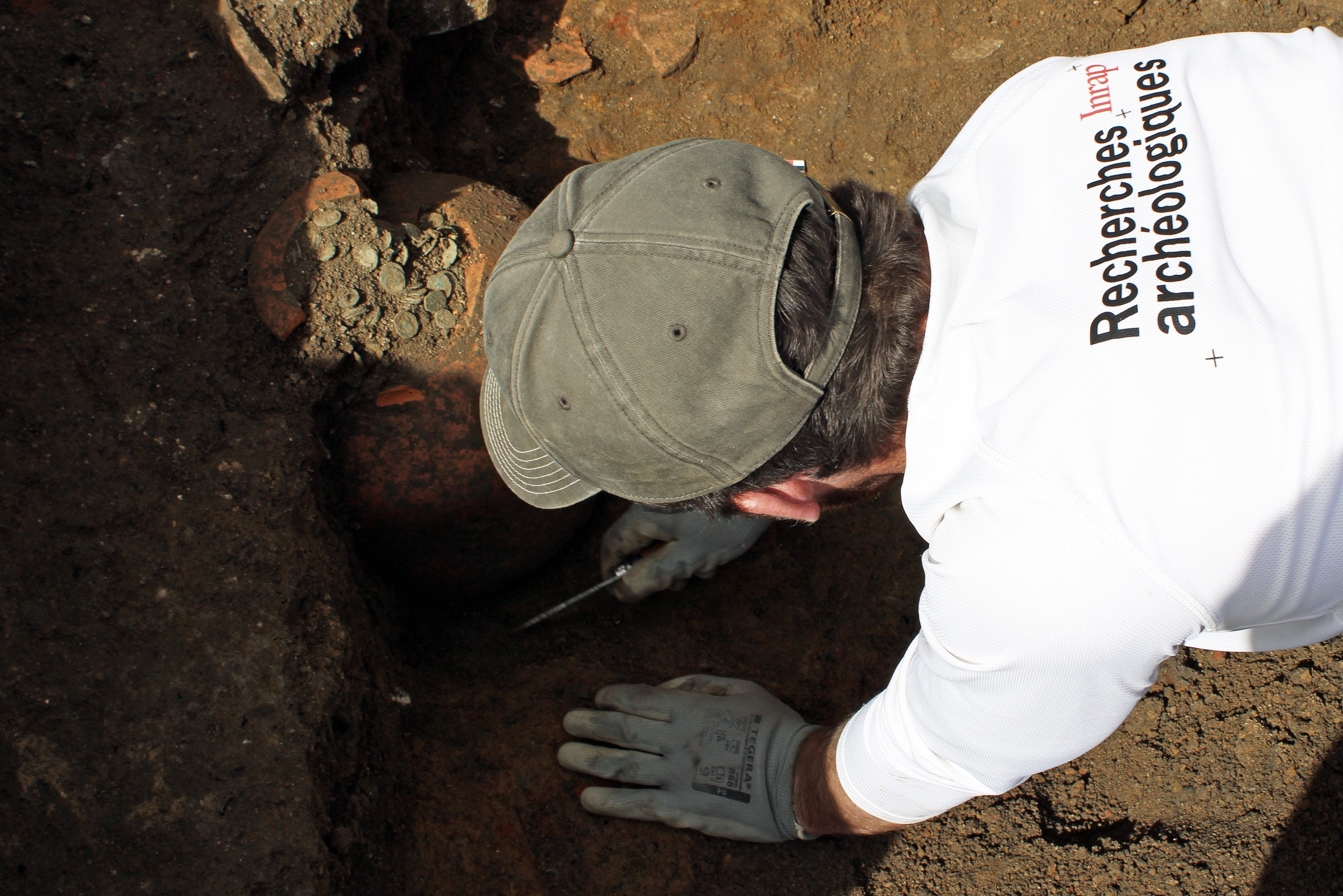
“Contrary to what one might initially think, it is not certain that these were ‘treasures’ hidden away during a period of insecurity,” INRAP wrote in a translated statement.
Instead, these jugs might be a snapshot of “complex monetary management,” a financial system that was potentially planned for medium to long-term savings or for within a household so that deposits and withdrawals could be made at various times.
“In two cases, the presence of a few coins found stuck to the outer face of the vessel clearly indicates that they were placed there after the vessel had been buried, before the pit was filled with sediment,” INRAP wrote.
Two of the deposits were found in what would have been a living room, and indicate that they would have been easily accessible to their owner.
Around the beginning of the fourth century, a large fire destroyed the original settlement. The area was re-established before a second fire. Despite both fires, the older age of the coins INRAP offers evidence that a clustered settlement already existed before the Roman conquest of the area.
“All hypotheses will be examined, but it is possible that there is a link between these three subcontemporary coin hoards—all buried, according to our current information, between 280 and 310 AD [CE]—and the known military occupation at Senon, attested by a fortification dating from the same period and located only 150 meters [492 feet] from the excavated area,” said INRAP.
