AVIATR Michael J. Malaska

Drones: they’re not just for controversial cross-border airstrikes anymore. Physicist Jason Barnes has designed a robotic aircraft that could cruise the methane skies of Saturn’s moon Titan almost indefinitely, beaming data and images back to Earth and terminating with extreme prejudice any terrorist threats it encounters there (we made that last part up).

AVIATR is Barnes’s concept for an aerial drone powered by two small nuclear generators (known as Advanced Stirling Radioisotope Generators, or ASRGs) that could stay airborne over Titan pretty much indefinitely. The ASRGs together would only provide about 250 watts, or enough to power two light bulbs. But Titan makes flying easy and non-energy-intensive--it exerts seven times less gravity than Earth and hosts an atmosphere that’s three times denser.

In fact, the most energy-intensive task AVIATR would face is beaming information back to Earth. To do so, the drone would climb to nearly 9 miles up, then divert all of its power to its datalink while gliding back down to 2 miles. Scientific data would include imagery captured from both high and low altitudes and information on the methane rains that shower Titan’s surface, as well as other atmospheric data.

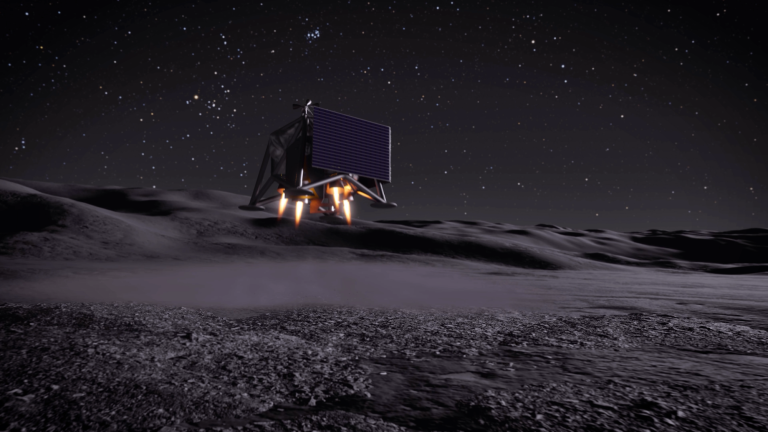
On such a mission, the drone would enter Titan’s airspace in an aeroshell with a parachute that would slow the entire package way down. AVIATR would then eject from the aeroshell, fire up its ASRGs and propeller, and deploy on what would likely be a one-year mission--though, as noted above, AVIATR could really stay aloft for years upon years barring mechanical failure of some kind.

Plus, it could provide strategic air support for the boats deployed on Titan’s methane lakes. That is, if either boat or plane ever makes it off the ground here on Earth. Titan is one of the more interesting bodies in the solar system (says me), but it didn’t get a nod from the Planetary Science Decadal Survey, which helps NASA prioritize its missions. That means if AVIATR does launch, it likely won’t be before the late 2020s.

[SPACE]

29 Comments

I'm sold.

Going from this article...
http://www.space.com/1825-view-titan-strong-winds-soft-ground-lightning.html

"....When the Huygens probe touched down on Titan, it landed on a relatively soft patch of material similar to lightly packed snow, researchers announced today.

But to get to that soft patch, Huygens had to descend through a treacherous atmosphere where winds raged up to 270 mph,...","...While the uppermost clouds – about 75 miles above the surface – spin around the moon at about 270 miles per hour, wind speeds gradually decline as the near the surface. Here generally weak winds, gusting no more than a few feet per second, were observed in the lowest 3 miles of the probe's descent.
The probe passed through one other region of near zero wind speeds, from altitudes 62 to 37 miles. Scientists cannot explain this yet..."

Now this is just one occurance of Titans wind. I imagine there maybe much higher speed winds.

There are other articles about Titans winds and how they change the landscape of Titan too.

I wonder how this little drone would hold up to higher winds?

..........................................
See life in all its beautiful colors, and
from different perspectives too!

the only thing about a methane sea, is that in may be a bit too viscous for sailing. At least, I would imagine this to be so. perhaps I am wrong.

--------------------------------------------------------------------------
why learn from your own mistakes, when you could learn from the mistakes of others?
“The most incomprehensible thing about the universe is that it is comprehensible” -Albert Ein

Um. Methane atmosphere. Is there some reason you couldn't build something that intakes methane, combusts it. Would seem you could stay aloft permanently then....

Too much moisture content or some other reason?

Would seem solvable.....

With all that Methane in the atmosphere, it would be awesome if we can have all our telescopes pointing at Titan and then have the probe light a match...

Okay, something tells me that wouldn't work, but still.. I just picture something similar to watching the Deathstar explode. lol

---
In space, no one can hear a tree fall in the forest.

@jm98 and @GMarsack
The methane is useless as a fuel without oxygen to combust with.
Planets or moons with explosive atmospheres can't exist. Meteorites, geological activity or lightning would set off even small amounts before they could build up into planet destroying concentrations. So scenarios like in the pathetic movie Battlefield Earth just won't happen.

Why does this illustrated robotic drone have a canopy for a human pilot? Is some poor soul being kidnap and to his surprise wake up in a flying drone on Titan?

I am just having thoughts of the movie Predators and waking up falling in the sky with an automatic parachute on an alien planet.

.............................
Science sees no further than what it can sense.
Religion sees beyond the senses.

Why does this illustrated robotic drone have a canopy for a human pilot? Is some poor soul being kidnap and to his surprise wake up in a flying drone on Titan?

I am just having thoughts of the movie Predators and waking up falling in the sky with an automatic parachute on an alien planet.

.............................
Science sees no further than what it can sense.
Religion sees beyond the senses.

@Robot
The hump you see on some large drones are very common as they hold the radar. They probably just colored that part in.

I'm the aerospace engineer who invented this mission concept.

The airplane is folded up inside an entry vehicle with a heat shield that is the same geometry as the one used on the Huyghens probe. That's why the airplane has the strange shape it has; it's designed to fold up inside the conical entry vehicle and then unfold in midair and start flying. It doesn't need to pop out of the entry vehicle until it is fairly low in the atmosphere, below the region where the high winds are. Down to that point, the probe is on the parachute exactly like the Huyghens probe was--and that probe obviously survived down to the surface.

At the altitudes where AVIATR would fly, the wind speeds are quite modest--around 12 m/s.

Also keep in mind that all airplanes, even those on Earth are usually flying in a mass of air that is moving relative to the surface but, by itself that doesn't necessarily cause any problems. What keeps an airplane up is the speed of the air over wings, which is not related to the speed the mass of air has relative to the ground.

However, just as with Earth airplanes, it is probably true that winds on Titan blowing over surface features such as hills and convective cells (if any) rising up from the surface would probably cause occasional turbulence at the altitudes AVIATR would fly at. We don't expect it to be worse than what you would experience in a light general aviation aircraft (i.e., Cessna 172).

Titan's atmosphere does not have any free Oxygen in it (or any other usable oxidizer). It would be possible to design an airplane to fly on Titan burning the Methane in the atmosphere if you brought along your own tank of Oxygen. But, when that Oxygen was consumed, the airplane would stop flying. That would only be a matter of a day or so (depending on exactly what fraction of the airplane weight was devoted to Oxygen).

AVIATR would not use up any consumable material (except the slow, radioactive decay of the on-board Plutonium). That's what allows this airplane to fly until something on it breaks (probably a year or more).

The light colored patch you see at the nose of the airplane is not a canopy for crew. It is a fiberglass cover for the dish antenna that is used for communication to Earth. The cover has to be made of something that is transparent to Radio Frequency transmissions. From where AVIATR would be flying on Titan, the Earth would appear to be above the local horizon virtually all the time. (Flying at Titan's equator, the Earth would be almost directly overhead. Flying near Titan's poles, the Earth would be near the local horizon.)

So, the dish antenna (which would actually be somewhat elliptical) can be pointed over a 180 degree arc from the starboard side, to directly overhead, to the port side.

If you Google a picture of a Global Hawk UAV, you will see a very similar light colored fiberglass patch that covers their communication antenna. In their case, they are communicating directly through a secure Radio Frequency link to a satellite. The communication geometry is very similar to what AVIATR would experience. (A terrestrial UAV flying at Earth's equator would see a geostationary satellite as being directly overhead. A terrestrial UAV flying at Earth's poles would see a geostationary satellite as being near the horizon.)

RocketScientist1947,
Thank you for the cool additional information!

..........................................
See life in all its beautiful colors, and
from different perspectives too!

I LOVE it when a person attached to a product or project logs on to popsci to add more info or counter stupid statements from commentators (I am referring to other instances like that carbon fiber battle/defense arm thing popsci did an article on, the one where Kevin Costner showed up in the vid talking about it)

I am digressing... cool idea!

@RocketScientist194
Now not to say its not true, but I'm always skeptical of someones online identity.

But I have some questions, the AI that flies the drone. Since Earth based UAV's use waypoint systems, and also have to avoid weather anomalies (storms, extreme turbulence etc you get what I mean) and are very reliant on data from orbiting satellites, which is not available on Titan.
How are we going to apply existing concepts to an unexplored planet with relatively unexplored/unknown weather conditions phenomenon?

Also the quite heavy maintenance required of earthbound UAVs, how does this factor in? They haven't proven too reliable in staying aloft 'autonomously', even though they are incredible and quite reliable at gathering data 'with' realtime viewing human controllers.

How is the aircraft, (since it can cover huge areas quite quickly versus conventional ground rovers) going to decide what is potentially interesting?

I've got more questions and some Ideas, but just not the time right now, so I will quickly leave this post here.

@RocketScientist1947: Thanks for clearing things up about the dish antenna, I found it odd too after seeing the concept picture. But yea just like inaka_rob said, it's cool when people involved in the project gets in touch with the public and explains things in explicit detail. There's probably less chances of misunderstandings cropping up that way.

I am sending you good vibes for your awesomeness.

C--, I agree with you.
I do not know who the source of RocketScientist1947. I was just being courteous before. The fact is we are all anonymous on POPSCI and as we read comments here, it is all hearsay. If a person wants actual facts; they need to move as close as possible to the source.

I do look forward to his responses to your questions to him.

Still, I do learn here on POPSCI and it is all fun to read the comments.

..........................................
See life in all its beautiful colors, and
from different perspectives too

!

C--

Those are good questions.

Many years ago when I was a student pilot, my instructor taught me that flying an airplane basically breaks down into 3 parts: aviating, navigating, and communicating. Aviating consists of keeping the air flowing over the wings and not running into things, which means keeping the propeller turning and keeping the control surfaces operating within their prescribed limits. That’s the easiest part of a Titan airplane; even an RC hobby autopilot can do that, these days. Communicating consists of exchanging information with the Earth using radio signals. That’s also relatively easy to engineer; the only complication is that it takes a lot of electrical power and a relatively big antenna, because the distance from Titan to Earth is so large. Navigating is actually the most intellectually challenging part of the problem.

The one-way light time from Earth to Titan can be on the order of a couple of hours, depending on exactly where Earth and Saturn are in their orbits. So, obviously, a Titan UAV will not be controlled with a human pilot in the loop the same way a terrestrial UAV in, say, Afghanistan is controlled by a pilot sitting in Nevada. It will not be possible to communicate with AVIATR more than once a day, and often less frequently than that. Therefore, the aircraft has to have enough autonomy to be able to stay out of trouble for days at a time.

The way we propose to operate is to first always fly at an altitude that is higher than any obstacles on Titan’s surface. Five km or so should do it, based on data from the Cassini-Huyghens mission. A combination of barometer and radar altimeter measurements will allow this.

Secondly, except at the equator, AVIATR can fly westward faster than Titan’s surface is receding to the east. This means that (except at the equator) AVIATR can always keep the Sun and Earth overhead and in view. The simplest navigation strategy is to use an upward looking sun sensor to keep the sun approximately overhead the airplane at all times. This can be done by flying along large, looping flight paths which will generate circular, or race track shaped ground tracks (maybe a few hundred km in diameter) centered around the subsolar point (or, “high noon”). This only requires the autopilot to execute very shallow banked turns at constant altitude, most of the time (the same holding patterns that terrestrial reconnaissance UAVs often fly, autonomously). In this simplest mode, AVIATR does not even try to fly relative to fixed points on the surface or relative to spacecraft in orbit.

As AVIATR orbits the subsolar point, Titan will slowly rotate to the east and it will be able to conduct scientific observations of the surface that flows beneath it, in daylight. After a few weeks, this few hundred km diameter spot will have made several laps around Titan, allowing the operators on Earth to have built up a partial but high resolution map of a band around Titan. Once high resolution images of a surface feature have been captured, any one of a number of machine vision and automatic pattern recognition algorithms can be used to allow the aircraft to autonomously detect when it overflys that feature again. This capability allows AVIATR to slowly build up the ability to navigate relative to fixed points on the surface and preferentially spend more time over them. Over time, a powered aircraft can go where the science team wants to explore, as opposed to wherever the winds happen to blow (as with a balloon). The science team would decide what features are interesting and designate those to the aircraft; the aircraft would have enough autonomy to recognize those features when it flies over them and to command the appropriate science sensors to turn on.

Titan has seasons in different hemispheres (just like Earth), because its spin axis is also tilted relative to the Sun (just like Earth). Just like on Earth, the best weather on Titan occurs in the hemisphere that is experiencing Summer and the worst weather (clouds, wind storms, precipitation) occurs in the hemisphere that is experiencing Winter. The idea would be to target the entry probe to begin the mission in whichever hemisphere is experiencing Summer at the time of arrival. After exploring that hemisphere for a period of time that the science team selects (6 months?) we would attempt to cross the equator and conduct operations in the other hemisphere. The equatorial region of Titan is, relatively speaking, a desert. Most of the interesting features such as Methane lakes, erosional features, etc. are at higher latitudes (north and south) so we imagine that we would not spend much time near the equator. That plan could always change in real time, however, depending on what was discovered.

After crossing the equator, the idea would be to approach the “severe” weather in the Winter hemisphere slowly and cautiously. Not a lot is known about the variability of the winds aloft on Titan, so we would be learning as we go. From theoretical considerations, we don’t expect the winds and turbulence on Titan to be greater than the aircraft could withstand, but the science team always has the option of not going any further into the bad weather than they judge to be prudent.

To get to your question about how long a Titan UAV could fly without maintenance and repair: we don’t know for sure what the limit is, but one Earth year should be achievable. The world record for continuous refueled flight of a piloted aircraft is about 2 months (64 days). It was a Cessna 172 and it was refueled in flight from a truck driving along on the ground. They were able to resupply consumables like fuel and oil, but it eventually stopped flying because (I think) the spark plugs stopped firing. The AVIATR is designed so that it has no consumables like fuel, oil, hydraulic fluid, or spark plugs. All actuated mechanisms are electromechanical, with brushless motors. Essentially, the only moving parts connected with each other are connected via low friction bearings. There are many cases of mechanisms like this in your normal life (wall clocks, computer disc drives, etc.) that operate for years without repair or maintenance. The radioisotope power supplies (Advanced Stirling Radioisotope Generators, or ASRGs) on AVIATR are exactly such devices. They are designed for a probable lifetime of 10 years of continuous operation. We think aircraft mechanisms of the type used on AVIATR can be designed for similar levels of reliability. DARPA has a program you can Google on (named Vulture), that aims to develop a very long duration high altitude terrestrial UAV using this approach. All the aerospace contractors participating in that program believe it is possible to design a terrestrial UAV for 5 years of continuous flight at high altitudes on Earth. One of those contractors is on the AVIATR team, so we would expect to get the benefit of the DARPA technology development.

Thanks very much for your Insight.
I presume such a project would once into testing phase also first be extensively test-run on earth, HOWEVER the aircraft has to be specifically Engineered for Titans atmosphere that will make it impossible to fly on earth.
As quoted from wikipedia article:

Flight on Titan

The very high ratio of atmospheric density to surface gravity also greatly reduces the wingspan needed for an aircraft to maintain lift, so much so that a human would be able to strap on wings and easily fly through the atmosphere.

The Engineering side of this has it all covered to be honest, for quite a while already, Its doable is what I'm saying! Just the AI software needed to keep this aircraft running proper, is the biggest challenge. I know that because I've been programming in C++ (hence my name) for several years allready, particularly in areas of Autonomous Analysis and Control aswell as General Artificial Intelligence. Are there any other locations in the Solar system that this Aero Probe concept could be viable? Oh and will you give it the ability to launch mini probes to the ground? (Just kidding, would be cool though) :)

And I do blame you for getting me fascinated with Titan! :D

titan is a very interesting target to study and RocketScientist1947 seems way too knowledgeable to be shining us on and who would spend this much time goofing on us and be that knowledgeable at the same time, not troll like attributes, thanks for the insites, cheers

C-- said:
“I presume such a project would once into testing phase also first be extensively test-run on earth, HOWEVER the aircraft has to be specifically Engineered for Titans atmosphere that will make it impossible to fly on earth.”

Yes, a Titan UAV would definitely be thoroughly tested on Earth before launching it into space. Some of the testing would be exactly the same that has been done on all terrestrial airplanes since the time of the Wright brothers. The first and most basic testing would be to determine the aerodynamic efficiency. This is usually expressed as the Lift-to-Drag ratio of the complete aircraft (L/D), and tells you how heavy the aircraft can be and still fly. The higher the L/D, the better.

Another and more subtle set of tests determine how the airplane responds to control inputs. The Wright brothers pioneered the technique of determining aircraft L/D and controllability in wind tunnels (holding the model stationary and blowing air past it). In fact, figuring out how to make an airplane controllable was perhaps the most important contribution that the Wright brothers made to aeronautics. Undoubtedly wind tunnel tests of AVIATR would be conducted, but these days it is increasingly common to also build a Radio Controlled scale model of a new airplane configuration and determine its performance in free flight; it can often be cheaper to build a flying model than to pay for wind tunnel time.

The power required to keep AVIATR aloft on Titan is about the amount needed to run one incandescent light bulb in your living room (100 W). It is correct that the combination of low gravity (about 1/7 of Earth’s) and high atmospheric density (about 5 times Earth’s) reduces the power required to maintain level flight on Titan to a small fraction of what it would be on Earth. In fact, if you tried to fly the AVIATR on Earth it would take more than 1500 times as much power (about 200 horsepower). So, possibly, you could fly an AVIATR on Earth with a gasoline engine in it in order to test its performance.

One of the tests that would be unique to this particular airplane would be of its thermal control system. The fuselage of AVIATR is constructed like a picnic chest, with two composite skins separated by plastic foam insulation. This allows the outside skin to operate at the atmospheric temperature of Titan (about 5 to 10 degrees C above the temperature of liquid nitrogen) while the inside of the fuselage is kept at room temperature. The idea is to have an inlet at the nose of the airplane that lets a small amount of the outside air into the fuselage. The amount of air is metered so that the heat generated inside the fuselage will warm the air up from liquid nitrogen temperatures to room temperature. This allows all of the electronics and mechanisms inside the fuselage to operate at exactly the same conditions they would operate at on Earth, so we don’t have to invent any new electronics and mechanisms.

“Are there any other locations in the Solar system that this Aero Probe concept could be viable?”

Basically, you can fly on any celestial body in that has a sensible atmosphere. That includes Venus, Earth, Mars, Titan, and all the gas giant planets. Before I started working on the Titan airplane concept, I spent about 10 years designing Mars airplanes and Venus airplanes. The mathematical equations that govern flight are exactly the same everywhere, but the specific conditions of gravity level, atmospheric density, and temperature vary all over the place. Titan is by far the easiest place in the Solar System to fly. The hard part is getting there.

“Oh and will you give it the ability to launch mini probes to the ground? (Just kidding, would be cool though) :)”

You mean, launch an air-to-ground missile against the Spirit rover on Mars, for example? My design team has discussed this many times. There is no reason you couldn’t do it.

And I do blame you for getting me fascinated with Titan! :D

Me too.

Actually the idea for the Aero Probe to launch mini probes to the ground sounds like a good idea. It could gather soil samples or take pictures of the terrain at ground level, while the probe flew overhead. Was it budgetary constraints that nixed the idea?

BA_Gilbert asked:
"... the idea for the Aero Probe to launch mini probes to the ground sounds like a good idea. ... Was it budgetary constraints that nixed the idea?"

I wouldn't say that the idea has definitely been nixed. If the AVIATR concept ever makes it to the actual flight project phase, it will probably be revisited to see if it makes sense from a science point of view. On a vehicle the size of AVIATR, you could probably support one or two probes (sometimes referred to as "dropsondes") with mass of about a kg, each. That way, once they were dropped, the mass of the aircraft wouldn't change by more than a couple of percent--so the aircraft performance would be basically unchanged.

The advantage of dropsondes is that you could target them quite accurately, after the aircraft had been flying for a while to obtain what is usually called "ground truth" (correlating a measurement of some parameter on the ground with the same measurement made from the air, by a different technique).

The disadvantages are:

1) They are small; part of the dropsonde mass would have to be devoted to an external shell, batteries, radios, insulation, etc. Probably only a couple of hundred grams would be left over for some kind of science sensor.

2) They would be short lived; they would probably last less than an hour before they froze up.

3) They would be special purpose; you could probably take only one scientific piece of data.

Even so, it might be possible to make a good argument to include a dropsonde as part of a larger overall investigation. The gain in scientific understanding due to having "ground truth" might outweigh the loss due to having fewer or smaller instruments on the aircraft.

@RocketScientist1947

Just have a couple of basic questions.

The article mentions AVIATR possibly providing some kind of support or cooperation with the recently proposed Discovery class Titan boat probes, what kind of benefits would be gained from this cooperation?

You mention the benefit of powered flight of balloon models. With Titan having around 3 times Earth's atmospheric density, would it not make sense to make a powered balloon probe? I assume with the higher air density a helium filled craft could be relatively tiny compared to those on earth and would (I suspect) give a large increase to the carrying capacity.

Finally, as an alternative to my last suggestion, instead of making the whole craft a balloon craft, why not make the dropsondes balloon "hybrids" in which each dropsonde would have a helium filled balloon to compensate for the added weight to the main craft? This would possibly allow the dropsondes to have more science sensors and could possibly allow the main craft to carry more dropsondes.

"You mention the benefit of powered flight of balloon models"

Meant to say "powered flight over balloon models"

Interesting ideas there racer79. Balloon Dropsondes, have however the disadvantage of having complete lack of control. They are merely at the mercy of the wind, hardly suited to charting the whole moon. They would also likely due to the high air density at ground level, be flying too high in Titans atmosphere.

Dropsonde's on the other hand could also be in the form of mini boats that could be dropped into Titans seas to sample the Chemical compositions and general conditions(or maybe even find some sort of methane based life). They would not need true computers of their own. Merely transmit sensor and camera data to AVIATR, for processing, then allow AVIATR to send basic commands to the dropsonde.
An option would be to perhaps have one land sonde and one sea sonde? These could then after prolonged aerial exploration be deployed to areas of highest interest.
It would also be the first Space probe to deploy secondary probes into a sea on another planets moon. And the first to deploy dropsonde's at all probably?

PS: sonde is german for 'probe' :)

Good point C--, perhaps the dropsondes, instead of having their balloons permanently attached, could have some release mechanism, that way they would not add any extra weight to the AVIATR and wouldn't be floating around uselessly in the atmosphere after being deployed.

I'm liking the aquatic (would it still be considered aquatic in a methane lake?) dropsonde idea. After all, according to the article I read, they were planning on making the boat probe an inexpensive discovery class probe, so it would make perfect sense to see if it would be possible to make it a dropsonde instead of sending it by itself.

@RocketScientist1947
I assume AVIATR is intended to identify thermals and use them to achieve higher altitude to assist with gliding.
Is it expected to have to do this by itself using smart programming? or are these thermals going to be plotted from Earth and guided remotely?
I'm guessing that remote piloting isn't going to be an option, especially when AVIATR is in poor weather conditions.


June 2013: American Energy Independence

Five amazing, clean technologies that will set us free, in this month's energy-focused issue. Also: how to build a better bomb detector, the robotic toys that are raising your children, a human catapult, the world's smallest arcade, and much more.


Online Content Director: Suzanne LaBarre | Email
Senior Editor: Paul Adams | Email
Associate Editor: Dan Nosowitz | Email
Assistant Editor: Colin Lecher | Email
Assistant Editor: Rose Pastore | Email

Contributing Writers:
Rebecca Boyle | Email
Kelsey D. Atherton | Email
Francie Diep | Email
Shaunacy Ferro | Email

circ-top-header.gif
circ-cover.gif
bmxmag-ps