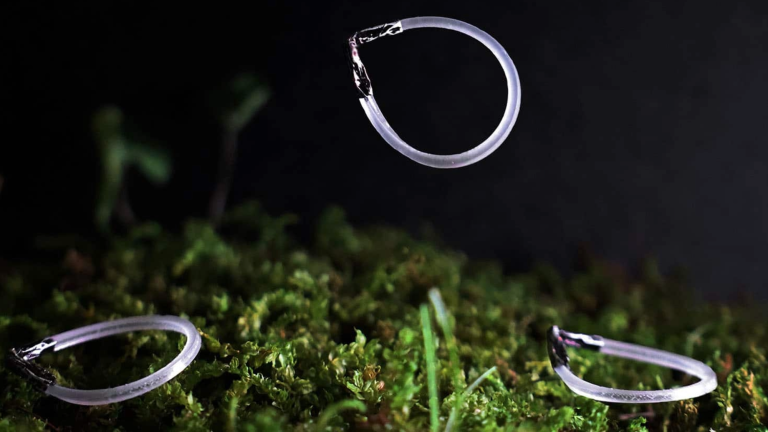
Japanese Spandex-maker Asahi Kasei Fibers has developed the world’s first elastic electrical cable, a stretchy conductive connector that could go a long way toward reducing cord clutter. But it’s not just a way to help you manage your multi-cord mess. Called Roboden, the stretchable cord could enable new generations of electronics-embedded textiles and robotic skins.
Roboden is already available in various kinds of cables, including USB cables and standard power cords, giving you that little bit of extra reach you always need to reach that wall socket. But the real upside is in the realm of automated machinery and robotics. Here, connecting cables previously had to be as long as the machines maximum range of motion to allow the machine to move unrestricted. This meant a lot of loose cord laying around.
With Roboden, the cord stretches when the robot/machine moves and pulls taut when the machine relaxes the tension, keeping extra cord from getting in the way. Likewise, when the day arrives that we want to start sheathing our humanoid robots in soft, skin-like coverings, stretchable electronics and chips are going to be the technologies that get us there.

140 years of Popular Science at your fingertips.
Each issue has been completely reimagined for your iPad. See our amazing new vision for magazines that goes far beyond the printed page
Stay up to date on the latest news of the future of science and technology from your iPhone or Android phone with full articles, images and offline viewing
Featuring every article from the magazine and website, plus links from around the Web. Also see our PopSci DIY feed
The 6th annual Invention Awards are here, from an inflatable tourniquet to a better lobster trap to spring-loaded hocket skates. This issue is all about the celebration of invention.
Plus: Making synthetic biology breakthroughs in a garage, building a constantly-moving ping-pong table, and a ridiculously overpowered barbecue.
its small things like this that makes it all happen !!!
---
bored? lets go mine the stars... ^^
I see this replacing damaged nervous systems in the future.
I could see this helping the movie industries.
this is kinda crazy, though i think they used the same technique to make the seat belt that expands when pulled taught. basically you have an elastic thread and a non elastic thread rolled together in a double helix to make a single thread.
just think, this could be one step closer to a wearable computer that keeps you warm in the winter.
to mars or bust!
Id like to know how far the wires can safely stretch. Also, the resistance of these wires compared to say a copper wire.
Finally, it seems like this technology should have been around for much longer, by the way are these safe, what happens if the cables snap? When can I buy one?
Wowsers!
@bob clementine
Yup and it prolly won't shed heat like good old copper.
This sounds great though, Im wondering what the voltage and current capacities of Roboden are. Could it be beefed up for larger applications, i.e. Twisted into large cables for power generation and transmission. I see a lot of damaged sheilded control cable in my field due to minor shifts in wire placement during normal operation.
Finally I can bungee jump and charge my cell phone at the same time.
Finally my music player can bungee jump! My corded earbuds are always getting pulled from my ears, pulled from my phone or stretched by both. It would be great to have a nice stretchy pair of head phones that won't break and could potentially save my device from a fall to certain doom!
This will be new to some, but not a new product. I purchased a similar product for use in the 1970's. The problem with what I bought was that although it stretched fine (as claimed), it had a high electrical resistance, about 0.5 ohm for 1 ft of cable. As I needed to send power down it I was not able to use it. It also very likely had a high inductance but I did not test that. So benefit will be very application dependant. Maybe this one is better.