Robot Cyclist DigInfo

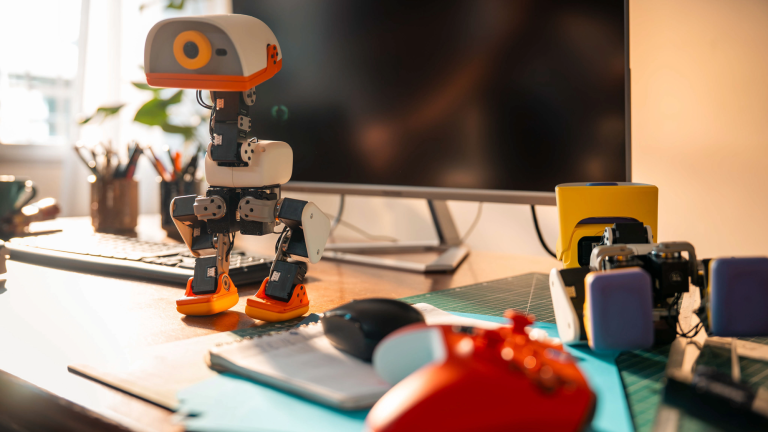
At this year's International Robot Exhibition, Masahiko Yamaguchi demonstrated a smallish robot--maybe a foot high or so--that is able to ride a fixed-gear bike, like a 2011 version of the opening scene from The Muppet Movie (and there's a Muppet movie coming out this year, too! Sorry sorry. Back to robots.) What's especially impressive is that the robot is capable of biking just like a human--it moves and brakes solely through the strength of its own adorable little body.

According to DigInfo, this is essentially an off-the-shelf robot, outfitted with a Tamagawa Seiki-made gyroscope to help the little guy keep his balance. A control board in his backpack processes the signals from the remote control, calculating how sharply the 'bot can turn the handlebars while maintaining its balance.

It uses a fixed-gear bike not out of trendiness but for a more simple reason: the robot would have a tough time managing a freewheel, which allows the back wheel to spin even if the robot stops pedaling. Also, a fixed-gear allows the robot to brake simply by slowing or applying reverse pressure to the pedals. He stops the same way you and I do: by taking his feet off the pedals and balancing on his toes. Perhaps the world's most failsafe electric brakes are a bit too complex for this minimalist robot cyclist.

[DigInfo]

3 Comments

Why strive to have robots be intelligent and capable of making their own decisions??? I think its better when we control them and not the other way around. Although some intelligence would be cool, we shouldn't forget that if the can learn and make their own decisions they can over power us......

The word robot was introduced to the public by the Czech interwar writer Karel Čapek in his play R.U.R. (Rossum's Universal Robots), published in 1920. The play begins in a factory that makes artificial people called robots, though they are closer to the modern ideas of androids, creatures that can be mistaken for humans. They can plainly think for themselves, though they seem happy to serve. At issue are whether the robots are being exploited and the consequences of their treatment.

Karel Čapek himself did not coin the word. He wrote a short letter in reference to an etymology in the Oxford English Dictionary in which he named his brother, the painter and writer Josef Čapek, as its actual originator.

.............................
Science sees no further than what it can sense.
Religion sees beyond the senses.

@Robot
You always have cut and paste comments.
Doesn't that make you a robot?
Religion is blind.


June 2013: American Energy Independence

Five amazing, clean technologies that will set us free, in this month's energy-focused issue. Also: how to build a better bomb detector, the robotic toys that are raising your children, a human catapult, the world's smallest arcade, and much more.


Online Content Director: Suzanne LaBarre | Email
Senior Editor: Paul Adams | Email
Associate Editor: Dan Nosowitz | Email
Assistant Editor: Colin Lecher | Email
Assistant Editor: Rose Pastore | Email

Contributing Writers:
Rebecca Boyle | Email
Kelsey D. Atherton | Email
Francie Diep | Email
Shaunacy Ferro | Email

circ-top-header.gif
circ-cover.gif