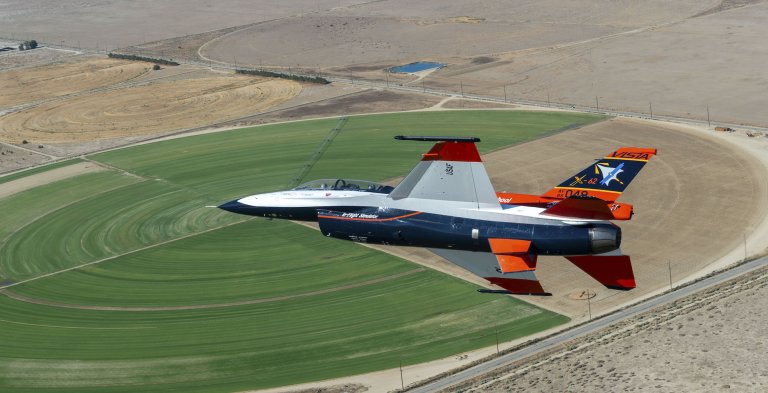
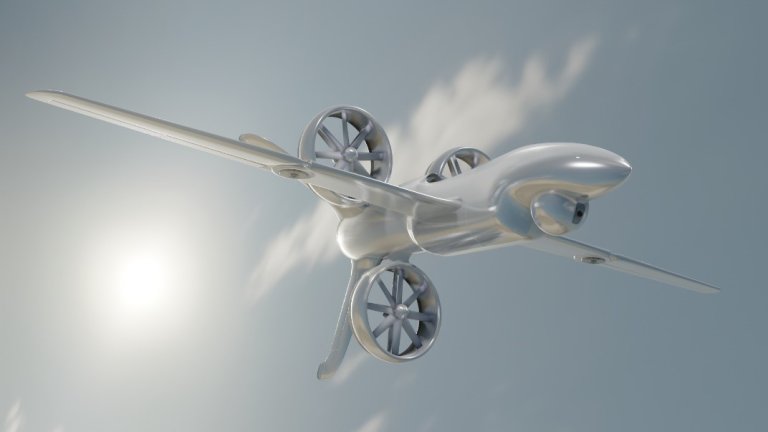
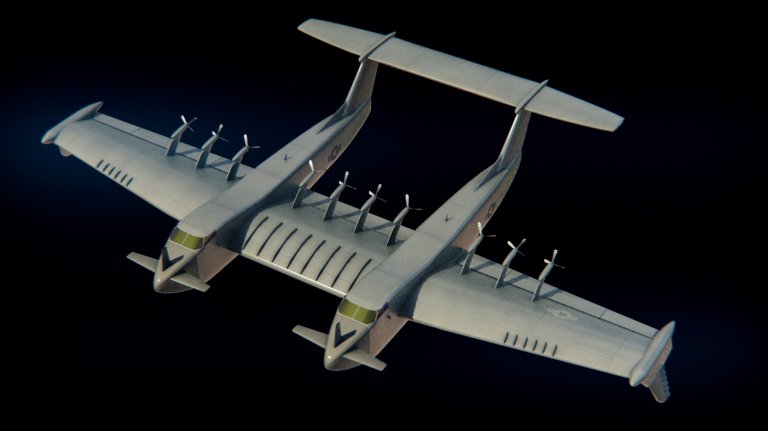
A flying car in mid-2015? There are no guarantees in the world of envelope-pushing, mind-bending military tech, but DARPA says both AAI and Lockheed Martin have produced “feasible designs” for its Transformer (TX) program, known more casually as the “flying Humvee” initiative. Both designs have moved to Phase 2, which requires them to begin work on prototypes for evaluation at the end of fiscal 2012.
This development also brings us a full phase closer to Phase 3, which is where things get really interesting: ground and flight demonstrations, slated for mid-fiscal 2015 should Phase 2 come off as planned. That’s just four years from right now. Given that we’ve been waiting for our cars to take flight for a century now, four years seems pretty reasonable by comparison.
You may recall from our relentless fawning over the Transformer program that the flying Humvee needn’t just be a roadable aircraft. Its design parameters call for a durable on- and off-road capable vehicle that can take small arms fire in stride and make a speedy shift from ground vehicle to vertical-takeoff-and-landing aircraft. It also needs to be easy enough to pilot that any grunt with a driver’s license can also grab the sticks of this new flying machine and be expected to pilot it safely (presumably with the help of autonomous computerized flight controls).So you’re looking at some design incongruities there. It needs to be light enough to lift off vertically under its own power, yet will require a serious power plant (weight) and some kind of wings and/or propellor/ducted fan (more weight). It also needs space for all this extra hardware while still maintaining passenger space for four soldiers (including driver).
Like most of DARPA’s challenges, bringing this one to life won’t be simple. But speaking to a conference recently, DARPA Transformer program manager Stephen Waller told attendees that “we are seeing feasible designs,” Aviation Week’s Ares blog reports. That’s promising. Let’s just hope these things can actually get off the ground.

[Ares]
Five amazing, clean technologies that will set us free, in this month's energy-focused issue. Also: how to build a better bomb detector, the robotic toys that are raising your children, a human catapult, the world's smallest arcade, and much more.


Online Content Director: Suzanne LaBarre | Email
Senior Editor: Paul Adams | Email
Associate Editor: Dan Nosowitz | Email
Assistant Editor: Colin Lecher | Email
Assistant Editor: Rose Pastore | Email
Contributing Writers:
Kelsey D. Atherton | Email
Francie Diep | Email
Shaunacy Ferro | Email
Arnold Schwarzenegger will probably will put this on his Christmas wish list, once it starts being produced. He bought his first Hummer in 1992.
Waste of money, time, effort, and anything else used to think up this ridiculous idea.
Chief! Get to the falcon!
they canned the idea b4 because it was a bad idea, thw wing would cause all sorts of problems when on the ground when a breeze comes up, plus the weight of all of the armor. what they need to to do is give up on a car plane. they could always make it into a helicopter.
As much as I would love a flying car, this still seems like a ridiculous idea for a military vehicle. You want a fast VTOL transport that can drop troops anywhere? Save the money you would have spent developing these and build more helicopters (or better yet, get those darn Ospreys to work reliably). You want a heavily-armored, high-speed vehicle for ground assaults? Save your money and build more Humvees. You want a lightly-armored, slow-moving monstrosity that costs more than either of the above options? Shell out the cash and build one of these things.
I know POPSCI has written many articles before on flying cars but just for a reminder there are already many flying car concepts out there.
Moller
Macro SkyRider X2R
Urban X-Hawk
LaBiche Aerospace FSC-1TM
Taylor Aerocar
Pal-V
Yes, I realize that DARPA wants a military design not one just for extracurricular activities.
I believe their are still progeny of the 1950s generation still alive that want so desperately for the flying car to take flight in this century for the sake of fulfilling a sci-fi prophesy of ill conception.
As stated by D13, the modular concept of the flying car we are all familiar with would have to work off anti-gravity based propulsion that would lift a non-aerodynamic (and heavy) frame such as an automobile into the air.
Other than that, the next closest thing short of vertical jets are turbofans. What comes out is a micro concoction too alien to be an aircraft but to small to be a conventional automobile (Popsci has had an issue or two concerning flying car concepts before and after the turn of the century).
Even if you could create the model flying car, operational traffic control would disasterously conflict with established air traffic control procedures performed by private, commercial, and government aircraft on a day to day basis in major metropolitan areas. For this such a device would be limited to flying at extremely low altitude not to conflict with aircraft that may be on approach to major airports. The complexity of establishing an aerial infrastructure for autmobiles is an unnecessary waist of time.
The airplane is a flying car. You just operate it differently. Otherwise they use the same powerplants and roll on inflated tires. Airports were created so that these "flying automobiles" could be properly sequenced and monitored for aerial transition.
The flying car won't work for our society because we don't live on Bespin or Coruscant. Like Q42 said, we have tools of necessity that already fit the needs of this creation. Proven technology of the most logical development from our limited advanced perspective (especially in the laws of physics).
The only way to revolutionize the helicopter and humvee is to create anti-grav repulsors that make wheels obsolete and allow the creation of aircraft that can operate like helicopters without the vulnerability of rotor blades that can be damaged in combat, or limit the level of access across multiple terrains.
@itadekimasu
That Moller M400 Skycar was talked about in a 99 or 2000 issue of Popsci magazine!
this is awesome and certainly not a waste of time money or effort!
You guys are killing me… obviously you’re missing the point. Why would a flying Humvee be beneficial? Because, for one, the vast majority of casualties in Iraq and Afghanistan have come from IEDs on the roadside… If it can fly then it only has to repel small arms (think AK47). The vehicle will be MUCH lighter as a result (currently armored Humvees are trying to repel grenades, IEDs, RPGs – and doing a very poor job). Furthermore, haven’t you seen the new ballistic tech they are coming out with? It doesn’t take much weight to repel and AK47 anymore.
But even with very limited flying capabilities, I could think of dozens of uses for this light raid vehicle: establishing a beachhead, forging a river, clearing a mine field/wall/crater/etc, avoiding dangerous stretches of road, quick surveillance, placing a heavy weapons system on a rooftop for tactical advantage, bounding over an ambush to exit the kill-zone, etc, etc.
You're not thinking outside of the box on this one, you're falling back on sci-fi crap. Think about current-day implications (and get those crappy artist renditions out of your head!)
Lastly, this is DARPA, remember what the "D" stands for, this is not meant for public use.
@8654
Every application you just listed has an efficient 20th to 21st Century style device (if not personnel) and/or process that is much cheaper and efficient than this concept. It is the pipe dream of some Baby boomer influenced engineer/scientist. No person in this day and age that really knows anything about how the world operates would advocate the use of something that would increase the operational cost of military forces.
We have manned and unmanned aircraft that can sufficiently evade and strike surface weaponry. Humvees may not be able to stop all bullets fired at it, but neither can battle armor, and kevlar vest have been around for longer than armored vehicles. Droids clear mines, walls, and craters.
Beachheads are established by existing efficient assets provided by naval forces such as amphibious boats and ships, and landing craft, to include helicopters and Ospreys which are also well suited for lifting heavy artillery for transport into theater.
The current methods of irrigation seem to work well without the necessity of aerial vehicles, so I reiterate that there are methods and devices in place for every implication of this technology you have listed. This is not out-of-the-box thinking. This is wishful thinking.
That sci-fi crap you mention is the reason the concept of the flying car exist. The modern day influence of sci-fi doesn't entirely have a place for the flying car when avian vehicles already exist. DARPA just needs to spend its money on making computers smarter so we might draw nearer to the singularity that obsoletes mankind in society.
They're going about it all wrong. If they want a VTOL capable ground vehicle they should just make a UAV that can is a very stripped down cargo/crane helicopter. Like those with the little spindly running gear that haul containers.
It could just grab a vehicle and go, drop off, and go back to base or carrier, or land in the vacenity for use later. Now you have a vehicle that can drive around and on short notice can either have a flying attachment fly to them and pick them up in the field or they can fly to where they need to go.
If it is a flop they can still pilotlessly fly cargo. I know I have seen pilotless cargo copters on here before.
@pheonix1012,
I disagree completely. Sure you have amphibious vehicles, but if you’re brining in Humvees you only have 2 options: LCACs or LCMs – which haven’t changed much since WWII. Besides, armored Humvees don’t play well in sand and good luck getting an LCAC up a fortified beach. Yes you have AmTracs and other amphib armor, but only so many and you know they’ll be putting Humvees on the beach.
And when a squad gets ambushed and they want to put a .50 cal or MRK19 on a roof, good luck since they are vehicle mounted (and nobody brings the tripod). Do you think they’ll call in a helicopter to lift the vehicle up? Perhaps the helicopter would come provide areal cover, well that doesn’t always work out – hence the recent Medal of Honor recipient… What I’m saying is if the vehicle could cruise up to a better vantage point, all the better.
Then there’s entering and exiting friendly lines and all the suicide bombers that love checkpoints. Well it sure would be nice to be able to just hop the wall into base and avoid all that.
Or, say you’re headed to Sadr City from the International Zone – would be nice to avoid those bridges/bottle necks and just hop the Tigris where you see fit. If you take a Helicopter, good luck finding a place to land it in a residential neighborhood. But even if you do, now you’re in the open, and that can be uncomfortable.
Yes, every application mentioned has an efficient device currently in use, but then why do they combine the M203 grenade launcher with the M4 rifle? Why do they make LAVs amphibious? Why do they make the Harrier VTOL? Because if you can add or combine capabilities it can give you a tactical advantage. I see a VTOL Humvee as a definite tactical advantage.
I could bring up scenarios all day, but suffice it to say that If made the right way (sans wings) there are plenty of practical applications for this technology.
And not to say DARPA is perfect, but it’s not like you just walk up to some “baby boomer” and say, “wouldn’t it be cool to develop a flying car?” and blam, you’ve got millions to run a muck with…
I think I have seen this before but where....http://youtu.be/rzv4q5EEy1k
Though I'm still highly skeptical of the concept in general, I have to agree with 8654 here. There is massive utility in consolidating systems in military operations (to a point), especially in a post-Iraq/Afghanistan military where we begin to shed some of our conflict specific weapon systems in favor of more versatile all-purpose ones.
We do have a number of highly specialized systems in the US military (MRAP comes to mind), but as 8654 points out, there are numerous examples where we have consolidated capabilities to provide a better broad-spectrum performance, perhaps at an increase in cost or detriment to efficiency at any one single function.
If you go out on wheels and you find you're operational scope changes to resemble something more suited for air transport, why not have a piece of hardware that can do both (if possible). Conversely, the fastest way to a location may be by air (usually is), or it may be the safest, but you may need ground transport through a portion of the route. Why double your logistical costs to bring in two systems (or possibly more if you need air transport and a bird to sling-load your ground transport).
Take the V-22 Osprey for instance. After a long line of issues and people looking at it and scratching their head, its starting to become a beloved (embellishment perhaps..) transport system. It doesn't fly as well as any fixed wing, and its not any better at being a helicopter, but it half-asses both enough to be a damned useful transport.
I would guess it would be easy to shoot down from the sky. Which makes it a bad idea as a military tool. Maybe as some kind of police tool it would be helpful.
@Grunt - Any particular reason it would be any easier to shoot down than, say, a helicopter? Not being critical, just genuinely wondering why you say that.
As someone said earlier, wipe the artist depiction out of your mind. That concept wont fly (Hah). Whats important, and what we wont likely get to see, is the FULL requirements document that DARPA produced that outlines what features and performance specifications must be met by a complete system in order to successfully win a production contract (not to be confused with an S&T/R&D or prototyping contract).
I would imagine (somewhat educated speculation) that the requirements will outline minimal ballistic protection, avoidance capabilities, countermeasures, etc., to minimize the risk of loss to ground fire. From what I can glean from various articles on the subject, these are in fact all in the requirements document. Cant actually find a copy of the solicitation though...
Regardless of whether or not we ever see these flying around Kabul (I like to think that perhaps they'll be flying around the states racking up flight hours by that time...), the price tag will, as is always the case with DARPA, be a drop in the bucket for defense spending, and will probably provide numerous advances that will inform some other weapon system you hadn't even thought of.
@8654
You just listed a bunch of operational scenarios for which with our current assets, a sound measure of military strategy while not completely alleviating the issues, dial them back significantly as to increase operational efficiency and overall strategic success.
Putting wings and rotor blades on a behicle that is already wider than a conventional aircraft will place the same limitations on the vehicle as any given helicopter. In which you would simply have a less versatile aircraft with extraneous developmental cost and little return on investment.
Consolidation of systems is efficient in military operations. Doesn't mean every technological fusion is a good idea. Something of greater operational efficiency than trying to turn a car into an aircraft (which for all intents and purpose is a helicopter or gyroplane; think about) would be a hovercraft. I don't mean hovercraft in the sense of the modern massive variants that float on air, but conventionally sized vehicles that would operate off anti-gravity fields useful for creating truly all-terrain vehicles. That way missions requiring land made vehicles that need to traverse treacherous terrain can be made more efficient and safe; especially if they can float over IED triggers. As well, missions requiring aircraft can be left to aircraft. It's all about mission necessity that determines the platform used.
@iambronco
As with the implication in my last few statements to 8654, You will not use two different modes of transporation to make a journey, and a flying car would not make things easier in that essence. Military operational planning and execution is based on intelligence, surveillance, and reconnaissance (ISR). The I pillar is where plans are generated from. In these plans, the best platform for a mission is chosen based on intelligence factors and operational necessity. If land vehicles will get the job done for a particular mission, aircraft might be deemed unnecessary unless an aerial escort is needed for extra convoy security (For this I reiterate that hovercraft would be a better evolution in the avian abilities of ground based vehicles as they would be suited to overcome the dangers of pressure sensitive terrestrial threats).
If an aircraft is needed for transport of products and personnel, then they will be used over ground based transports. Necessity is the mother of invention, and a gyroplane or helicopter the size of an armored surface vehicle capable of only carrying five to six people is not only operationally inefficient, but technologically backwards. The concept of the flying car (in military and civil applications) should be dropped until breakthroughs in physics are made that will allow the creation of vehicles that hover, not operate off the same aerodynamic principles of flight for which efficient devices already exist.
BTW, anything that operates by rotating on all three aerodynamic axes of flight utilizing airfoils, rudders, and elevator control will require aeronautical training to operate (i.e. pilot training). The concept of a hovercraft could be made to negate the concept of common flight through the manipulation of that "special field" for ascension and descension, leaving only the necessity for directional and longitudinal control. That is, a concept that is well suited for a primarily ground based vehicle.
This is stupid, their spending billions (or close to it) on this monstrosity that will take years to build and one RPG to destroy, pathetic DARPA. Why don't you make some pot hole filling robotic cars, or better yet, why dont you make a solar panel roof that everyone can afford. Im dissapointed my tax dollars are going to this Bologna!
@pheonix
It's not going to literally be a humvee... just similar in payload and operation I would imagine. The humvee part is just some media nonsense.
What would be nice if they just retrofit the flying compartment as a drop-off pick-up drone and the vehicle can drop off soldiers in their hum vee via rapid insertion and when they need to exist the area the drone and vehicle computer connect (presumably while moving forward) and lift soldiers up to be taken back to base or whatever.
Its well within the tech provided, a drone and vehicle made out of carbon fibre or nano carbon structure would be nice and durable too. But like the vehicle would only be able to take max 4 passengers.
Cough, Prime, see my first post? lol
@johnt007871
Regardless, its still a technological concept trying to be something that already exist. We have flying cars already. These military variants of flying automobiles are even suited for rugged terrain. This concept doesn't need to be developed. It's wastefully extravagant.
A more practicle but partially equal in wasteful extravagant way to improve on the design of ground based automobile would be to make the wheel obsolete by making them levitate a few inches to a few yards off the ground. That's more practicle.
Besides, why try to create flying cars when the majority of people are impartial to, hate, or fear flying? That's a bit of a societal oxymoron.
I read through everyones comments and found several persuasive arguments for both sides. What everyone failed to point out is the fact that DARPA is responsible for a lot of innovations in science. And while you may not see the immediate benefits of spending in this instance, there are undeniable benefits from scientific research. And I don't think anyone on this site can disagree with that.
@Dr_Pancakes
No I cannot. For all we know, this fruitless volley of a concept might revolutionize the aviation realm of powerlift category aircraft.
@ pheonix1012 : Actually, the ongoing escapades of the various Moller "prototypes" have been tracked and written up in Popsci and Popmech for 25 years or so. From what I could find out a year or two back when the subject came up with some of us on here, I found that Moller had received at least 20 million in cash investments; and possibly as much as another twenty mil from the U.S. government. As much as I've always wanted to see that company in particular succeed; I gotta say that I now think they are a very expensive pipe dream. I'd say outright scam, but some of their designs DID have real potential. As to this flying humvee thing; I think it's BS at this point. We aren't going to end up with anything better than the aircraft we have now, not at any price. At least for a few years.
@quasi44
Yeah, I remember thinking, "The flying car has finally arrived," when I saw that popsci issue that featured the M400. The car seemed to hover well. They just haven't done actual flight test or a hover test without a tether.
Personally I don't think the concept of a flying, or rather hovering automobile is not achieveable with todays technology (although like you said very expensive). It's just irrelevant.
Aerial vehicles already serve their most useful purpose, and the ratio of aircraft to automobiles worldwide is a testament to the mindset of people who want to fly and people who don't care to.
As far as having an alternative to being able to hop over ground based obstacles (like traffic), there is still the issue of air congestion. If one person thinks they can hop traffic by taking flight, everyone will want to do so. Then you have congestion on the ground and in the skies. What's more dangerous is that moving at speeds faster than what the normal human psychomotor skills are barely sufficient for handling will lead to multiple mid-air fatalities without proper levitating controls to control traffic.
Limits in altitude must be placed on vehicle operation because, even if an avian automobile could reach the heights of airplanes, motorists would cause all sorts of traffic problems for aviators and air traffic controllers in airspace surrounding an airport that lies just above the metropolitan areas people would use these vehicles in. Then, how else would you regulate the motion of air traffic at airports and within cities? Because the floating street sign concept is definitely no where near achieveable to the creation of a flying car.
Air Traffic Control facilities nationwide are already tasked to handle the millions of scheduled and unscheduled flights that buzz overhead by the minute. Adding every driver in the country to that system would be impossible to regulate.
The concept of the infrastructure necessary to regulate personally operated vehicles that fly (other than airplanes and helicopters) in a realm dominated by more efficient means of aerial travel stretches from the delusionally grandiose to the outright absurd.
Of course, with continued developments in science and technology together, aviation in the future will not look the same. Doesn't mean every person will own a vehicle that flies. In order for the flying car to be feasible, we'd have to live in a society existing on skyscrapers complexes that stretch for hundreds of miles in every direction and tens of thousands of feet in the air. Traffic that operates in the metroplexes could still be seperated from longer range air traffic and departing and arriving space traffic with altitude restriction based on aircraft design.
But that's a description of Coruscant from Star Wars, and we all know how scientifically feasible the techno-concepts are in that story.
I like how everyone is saying "blah blah physics needs anti grav wahh wahh."
We dont even fully understand gravity, let alone know it has an opposite (unless your talking dark energy)
SO SHUT UP
bjorn,
You use capitals in your sentences! You used punctuation! OH MY GOD! I can actually understand what you are saying! Of course you lost it the end.....
But, I feel we are progressing! This was a very good day!
Group, how do you feel about bjorns progress, good yes?
Let's all applaud bjorn for his use of punctuation!
GOOD JOB! WELL DONE!
I have a more feasible idea: a troop canon. A big gun that fires a big shell containing 1 soldier. The cannon would need to induce a small stabilizing spin to the shell so that the soldier is not killed by g forces. I haven't worked out the landing yet.
@Q
I'm just glad he didn't find a way to bring god into the conversation.
Congratulations! This IS progress!
I see ya flying 'round town with the girl I love
And I'm like F### You! (Woohoohoo!)
I guess my self tieing Nikes weren't enough
So I'm like F### you, and yo pink board too
If I had Mr. Fusion, I'd go Back to the Future
Now ain't that some S### (Ain't that some S###)
And, though theres air in my vest I still wish you the best,
And, uh F### you (Woohoohoohoooo!)
She don't love me, she loves my automobile;
cruisin all around, all above the town for thrills...
The one concept picks up on an old and reliable idea: the gyroplane. Not much advance engineering there. Think it might be a cheap remedy.
I believe this is a great idea however, it would be to vulnerable on take off and landing. I think DARPA needs to rethink a little bit.
I think the secrets of anti gravity will lay in the findings of what dark matter and dark energy are and how they work I mean they (They being some scientists) think it is effecting how the Universe is expanding in that it is speeding it up which points to it haveing a repulsive effect on "normal"matter which if harnessed would be anti-gravity Right?
this is a waste of metal.This will be a epic fail
Bullet proof flying cars with mounted machine guns? Now we are talking.
the helicopter design is going to fail but the lift fan design could be promising
machine guns aren't going to be effective while moving in a seemingly unstable platform
Though looking strange these could revolutionize ground warfare giving us and our allies an advantage over our enemies