
With London streets ablaze amid a rash of rioting last week, law enforcement turned to the social nature of the Internet and the images posted to photo sharing sites to try and identify people photographed committing crimes. But even given the instantaneous sharing power of the Web, London cops could only hope to catch perpetrators well after the fact. What if there was a way to search not only the Internet, but the entire universe of mobile phones themselves for images of a certain person or object in realtime?
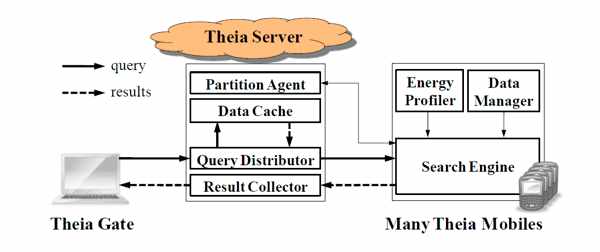
Researchers at Rice University claim in a recent paper that they’ve created just such a system. Called Theia, their phone searching scheme works via a voluntarily downloaded app that allows their search tools to access the photo libraries on participating phones. When a user submits a query–say for a particular face or a particular background–Theia directs the apps on all participating phones to begin searching their photo libraries for those query subjects.
To keep things efficient and avoid overloading phones, the search is two-tiered. First, Theia uses a set of broader search parameters to determine, wholesale, which pics might be worth a closer look (these parameters can include meta data associated with images as well as the images themselves). Images that are deemed worthy of a closer look are then uploaded to Theia’s servers and subjected to greater scrutiny. Theia users can specify a processing budget on their phones so the system doesn’t dominate their processing power and slow other functions.
The idea here, of course, is to enable realtime searching of the physical world via image data provided by the crowd. Say a child is abducted; Theia springs into action searching phones near the place where the child was last seen for images that may have inadvertently captured the child, allowing authorities to begin combing through crowdsourced evidence long before images get posted to Flickr or Facebook. If it finds a positive match, it can zero in on a geographic area by focusing on other searchable cell phones in the same general area. In some cases, Theia might even allow for realtime or near-realtime tracking of a person or object through the physical world via the images snapped by multiple different cell phones.
And all it requires is that you grant some faceless entity access to the data on your smartphone. What objections could you possibly have?
