Video: Ground-Based ‘Bots Swarm to Assemble a Landing Pad for Their Quadcopter Friend
We’ve seen plenty of quadcopters and plenty of follow-the-leader ‘bots, but this might be our first brush with follow-the-leader ‘bots...
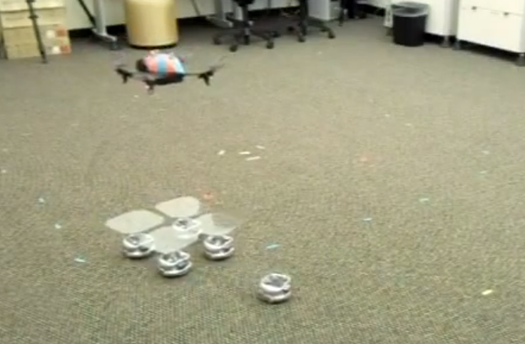
We’ve seen plenty of quadcopters and plenty of follow-the-leader ‘bots, but this might be our first brush with follow-the-leader ‘bots that work together to build a mobile landing pad for a quadcopter while it’s in flight. But that’s not even the coolest part about this robotic system from the Georgia Robotics and Intelligent Systems Lab.
The coolest part is that the robots on the ground aren’t actually communicating with each other. Rather, they are taking broad orders remotely but independently. For instance, the follower robots are commanded to arrange themselves in a box formation around the leader bot, but the followers don’t communicate with each other to make this happen. Rather, by knowing only the relative locations of their counterparts and the objective they are supposed to be achieving, they independently decide what action or role to take in order to achieve that objective.
In other words, they are problem solving as a team by “thinking” individually about the best way each ‘bot can contribute to the larger objective. And, as you can see in the video, they get it right–when commanded to arrange themselves into a tight square formation so the quadcopter can set down, they quickly move in to enable a successful landing. It’s like watching the future of robotic supply chain systems, military support technologies, and possibly even human transit (perhaps someday) unfolding on someone’s office floor.
