
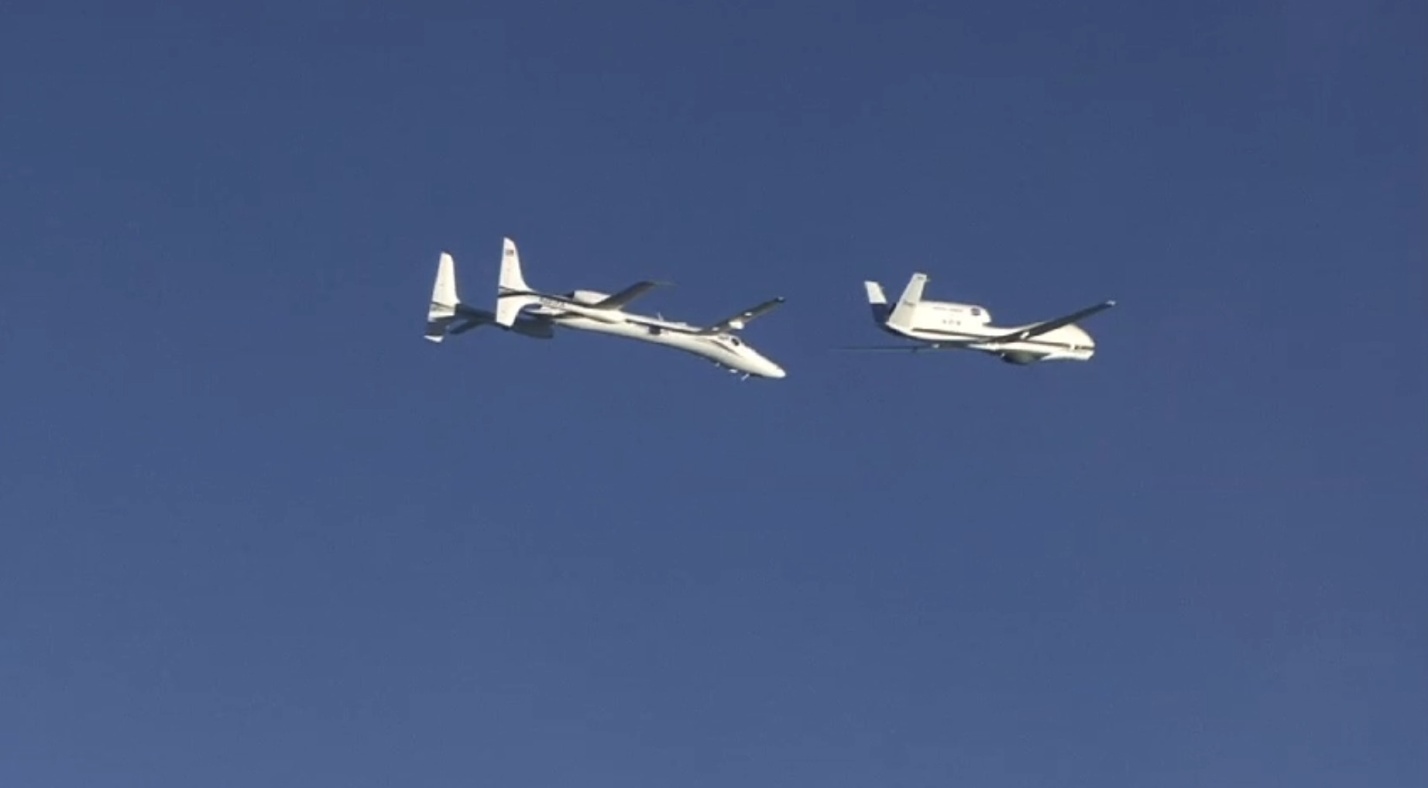
Autonomous Flight Formation A Northrop Grumman Proteus test aircraft approaches a NASA Global Hawk during a test flight. It was the closest two unmanned aircraft have ever flown together, a step toward autonomous refueling in the air. NASA Dryden Flight Research Center

In a recent test of autonomous in-flight refueling, two unmanned aircraft flew within 40 feet of each other at an altitude of 45,000 feet, an aviation record. A Northrop Grumman Proteus test aircraft crept up on a NASA Global Hawk, testing wake turbulence and engine performance in the stratosphere. The test is a step toward teams of drones flying in formation, for refueling or other purposes.

Autonomous aircraft offer plenty of benefits — they can fly long distances at high altitudes, they can take off and land by themselves, etc. — but they’re still not self-sufficient, requiring pit stops to refuel. This will change next year, when Northrop Grumman attempts to refuel two Global Hawk drones in flight, allowing for a week-long journey.

It’s part of a $33 million DARPA program called KQ-X, which seeks to prove autonomous refueling. A previous test used an F-18 as a surrogate unmanned aircraft to autonomously refuel from a 707 tanker. Next time, both planes will be drones.

With or without pilots, flying two high-altitude aircraft in close formation is a notable feat — engines perform differently at 45,000 feet than at lower altitudes. But when both airplanes are drones, it’s even more impressive.

There are plenty of reasons to fly a drone for a week at a time. Last fall, NASA used a Global Hawk to study hurricane formation, because the drones' 30-hour flight time offers a long window to collect data as hurricanes evolve. A whole week would be that much better. Long-term surveillance is obviously another application.

Watch the airplanes' dance in this video.

[via Northrop Grumman]

4 Comments

Unless there has been an unannounced change in how it operates, Proteus is not unmanned. There is normally a pilot and copilot aboard. Northrop-Grumman's press release indicates that a joint flight with two autonomous drones will be a future test.

Hatcat is correct...the Proteus is normally a manned aircraft.

So unless they modified the Proteus, then there's a pilot in there (although, it looks to be REALLY cramped inside the tiny cockpit).

Hmmm, I see where you could get that. The first paragraph of the release said, "...took a major step toward demonstrating autonomous aerial refueling between two unmanned, high altitude aircraft..." which refers to a future capability. The second paragraph should have said, "In a key risk reduction flight test, Northrop Grumman's MANNED Proteus test aircraft and aN UNMANNED NASA Global Hawk flew as close as 40 feet apart at an altitude of 45,000 feet..." Still, the video is pretty cool.

While I realize Northrop Grumman now owns Scaled Composites. Proteus was designed and built entirely by Scaled Composites before Northrop Grumman's acquisition.


June 2013: American Energy Independence

Five amazing, clean technologies that will set us free, in this month's energy-focused issue. Also: how to build a better bomb detector, the robotic toys that are raising your children, a human catapult, the world's smallest arcade, and much more.


Online Content Director: Suzanne LaBarre | Email
Senior Editor: Paul Adams | Email
Associate Editor: Dan Nosowitz | Email
Assistant Editor: Colin Lecher | Email
Assistant Editor: Rose Pastore | Email

Contributing Writers:
Rebecca Boyle | Email
Kelsey D. Atherton | Email
Francie Diep | Email
Shaunacy Ferro | Email

circ-top-header.gif
circ-cover.gif