
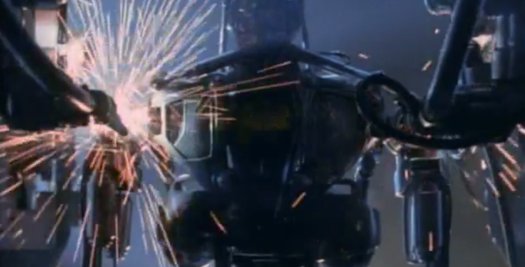
It’s one thing for humans to make robots, but the idea of robots making robots tends to conjure all those sci-fi scenarios wherein Arnold Schwarzenegger or Keanu Reeves have to save what’s left of humanity. Nonetheless, the U.S. military presses on. According to this proposal, as Danger Room points out, the Navy is pursuing technologies that would allow swarms of semi-autonomous ‘bots to interact, team up, and manufacture things via 3-D printing tech.
In other words, the Navy wants robots that can make, among other things, more robots. And it wants to give the robots the capability to do it quickly wherever they are operating, via rapid prototyping machines that can churn out parts assembly line style in a variety of materials, including “multi-functional materials, programmable materials, metamorphic materials, extreme materials, heterogeneous materials, synthetic materials, etc.”
As DangerRoom notes, things like “programmable” and “metamorphic” materials are very SkyNet indeed, but it what the Navy is really looking for from its robots is increased flexibility. According to the proposal:Each micro-robot would perform a specific task, often a single rudimentary task, repeatedly. Collectively, these tasks would be choreographed in purposeful activities for manufacturing. A micro-robot swarm should be able to perform material synthesis and component assembly, concurrently. The micro-robots could be designed to perform basic operations such as pick and place, dispense liquids, print inks, remove material, join components, etc. These micro-robots should be able to move cooperatively within a workspace to achieve highly efficient synthesis and assembly.
Such a self-contained robotic factory could be extremely useful aboard the Navy’s floating fortresses, for instance, allowing crippled vessels to manufacture critical parts to repair themselves or their constituents (like on-board aircraft) at sea or for the creation of mission-specific hardware on-demand, cutting down on the reliance on lengthy maritime supply chains.
But we should probably ready the electromagnetic pulse weapons. You know, just in case.
[DoD via Danger Room]

Five amazing, clean technologies that will set us free, in this month's energy-focused issue. Also: how to build a better bomb detector, the robotic toys that are raising your children, a human catapult, the world's smallest arcade, and much more.


Online Content Director: Suzanne LaBarre | Email
Senior Editor: Paul Adams | Email
Associate Editor: Dan Nosowitz | Email
Assistant Editor: Colin Lecher | Email
Assistant Editor: Rose Pastore | Email
Contributing Writers:
Kelsey D. Atherton | Email
Francie Diep | Email
Shaunacy Ferro | Email
great
It would be cool if they could "tear down" old parts and recycle them into new ones. Otherwise the ship would still depend on supply chains delivering the raw materials needed to build the robots/parts.
@B.V.
I think the idea is that they could have enough material to manufacture a set amount (say 10 tons) of parts. If you can manufacture them then its 10 tons of parts you need, even parts that don't brake very often. Currently they have tons of parts but they don't carry parts for everything so you end up needing some that you don't carry and running out of the ones, that you didn't carry enough of to supply the demand. The idea isn't to get rid of the supply chain altogether, just to make it so you can take time to get it. Instead of saying "a part broke and we need it right away", it can be more like "we are running low on resin and synthetic material #3 we will need a resupply within 2 weeks."
I, for one, welcome our new machine overlords.
According to the Catalog of human population any person is a bio-robot and has a program and 3 manipulation modes. This allows to get complete power over a person without dependence from his will as translation of manipulation modes does not get registered by intellect and consciousness of the receiver.
Replicators! (Stargate)
NASA, DARPA, NAVY... Everyone wants to build smart robots. Maybe it's time to establish robotic service branch of the United States Armed Forces?
Was thinking... You know, all these little robots are going to be really difficult to feed/power. Solution: tesla coil. A sufficiently sized coil could pump enough into the air that a few thousand of these things could work seemlessly without worrying about having to feed or recharge.
Just a thought...
Hey great! Once we have military machines that can build themselves, we won't need defense corporations anymore. Defense corporation stock will plunge to zero and their CEOs and shareholders will go broke and politicians will stop receiving bribes from defense industry lobbyists. Without political pressure in its favor, the defense budget will have much-needed massive cuts, and then most of the generals can go home too.
Sounds like a plan . . . that just got round-filed.
you all miss the big picture here...one of the necessary components for robots/AI to not need us would be their ability to breed...one more step towards our end
I once heard about a machine like this. except it is a space craft, or space probe. It is theorized that any intelligent species would inevitably one day create a device like this. I believe it was Van Braun (sp?).
Some people have used the idea of a "Van Braun Machine" to claim there is no life outside of earth. The theory is that to effectively explore the universe we would have to deploy van braun machines. A space probe is sent out into space that maps and explores what ever it comes across. the probe is also given the ability to use materials it finds to create more probes. those probes are then sent out in different directions. this process continues until you have millions of probes replicating and exploring the universe. Some believe it so logic an idea than any at some point any intelligent species would or will attempt this. BUT this means that the universe SHOULD be teaming with van braun machines.
anyway. its a cool idea. but the idea of sending a self replicating space probe does indeed sound like a novel idea and would speed up space exploration considerably.
@B.V. I am sorry if I spelled something wrong or messed up my grammar somewhere.
Here is the scariest thing I've heard on tv in the last year about robot take over--what if robots determined that rust was a major problem(for them) and eliminated oxygen?(causing a major problem for us!)
You beat me to it BillyBlackhawk :o) I was thinking replicators too!
The Dome Diva
All the world is a stage and I get to play with it.
i have to agree with TheDomeDiva and BillyBlackhawk...only thing left for the Replicators to become possible is the ability to alter their programs and be able to change themselves to better suit the conditions that they are in...oh wait, we basically have that now
Interesting......lets see here, micro indicates extremely small perhaps even microscopic. I can see possibilities for these guys in the medical field. we could send in a cluster to locate malicious cells and then deliver meds only to the affected cells. This could be a viable way to correct internal damage without invasive surgery. The problem I see is that if they are given the ability to replicate, they could cause some real damage and death while inside a body. Amazing technology, but a bit scarey as well. what are we supposed to do when they no longer need a human input to tell them what to do?