
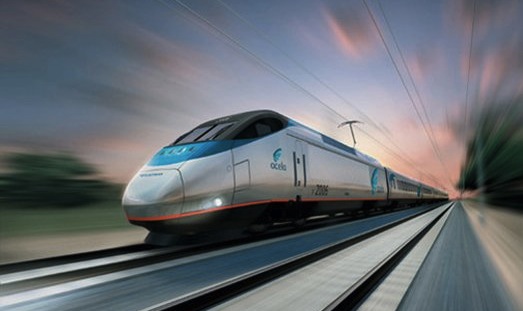
A few weeks ago, a train glided out of a station in Hangzhou, China, bound for Shanghai some 125 miles to the northeast. It arrived less than an hour later, cutting the usual commute time in half. Some trains on the line average 220 miles per hour, making it the fastest daily train in the world.
A month before the Hangzhou-Shanghai line was anointed, Amtrak rolled out its own grand vision for the future of high-speed rail in America: an upgrade that will increase average speeds between Boston and D.C. to 148 miles per hour – just two-thirds the speed of China’s new line – and not until 2040.
Questioning why America is so far behind Europe, China, and Japan in passenger rail technology is a pastime among high-speed advocates, but it’s not really productive. There are more important, forward-looking questions that need asking: Will true high-speed rail even work in America, and if so are we deploying it in the smartest ways possible?
The answers, respectively, are “maybe,” and “probably not.” There probably are places where trains topping 200 miles per hour make sense, but those places are not leading the national conversation. Instead, the northeast corridor – the largest passenger rail market in the nation – has taken center stage even though there are few places in America more ill suited for super-fast surface trains.“Amtrak is going to set its sights first on the northeast because that’s its cash cow, but where the Federal Railroad Administration could really help out is taking rail to the next level in other parts of the country,” says Dr. Leslie McCarthy, an assistant professor of civil and environmental engineering at Villanova who works closely with the Transportation Research Board.
Why not make the densely packed, train-savvy northeast corridor the model for blistering fast next-gen American rail? There are a variety of reasons – history, politics, unchecked urban sprawl – but simply put, it’s not practical. America suffers from something of a high-speed rail quandary, in which the places that want true high-speed rail the most can’t have it and the places where it’s most feasible can’t support it.
Unlike Europe and Asia, where the dividing line between urban and rural is far more defined, the northeast corridor is the definition of urban sprawl, with populated cities separated by endless suburbs and smaller burgs that all want access to the train. To bullet trains, sprawl is anathema.
“The very high speeds that China is achieving can be obtained only if you space the stations far apart because it takes time to accelerate and decelerate the trains,” says Ken Orski, a career urban transit expert who served in the Nixon and Ford administrations and is now publisher of Innovation NewsBriefs, a widely read transportation policy newsletter. “If you space those stations very closely you lose the technological advantage of high speed.”
Basic physics and human physiology dictate the limits to how fast a train can gather speed or slow down. The intercity distances – from Washington to Baltimore, Baltimore to Wilmington, Wilmington to Philadelphia, Philadelphia Newark and on to NYC and so on – are all short hauls, too abbreviated to take advantage of bullet trains’ top speeds. That’s not even taking into account all the street crossings, which hinder both automobile and train traffic along the route. Take all that into consideration, and 150 miles per hour is probably about as fast as northeast corridor trains can hope for.
Therein lies the aforementioned quandary: In the northeast corridor, there is enough demand to support an investment in next-gen high-speed rail, but bullet trains simply aren’t practical there. And, as Dr. David Levinson, associate professor of transportation engineering at the University of Minnesota, points out, in more wide-open places like the Midwest where true, 200-plus miles per hour high-speed trains have room to run, populations often aren’t dense enough to justify the trains. “The cost side of this is very high,” Levinson says. “And outside of the northeast corridor and a few other places, the benefits are relatively low, so there are limited places where you have enough demand to support passenger service.”
Of course, if Amtrak really wants to roll out China-magnitude trains in the northeast it could simply eliminate stops between major cities. But where trains go and where trains stop is a political issue, and nothing is so effective a destroyer of a potential public good as politics. High-speed rail tends to enjoy hot-button-issue status in the places where it’s an issue at all. In other places, it’s not even on the political radar.
“Fifty or 60 years ago, Eisenhower knew the value of the Interstate highway system,” says Jose Holguin-Veras, a civil and environmental engineering professor at Rensselaer Polytechnic Institute. “All the governors were clamoring for it. Who is speaking about this? There are some governors, there are some senators, but it’s not an agenda item.”
Where it is on the agenda, it’s often a divisive issue at every level. Local officials are happy to get on board as long as their constituencies – regardless of size or significance – get access to the rails by way of a train-slowing station stop. Then there’s politics at the state level, where attitudes shift with the election cycle. For instance, both Wisconsin and Ohio had aggressive plans to improve passenger rail prior to the recent gubernatorial elections; now, new governors in those states have vowed to scrub the costly projects.
But the money comes from the federal level, and that’s where American democratic politics introduce obstacles that centralized countries like China don’t have to deal with. “It’s hard to get national support for a localized system,” Levinson explains. “In order to get national support you have to build stuff everywhere, which dissipates all the benefits you might get if you did just one good thing.”
To build the northeast corridor to Amtrak’s vision would cost roughly $400 for every person in the United States, the vast majority of whom would never ride the train. It’s difficult to sell that kind of spending in Congress. Levinson opposes the deployment of high-speed rail in the U.S. for exactly this reason: the costs are astronomically high and the benefits relatively low for most people. To him, spending tens of billion of dollars chasing the last century’s technology simply doesn’t make sense.
“Look, in 2040 – as other readers of your magazine know – we’ll have cars that drive themselves,” he says. “It’s not merely that you’re building 2010 technology in 2040, it’s that you’re building 1960 technology in 2040. There’s no reason to be spending money on 80-year-old technology.”
It’s a valid point. At the current pace of innovation, technological improvements in automobiles and aircraft – or trains, for that matter – may leapfrog wheel-on-rail train tech completely, easing congestion and moving people more efficiently without laying an inch of track.
But not everyone shares that argument.
“Let’s say in the next 30 years we really take our technology to the next level and cut our congestion in half,” McCarthy says. “We’re still looking at some real inefficiency on our highways.” She sees potential for bullet trains in places like the Midwest where intercity rail can be competitive with both driving and short-haul flights. Rensselaer’s Holguin-Veras agrees, citing air traffic congestion on top of highway inefficiencies.
“From an economic point of view, it doesn’t make any sense to use air for all these short trips,” he says. “The demand for these short trips is very, very high, and if you crowd the airports with all these short flights, airports must continue to expand. Over short distances, high-speed rail can move thousands of people in one shot.”
Orski, approaching the issue with his years of government experience in transit policy, takes a less-optimistic stance regarding high-speed rail’s real value to America. “You’ve got to find the proper kind of situation,” he says. “You need to find cities that are not too closely situated but also cities that are large enough to provide the ridership to make it an economic venture. There aren’t a lot of places like that in America.”
The consensus seems to be that real, 200-plus-miles-per-hour high-speed rail is within reach in America, but only in situations where the distance, population density, demand, and dollar signs all line up like some kind of rare astronomical event. Those situations are far fewer that one might guess by looking at the number of rail projects seeking federal funding.
If America really wants to see super-fast passenger trains connecting its cities within a generation, it needs to be both realistic and efficient – find those few places where laying dedicated, high-speed track is economically viable and concentrate its billions there. Otherwise, the lackluster northeast corridor plan will remain the height of America’s rail ambitions, rolling out 20th century tech while the rest of the world goes screaming past.

Five amazing, clean technologies that will set us free, in this month's energy-focused issue. Also: how to build a better bomb detector, the robotic toys that are raising your children, a human catapult, the world's smallest arcade, and much more.


Online Content Director: Suzanne LaBarre | Email
Senior Editor: Paul Adams | Email
Associate Editor: Dan Nosowitz | Email
Assistant Editor: Colin Lecher | Email
Assistant Editor: Rose Pastore | Email
Contributing Writers:
Rebecca Boyle | Email
Kelsey D. Atherton | Email
Francie Diep | Email
Shaunacy Ferro | Email
It makes far more sense to use electric cars for all commuting period.
As technology advances such as eStor's ultracapacitor, it will make possible the swapping of batteries in 5 minutes which is just as fast as gassing up. And they will have 300 plus mile ranges which they hold more charge, never wear out, discharge quicker, charger far quicker, and are lighter and smaller than Lithium Ion batteries.
Ultra Caps are the way of the future.
Trains are for FREIGHT and sightseers on specialty runs through the mountains, etc.
*D Ace Lee*____Bobcat ftw____
could someone tell me how the bookmark thing works?...
Chicago to St. Louis?
Ohio was the perfect state for a project like this. According to all the data I saw, The corridor from Cleveland to Cincinnati going through Columbus and Dayton was the most populated corridor that was serviced by no passenger train. We had $400 million committed by the government and our previous governor was pushing for it hard, even had plans of laying high speed track right off the bat instead of having to upgrade later.
Alas, the incoming governor recently called to cancel all of these plans. It really makes me sad and annoyed that the people couldn't see the benefits it would bring our area (I'm from Dayton specifically) and didn't go out and vote for the one who would move our economy forward.
@ Coolhand032
What really makes me made was that Kacish wanted at first to return the 400 mill to help offset the deficit, which i thought was under-stable and made sense but now instead of returning it and not using it on the high speed rail he wants to spend it on road construction... grrrr I believe that high speed rail wont be happing anytime soon :(
Modern, energy efficient passenger rail travel is politically obstructed by industries who benefit by keeping the American consumer shackled to the convenience store gasoline pump.
For passenger rail to become competitively successful, politicians obstructing their construction must be thrown out of office.
I don't think it'll ever happen. The short-sighted voting public will never want to pay for something, regardless its future benefits.
@gizmowiz,
Good point, though I think there's room for both technologies. Electric car is more suited for shorter distances - not because of battery limitations, as you pointed out, and I agree with you - but because I wouldn't travel 800 miles on a whim in a car, but I would travel 800 miles on a whim via a high speed rail.
We also don't have ultracapacitors applied to cars for comparison here. There are great *potential* benefits.
And trains are still more efficient per person, flat out.
Trains are a more efficient mover, but face it, this is America. Why does it seem like all the libs want to make America like Europe and Asia? We're not, we like to travel in cars. Its convenient: we can leave when we want to, we can stop when and where we want to. Want to stop at Denny's for breakfast? Want to stop at Saltgrass for lunch? Want to stop at that beautiful park over there? Don't want to stop at all? We like the freedom of choice more than the perks of a quick travel. I would drive a car over flying any day (especially now!)
I've ridden the bullet trains in Japan, and they are nice. But their freeway infrastructure there is really made for quick (or cheap) travel, rail was the best option. However I didn't really get to enjoy the landscape that much flying through it at 160+ MPH. Plus there wasn't anything good to eat on the train.
@gizmowiz
Electric cars are a great concept...unfortunately we have not perfected the system of getting the electricity in the first place. Therefore, the carbon cost of energizing all of these electric cars via coal power plans and inefficient alternative energies isn't much better than just using gas at this juncture. Which would mean that public transit is still the most effective way to cut carbon costs for per person transfer.
My suggestion for short transit - Ride a bike and request a shower be installed at your work.
Most people do not spend their time driving for "convenience."
I drive a minimum of two times a day: once to go to work, once to come home. Sometimes I drive to go to the store, or to meet up with friends.
On neither occasion do I think:
"Hmm, today I think I'll leave for work at 11:00 AM instead of 7:45 because as a driver of a car I get to decide when I want to leave instead of having to follow a train schedule."
"Hmm, perhaps I'll stop at this beautiful park before going to work since as a car driver I can pause my trips whenever I feel like it with disregard to my other obligations and schedules."
"Hmm, perhaps I'll just go spend half and hour at Denny's before going to work today since as a car driver I apparently have the ability to pause time itself and do whatever I want, whenever I want!"
The "convenience" argument is complete B.S. because it is not applicable in most situations. People who live in satellite cities and have to commute hours to work do NOT enjoy any of those "benefits" to driving that you mention.
The only time it WOULD be applicable is when one goes on a long trip, like when I have to drive two and a half hours to see my family who lives 150 miles away...
But, guess what? If I could take a 160mph train those 150 miles it wouldn't take 2.5 hours to traverse and I wouldn't have to pull over to get gas, or take a leak, or get a snack, because I just just sit on the train and watch a TV show on my laptop, read a book, or do some work instead of clenching a steering wheel in my hands and staring at the traffic in front of me like some brain-dead zombie.
Only those who do not value their time and have never had to sit around in bumper to bumper traffic for HOURS would think that cars are "convenient" and all residents in the U.S. prefer them to all other alternatives.
Why are you people debating cars vs trains again? Does such controversy exist? Is this some new liberal vs conservative issue that I'm not aware of?
Like B.V. said, trains can provide a quick and predictable route for routine travel. For our daily obligations, such as work and school, trains can provide a faster and easier commute. They also help ease the congestion and is environmentally friendly. We will still have our roads and our cars for other situations. The only difference is that trains will provide MORE choice, and help solve several transportation issues.
Whoa! I have seen this train in Microsoft Train Simulator. I can manage to get it up to 160 mph, but when I slow it down to 0, I can never restart it.
Two points:
1) Rail only works profitably when lots of people are going from the same place to the same place (along a line or spoke). The fewer people you have going to where the train goes, the smaller an efficient train should to be, until you eventually reach a train size of one person---the automobile. Because U.S. cities don't have the population density of London, New York, and Bejing, U.S. transit systems lose millions of tax-payer dollars each year. It's okay to say they are losing money but you still want them, but recognize the costs when you argue based on the environment, energy efficiency, or your childhood love of toy trains.
2) High-speed rail competes with airlines and roads. This seems obvious, but do you really want to fund two state-of-the-art systems that compete with each other? If we are already funding roads, why fund trains too? If you think shifting the focus entirely to trains is worthwhile, argue that. But address whether we really want to pay twice for transportation.
Should say "Because MOST U.S. cities don't have the population density of London, New York, and Bejing...." NY is in the U.S.
The key problem with high-speed trains in America is that they are just way too expensive. No company in America can come up with the 120 Billion dollars necessary to build one, and I personally do not believe that it is the role of the government to pay for such a thing (It is not the role of the government to provide luxury services that serve only niche markets). If the construction costs of a well-placed high speed train line could come down to a level that a commercial business could do it without any government support, then it would be great. But until then, I don't support it.
@woolsocks - The present rail system is ancient and this is the perfect situation where a hand from the government is welcomed. I'm all for private companies stepping up and taking on this project, but the problem is that you need government involvement to cross a street let alone a whole country. Travel by rail is a heck of a lot more practical than air travel. Especially when it comes to getting groped and stranded at the at the airport for hours. If I was given a choice to fly or ride the rail, I'd ride the rail 9 out of 10 times, cost is not factor (although it's a heck of a lot cheaper).
I think the bullet trains would work well connecting the western states like AZ and Cali and such the east coast just needs to replace their trains that have been running forever, New York is practically falling apart the city is so old and not being kept up like it should.
@Igot1forya
Rail tickers aren't cheaper. Picked two cities at random for this, Frankfurt to Rome, two weeks out:
High-speed rail (lowest class): $375
Airfare (Ryanair): 38 euros
I'll just wait until we can just teleport across the planet via Asgard beaming tech.
@paulcrosoft: there is no actual high speed rail between the cities you chose. It's not like Europe has a 100% high speed rail yet.
Sure as a rail/train operator it is not economically viable everywhere and requires tough choices on choosing stations where you should stop.
But high speed rail is still better than car or plane for many journeys as a consumer.
e.g. The journey from my home in London to my parents in Liege, Belgium (approx 300 miles and a sea-crossing in the middle) takes me around 3 hours from my office to their front door. All for €79 if I plan ahead. It beats going to a godforsaken airport far outside London where low-cost companies fly from. And enduring endless check-in, security checks, staring at conveyor belts, cramped seats, arriving at other godforsaken airport to find a taxi to the city centre. Driving would take 6 hours.
Same for my uncle's daily commute from Brussels to Paris (1h30min) on Thalys. You can't beat this by car or plane, even considering his taxi to the station each morning. And then there is parking in most major cities; it's not cheap.
I love driving, and would still choose driving over rail whenever the journey ahead looks enjoyable, or where the car is an absolute necessity on arrival. But apart from some weekends away I can't think of any reason.
Planes are great for long distances, but I believe high speed train beats them hands down for short/medium haul if you factor all the time lost getting on and off a plane.
Trains and plains are on a broken cycle in the US. They loose money and the government steps in so that they stay afloat.
These companies could increase prices, reduce services, and find a balance that would keep them in buisness competitively.
Rather than allowing that to happen, the government steps in to preserve their inefficiencies and keep their prices contained.
This is the equivalent of raising ticket prices - the only difference is that the increase is split between the non-participants and the participants. This lowers the cost for users, while increasing the cost for non-users (punishing those who do not or seldom fly or use trains and rewarding those who regularly do).
Of all the train tickets I've ever priced out, it was always cheaper (and faster) to fly.
I love trains. I grew up near a rail. I built models. But in reality, I don't see this high speed rail thing going anywhere. At least not on a large scale.
I live in the northeast. I can drive to Boston or NYC within 2 hours. While a HSR might be good between those two locations, it certainly doesn't help me. I'd be happy with just extending the cheap commuter rail. I wouldn't mind taking a few more minutes to get there if I could read during the trip.
And let's expand freight rail. Get more of those big rigs off the road.
Let's imagine a high-speed rail network existed in the US today. Would there be x-rays and gropings in the train station?
The medium-haul routes make the most sense in the west, because there's not much to stop for between Los Angeles and Las Vegas or Phoenix. The LA-Vegas trip is perhaps the best example; there the train competes with 6 hours by bus, 4 hours by car, or 3 hours by air (assuming 90 minutes in the departing airport, an hour flight, and 30 minutes on the far end). A train averaging 150 miles per hour could get there in two hours, but start tacking on some arduous boarding procedure and people will just drive themselves. Add on a car rental at the destination and the economy disappears too.
these are just a bunch of excuses not having speed rail on long or short distance rides because you can go underground, upground, high static or hanging speed train developed in Germany. The actual traffic situation in the USA is state of the art corruption, just make questions deep enough folks. Acceleration can go 1/2 g without a problem as long as everybody does sit in those trains, they can be in a tube, they can use magnetic propulsion and NON of them got to be a polutor not even of noise. Non of this is science fiction and does exist, does work and even the start up massive finance is back in no time, counting the environment repairs of heavy traffic. Dr. Horst G Ludwig developed even a over night merchant retail system in the electric motor driven system of hanging speed trains (220 mph) and all goods are distributed over night across urban concentrations. No more traffic jam, stinky, noisy billion dolar business of those whom killed the US economy and growth. Well, better shoot ourselves in the head instead of analyzing idiocracy, or was it democracy.
good news,there's Fashionable.
☆ ☆
╭⌒╭⌒ ★ ╮╭⌒╮~╭⌒
☆ ╭⌒╮ ╭⌒
our websit: ★∴ ☆
☆ ( http://www.shoppinglove.org )
accept paypal╭⌒╮⌒╮★∵╭⌒ ★∴ ☆
╱◥██◣ ☆
|田|田田│ ☆Free Shipping ★
╬╬╬╬╬╬╬╬╬╬╬
( http://www.shoppinglove.org)
fghgfhryrtyty