
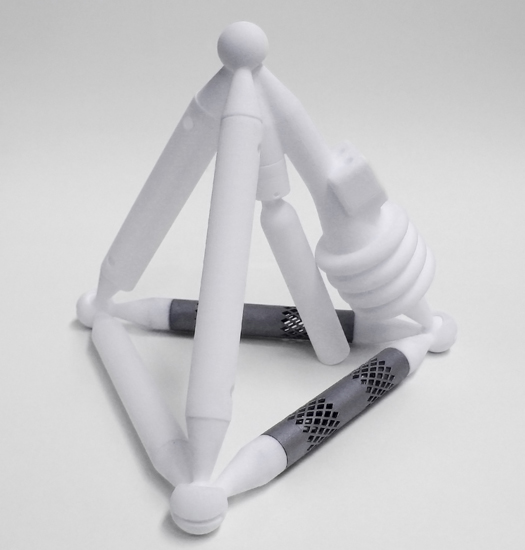
Genetic Robots Consisting of cylindrical tubes and ball-and-socket joints, Fraunhofer's Genetic Robots can be constructed by other robots to perform tasks based on a range of external factors. Fraunhofer IPA

In sci-fi lore, one of the great qualifying events leading up to the eventual war with and enslavement by our machines is the moment when robots begin replicating – that is, they begin manufacturing themselves without help from humans. If that’s the case, then the latest news out of the Fraunhofer Institute should be particularly discomforting. Researchers there have created so-called genetic robots that are created fully automatically from a genetic software algorithm and a 3-D printer, no human intervention necessary.

The notion of genetic robots certainly isn’t new, but the Fraunhofer team has reached a milestone by creating a computer algorithm that can take into account environmental factors, physical laws, the task at hand, and other external characteristics to design -– from scratch – a robot for the job. Using additive manufacturing (3-D printing), the algorithm can design a multitude of possible robots for a job and select the one it thinks is best, all from a few inputs either from a human or from another computer program.

Right now, those inputs and the robots are fairly simple – “build a robot that can efficiently move across this level surface,” for instance – resulting in ‘bots consisting of cylinder-shaped tubes, ball-and-socket-joints, and tiny actuators that drive them. But as they become more sophisticated, it’s not a stretch to think that factories, homes, and (dare we say it?) militaries might be able to design task-specific, on demand robots.

So what’s so “genetic” about these robots? The software takes into account the kinds of tasks and environmental factors a particular robot will face – like whether it will travel over solid ground, swim in water, climb stairs, etc. – but because it can design several possible outcomes from a given set of inputs the results vary, much as they do in the biological world. “The algorithm often spits out surprising variations – ‘mutations’ that would not necessarily have occurred to the designer,” says Fraunhofer industrial designer and product developer Andreas Fischer in a press release.

So these ‘bots can mutate over time, traverse land, AND swim in the water? Clearly the Fraunhofer team hasn’t seen Terminator: Salvation.

7 Comments

Well, we're screwed

Anyone else feel slightly dirty about watching one robot "create" another one?

Sorry, @ Clay Dillow for reducing an interesting article about a potentially useful idea down to the concept of robot porn.

iRobot

well that's one step closer to von neumann machines! oh boy!

This was ten years back,they are still there...??
thats lame.....
════════════════════════════════════════════════════════════
why, mr. Anderson, why, why do you persist?
Because I Choose To...
Regards
════════════════════════════════════════════════════════════

oh yeah i saw this in a book... FROM OVER 15 YEARS AGO
lol

We are robots and it is the next step in our evolution. Our genetic code is just code. We are comprised of materials combined in such a way, that we function successfully. Our offspring robots will be the next evolution of that code, where we take the step from random code blocks being thrown together and genetic defects being introduced from generation to generation, to a point where we program the DNA ourselves to create the purpose built, next generation human. Whether the material is a collection of cells, or mostly alloys, or a combination of both, is irrelevant. What is important is that humanity will soon have the full capability of determining future stages of human evolution, instead of leaving it to environmental conditions on Earth's surface.

Just think of humans with titanium endoskeletons, can breathe underwater, absorb CO2, like plants and have a photosynthetic skin to absorb energy?

How about colonizing Mars with humans designed to live in low G, thin air atmosphere's that consume chemicals from the atmosphere that would kill humans on earth?

Man is a robot and robots are our legacy. We are Borg. We just don't have an agenda to assimilate other species and why would we? That's so inefficient. Just reprogram human robots with the required characteristics.

Man can be that alien species that travels across the universe to explore other planets and their life forms.

And you think all the above is pure fiction. It's more a prediction. Almost an inevitability. And it's nothing to fear.


June 2013: American Energy Independence

Five amazing, clean technologies that will set us free, in this month's energy-focused issue. Also: how to build a better bomb detector, the robotic toys that are raising your children, a human catapult, the world's smallest arcade, and much more.


Online Content Director: Suzanne LaBarre | Email
Senior Editor: Paul Adams | Email
Associate Editor: Dan Nosowitz | Email
Assistant Editor: Colin Lecher | Email
Assistant Editor: Rose Pastore | Email

Contributing Writers:
Rebecca Boyle | Email
Kelsey D. Atherton | Email
Francie Diep | Email
Shaunacy Ferro | Email

circ-top-header.gif
circ-cover.gif