Feature
In orbit, debris as small as a metal screw can cripple a vehicle or kill an astronaut. Here are five ideas for cleaning up the growing band of trash circling Earth

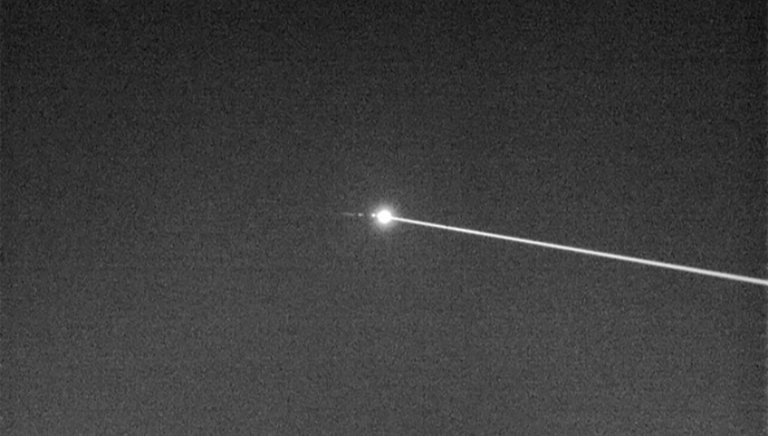
Trash Pickers Sunlight reflects off a piece of space junk, alerting the deorbiting satellite to its presence. The satellite tracks the debris with one laser until the trash is in range, and then another laser nudges the debris out of orbit so it burns up in the atmosphere. Kevin Hand

One Friday last November, the six astronauts onboard the International Space Station received an urgent warning from mission control: Watch out for space junk. A piece of orbital debris, possibly a chunk of satellite, was hurtling toward the station. A direct hit could break through the hull. The crew prepped for escape.

The fragment ended up missing them by about 3.7 miles. Near-collisions between debris and spacecraft are on the rise, as we continue to put trash in orbit faster than it can fall back out—a phenomenon known as the Kessler Syndrome, in which each collision between pieces of space debris creates even more debris. It’s a chain reaction that will make the problem much worse.

In October, just one week before the ISS scare, NASA delayed a return trip from the ISS of a Japanese craft when a shard of Russian satellite was spotted near the space station. In February 2009, two satellites smashed into each other 500 miles over Siberia. And in 2007, China littered low-Earth orbit with the fragments of a satellite that it had deliberately shot down. The debris population in low-Earth orbit now totals more than 20,000 items larger than four inches, from pieces of rockets to old screwdrivers.

In 1976, when NASA scientists first identified the debris risk, they predicted that space collisions would happen once a century. Four occurred over the next four decades. Today the agency predicts four collisions every 20 years. Former NASA scientist Don Kessler, who discovered the debris amplification process with former Norad senior analyst John Gabbard, foresees a catastrophic collision once every 20 years.

Even NASA recognizes that its existing rule—objects must have the capability to push themselves (or be pushed) out of orbit within 30 years of launch—isn’t enough anymore. Earlier this year, it published a paper showing that it could make low-Earth orbit safe by removing five objects per year.

To collect ideas on how to achieve this, last year NASA and Darpa, the Department of Defense’s research arm, gathered hundreds of engineers and scientists for the first-ever International Conference on Orbital Debris Removal, in Chantilly, Virginia. Nearly all the solutions discussed there rely on finding some way to deorbit the debris so it burns up in the atmosphere. The conference also revealed that international cooperation is the greatest hurdle. There is, for example, no official consensus on what constitutes space debris—one country’s seemingly dead satellite might just be hibernating for future use. Governments are concerned that debris-removal systems could have military uses. And not every country is providing details about what they have in orbit.

To punctuate the need for international cooperation, Brian Weeden of the Secure World Foundation noted at the Orbital Debris Conference, “60 percent of the orbital-debris population is owned by Russia and China.” He scanned the room. “Is anyone from China or Russia at this conference?” One brave person in the back raised his hand.
Whatever the challenges here on Earth, something must be done up there. With some luck, one of the following five solutions could clean up our orbital junkyard.

Lasers

How It Works: In a ground-based configuration, a detection system could be made up of radar or lidar to locate a piece of stray debris. Then a laser fires a series of pulses at the object, altering its orbit and knocking it into the atmosphere, where it descends and is incinerated. Space-based systems require a shorter range and lower laser power.

Pros: A laser system is effective on objects smaller than four inches in size, because they are less apt to create more debris during the removal process. A laser-equipped satellite would wait in orbit for a target to pass by and then zap it. “The duck-hunter paradigm is becoming an option,” says Richard Fork, a principal investigator for the Laser Science and Engineering Laboratory at the University of Alabama at Huntsville. “You sit and wait for debris to come past you. Then you can hit it with enough impulse to deorbit it.”

Cons: Because the ground-based lasers would need to be powerful, the systems are alarming to countries that see in them the potential for anti-satellite military technology.

Plausibility: It’s technically possible but still very controversial for political reasons.

Space Tug: A tether could work like a giant electrified lasso, pulling objects out of orbit.  Kevin Hand

Tethers and Nets

How It Works: Aerospace company Tethers Unlimited proposes a system called Rustler (for Round Up Space Trash Low Earth-orbit Remediation). Once launched into low-Earth orbit, the satellite releases an electrodynamic tether, a 1.5-mile-long cable that conducts electricity. The conductivity allows the tether to wrap a net around any piece of debris that it encounters, which it then drags into the atmosphere, where the object either falls into the ocean or burns up on reentry. The net secures even small objects tumbling around in space, a challenge for other systems.

Pros: Tethers and nets don’t require propellant, saving cost by relying on solar power and electrodynamic thrust, and can piggyback on almost any low-Earth-orbit launch.

Cons: It requires tricky maneuvering, because potentially miles of material twisting around in space could just create more junk.

Plausibility: Tether-based solutions have been tested by NASA, including a 1996 experiment with a 12.5-mile cable in space. The Rustler system was tested on a zero-G flight last September and could launch on a real mission within five years.

single page
Page 1 of 2 12next ›last »

1 Comment

Gather it up and send it to Mars. Future colonists could potentially salvage materials for as of yet unknown purposes.


140 years of Popular Science at your fingertips.


Popular Science+ For iPad

Each issue has been completely reimagined for your iPad. See our amazing new vision for magazines that goes far beyond the printed page


Download Our App

Stay up to date on the latest news of the future of science and technology from your iPhone or Android phone with full articles, images and offline viewing


Follow Us On Twitter

Featuring every article from the magazine and website, plus links from around the Web. Also see our PopSci DIY feed


February 2013: How To Build A Hero

Engineers are racing to build robots that can take the place of rescuers. That story, plus a city that storms can't break and how having fun could lead to breakthrough science.

Also! A leech detective, the solution to America's train-crash problems, the world's fastest baby carriage, and more.


Online Content Director: Suzanne LaBarre | Email
Senior Editor: Paul Adams | Email
Associate Editor: Dan Nosowitz | Email

Contributing Writers:
Clay Dillow | Email
Rebecca Boyle | Email
Colin Lecher | Email
Emily Elert | Email

Intern:
Shaunacy Ferro | Email

circ-top-header.gif
circ-cover.gif
bmxmag-ps