Air Force Wants Drones That Can Sense Other Airplanes’ Intent
Future airplane flocks would require a trained corps of pilots who intimately know their aircraft and their partners’ flying habits....
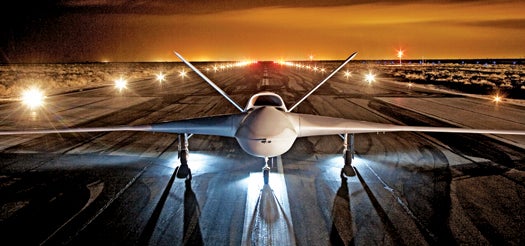
Future airplane flocks would require a trained corps of pilots who intimately know their aircraft and their partners’ flying habits. Drone flocks would be a different task, however. Drones are not as smart as pilots, and cannot tell what other aircraft will do. But the military would like to change that.
The Air Force Research Laboratory at Wright-Patterson Air Force Base in Ohio is asking engineers to design an algorithm that would allow drones to recognize the intent of other aircraft.
The main goal would be allowing drones to integrate with piloted planes for takeoff and landing. Drones would be able to link up with air traffic controllers and consult a database of airport procedures, and use algorithms to understand what other aircraft will do.
This proposal solicitation outlines the Air Force’s desires: unmanned aerial systems that can analyze airfield maps and air traffic control data, just like pilots do. They would use cameras to watch other aircraft and use this “intent data” to remove ambiguity.
“The developed algorithm(s), optimally, would require no more a priori information than a human pilot,” the Air Force says.
The Air Force gives an example of aircraft landing on parallel runways. To a drone, they look like they’re on a collision course before they bank and land. The drone does not know the plane’s course will change, however, so it perceives the other plane’s trajectory as a collision threat. An algorithm could help the drone process airfield maps and realize there’s no danger.
Danger Room points out that there are a few commercial benefits to this type of technology, especially as the nation’s skies grow more crowded. FedEx, for one, has considered using flocks of drones led by a piloted plane, and an intent algorithm could make that possible.