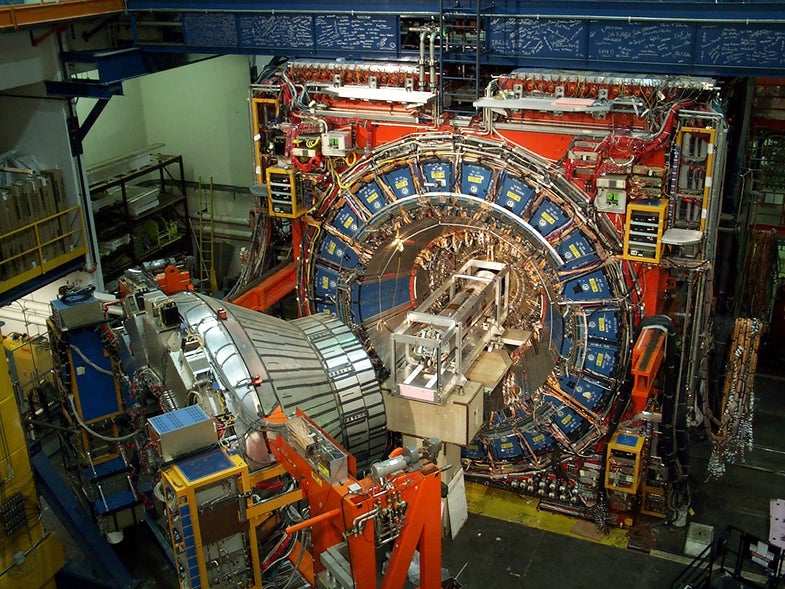
While the LHC's in the shop for repairs from its massive breakdown last September, an older particle accelerator might beat them to finding the Higgs boson, the fundamental particle thought to give matter mass.
At a conference last week, Tevatron physicists threw down the gauntlet, vowing that by 2011, the Tevatron accelerator (located at Fermi National Accelerator Lab outside Chicago) will be able to definitively prove or disprove the existence of the Higgs boson.
Tevatron is currently the highest-energy particle collider, until the LHC starts up again this November (fingers crossed). The poor, ailing LHC will still maintain its dominance in the search for dark matter, which isn't Tevatron's specialty.Which one will end the universe is still up for grabs.
[Via New Scientist]
Stay up to date on the latest news of the future of science and technology from your iPhone with full articles, images and offline viewing
Featuring every article from the magazine and website, plus links from around the Web. Also see our PopSci DIY feed
Share links with friends, comment on stories and more
In our December issue, Popular Science names the 100 best innovations of the year: bombproof wallpaper, self-parking cars, the fastest helicopter, and 97 more. Plus inventor profiles and videos.
Check out the best of what's new here.
"Which one will end the universe is still up for grabs."
I vote for Tevatron just because it sounds more like Megatron.
Well, considering they are willing to cycle up the LHC before knowing it is ready, I'd say they might be prime candidates for disaster. I wonder why the system flow simulators did not detect their problems before they put power in the tube. Aren't systems like that supposed to do microflow checks before cycling? Aren't these systems supposed to scram at the hint of irregularity?