PopSci's vision for making travel faster, greener, and more fun

More Shoulder Room The N+3-generation airplane offers a peek at air travel, three generations into the future Kevin Hand

Commercial Flight: 2020

The long, skinny tube has to go. Tasked with improving the nation's air transportation, NASA wants airplanes to burn 40 percent less fuel than a 777 by 2020 and 70 percent less by 2030. Not only that, it wants those same planes to be whisper-quiet. The best -- and perhaps the only -- way to reach these ambitious benchmarks is to design commercial planes more like stealth bombers and less like pencils.

This past winter, the agency awarded $12.3 million to Boeing, Lockheed Martin and other companies to develop the so-called N+3-generation airplane -- that is, a design three generations ahead of today's. The leading contender is the fabled blended-wing body, which replaces the conventional tube with a triangular shape. "It's the only design that we think can meet our fuel and noise goals," says Tony Strazisar, a senior technologist with NASA's Fundamental Aeronautics Program. With high-speed wind tests of scale models under way, the blended wing could take flight before 2020. Here's how it would work.

Body Shape: The blended wing’s fuselage relies on a triangular shape to reduce its surface area and generate 20 percent of its lift. Less surface area means less drag, and less drag means more fuel efficiency.  Kevin Hand

Engines
Gains in fuel efficiency and noise reduction could also come from embedding the engines into the topside of the fuselage. This produces less drag, and the airplane itself shields ground noise. The big challenge is figuring out how to design the air intakes to maximize airflow over the fuselage.

Passenger cabin
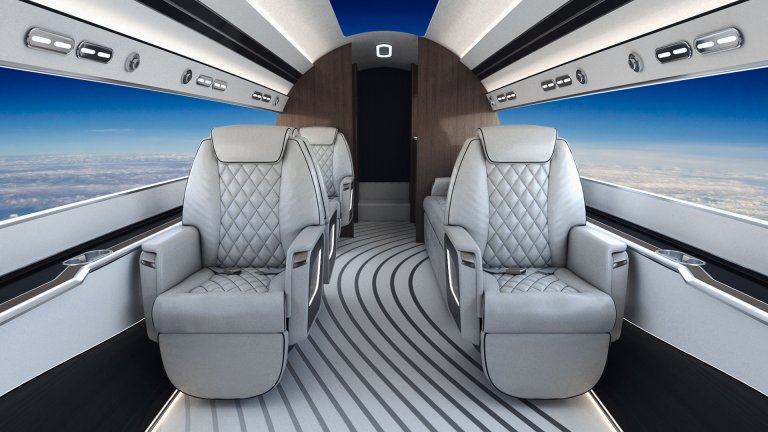
The blended wing's widened fuselage will make for amphitheater-like seating, with long, wide rows. Of course, there will be fewer window seats, but the interior design could compensate through spaciousness or swanky amenities such as in-flight lounges, viewing areas or seat-back virtual windows.

Controls
"Blended wings have been tried for years," says NASA's Tony Strazisar, "but they've always faltered because the lack of a tail creates instability." Boeing's solution: nearly 24 control flaps on the wing, with computerized control systems to coordinate them.

Other Ideas Taking Off: Three paths to greener skies

2010: Recycling
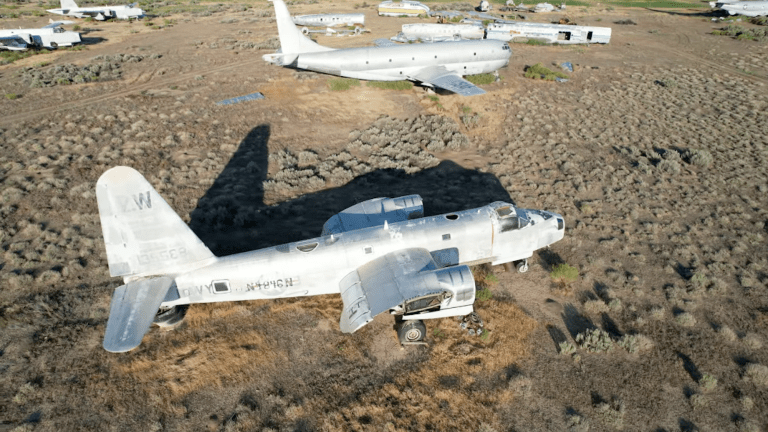
The airline industry expects to retire more than 4,000 planes by 2023. Rather than junk their airplanes in the desert, Boeing and Airbus are developing plans to reuse and recycle as much as 85 percent of the materials in aircraft that are flying now, from tires and batteries to carbon fiber and hydraulic fluids.

2012: Seed Fuel
Montana's Sustainable Oils is breeding camelina seeds -- a canola derivative -- that can easily be refined into jet fuel. Camelina's main draw is that it can be grown quickly on fallow wheat fields, so it can slot into the existing agricultural infrastructure.

2020: Algal Fuel
In January, Continental performed the first algae-fueled flight in the U.S., flying an unmodified 737 for 90 minutes on a blend of half algae-derived fuel, half jet fuel. The next major step is to reduce the cost of squeezing a gallon of oil from algae from $100 to $2.

Thinking about booking a ticket to space? Check out our guide to the leading carriers.

Page 1 of 5 12345next ›last »
Want to learn more about breakthroughs in electronics, medicine, nanotech, and more?
Subscribe to Popular Science and enter to win $5,000!

11 Comments

I have a copy of popular mechanics from the late 50's that has a picture of a 'space plane' that looks uncannily similar to the one on page 2, with a similar claim of speed. They said we would have one by the late 1960's.

People will undoubtedly look at this article in 2015 and laugh, as they sit in the airport lounge waiting to be crammed into a 747.

Wasn't it aboout 1954 that AT&T boasted that within a decade most people would have a video-phone? I have yet to meet anyone who actually has ever had a video-phone... And I remember reading about the aborted Dyno-soar program that NASA seems to have forgotten about.

Science has promised me so much! Maybe by the year 2000 I'll have my robot butler, flying car, and vacation on the Moon.

Sorry if I seem a bit disillusioned. I really do want to believe! I want to live in a world where Heinlein and Clarke and Niven and others have imagined. :(

For the passenger-less bus, how do they figure that there is 600-some grams of carbon for passenger mile? There are no passengers.

so let down #56: Megaplane #57: Videophone

How difficult would it be to provide a website address to the manufacturers of the products featured in your articles?

extremely difficult.

"The blended wing's widened fuselage will make for amphitheater-like seating, with long, wide rows. Of course, there will be fewer window seats..." and fewer easy accessible exits, also! Imagine this amphiteater being evacuated after a ditching, a belly landing or an aborted takeoff. For this reason, Boeing reported two years ago: "While a commercial passenger application for the BWB concept is not in Boeing's current 20-year market outlook, the Advanced Systems organization of Boeing Integrated Defense Systems' (IDS) is closely monitoring the research based on the BWB's potential as a flexible, long-range, high-capacity military aircraft". Did they changed their minds? Waiting for an official announcement from Boeing...

will789

from arcadia, california

not everyhing on ps is real. it not a promise, it a pridiction

Okay first of all - to those of you who poo poo science and the future let's all just look at where the hell we are right now...commenting on a computer that processes information millions of times faster than anything we envisioned 50 years ago...let along 10 years ago.

Second - you are right - planes not traveling at mach 10 to deliver people to tokyo not so much but I can call someone in Tokyo via my voip and it won't cost me much of anything. I can also see Tokyo via sat photo.

Third - as for video phone - 30 bucks x 2 for cams and a headset...no we didn't shrink it to cell phone size but we also didn't anticipate having handheld devices that could detect what song is playing then allow us to buy that song via our iphone.

Fourth - I doubt we figured we'd know EXACTLY where we all were via GPS to the foot through our cell phones 20 years ago.

Fifth - did someone just milk a goat and come up with a material 7x as strong as steel. Did someone write about "buckyballs" 20 years ago?

Ease up on the world of science...and remember that the Russians used a pencil in space while the Americans invented a material which helps keep my swim trunks shut and the military just used pig intestines to stop bleeding soldiers.

No one knows where science will lead. It takes an idea, a moment of opportunity and someone from left field to think out of the box.

Boeing's BWB is a better design than the tubes we fly today with 20% of the lift from the body and 25% better fuel economy per passenger. They say they can have it operational by 2020 but with the current 787 already years behind schedule, I don't see how they can make that claim. It is a totally untested design and will be at least 15 years if not 20 before one of these rolls out of the production line. There is a design waiting in the wings that could meet or beat that 2020 target production date.

Check out this plane www.burnelli.com/Welcome.html . This is the design of Vincent Justus Burnelli, a first generation Italian - American who strived to do great things for America.

This plane is the last design of over 40 years of the creativity of this one man. This design has a history of 9 fully functional planes, exemplary NASA wind tunnel tests and proven safety and crash worthiness. With this design's proven history, I believe test models could be built and tested, proven and ready for world-wide production and distribution within 7 years. As beantown179 says, "It takes an idea, a moment of opportunity and someone from left field to think out of the box."

I found this to be true with the company SpaceDev who's rocket design put SpaceShipOne into the history books. In that case it was Jim Benson, who built SpaceDev around this unconventional hybrid rocket motor design. He was the man with the money, the vision and the opportunity to take this rocket where no one had taken it before. SpaceDev has now been asked to join the SpaceShipTwo program to ensure its success.

The Burnelli 1964 design's potential needs the same type or person or group with the money and the vision. The opportunity is already there, with the airline industry living on the edge, charging us for baggage and soon for our weight. This plane's expectations far exceed Boeing's BWB design.

Boeing claims 20% lift from the body.
Burnelli's potential could be 50% or more.
Boeing claims 25% better fuel economy.
Burnelli's potential is 50% or more.
Costs and production time would be 1/2 or less.
Fares would be reduced from all these savings.
Take off and landing speeds as low as 100mph.
Shortened runways = reduced terminal costs.
Safety in emergency landings would increase 85% or more.

The majority I've spoken to in the 3 years I've been involved with this have recognized the qualities above intuitively. A few sceptics have shot this design down on their viewpoint alone. They claim that because no one built it, it wasn't worth building. Only testing will make it clear if this design is all that it looks and is claimed to be. So, why not test it and find out for sure?

I'm workin' on it.

My home built, 1964 Burnelli design, successful maiden flight, Dec. 20, 2008... and it flew really well.
aerodromedia.blogspot.com/ (http only no www, Toward the bottom, the white one) It flew "really" well. The yellow prop, bush plane is by another supporter out in California.

This is what we need...a plane w bars/lounges/spas...that's what I'm talkin about...i am tired of being herded into pencil shaped crammed airplanes that can go 19 hrs w/out refueling.

When are we going to find a way to make air travel just a little more 'civilized'?

There are always challenges to address, however, this is a step in the right direction.


Download Our iPhone App

Stay up to date on the latest news of the future of science and technology from your iPhone with full articles, images and offline viewing


Follow Us On Twitter

Featuring every article from the magazine and website, plus links from around the Web. Also see our PopSci DIY feed


Become a Fan On Facebook

Share links with friends, comment on stories and more


December 2009: Best of What's New

In our December issue, Popular Science names the 100 best innovations of the year: bombproof wallpaper, self-parking cars, the fastest helicopter, and 97 more. Plus inventor profiles and videos.

Check out the best of what's new here.

Popular Science Photo Pool


Share your photos in the Pop Sci pool at www.flickr.com!
tags_sprite.png
POP_embeddedForm_cover_May09.jpg