
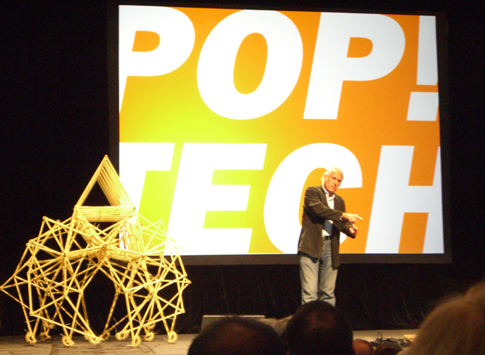
The PopTech conference, curated by Popular Science contriubting futurist Andrew Zolli, showcases the world’s most exciting ideas and inventions every October in Camden, Maine. This year’s gathering tackles the “grand challenges” facing humankind today. PopSci executive editor Michael Moyer has posted his notes from the conference-the Cliff Notes, if you will, to the ideas and trends shaping the intersection of technology and culture. Detailed speaker bios are available at poptech.org.
Topics and Speakers:
Seeing What’s There
Building a Gigapxl Camera
DNA Barcodes, Biodiversity and You
It’s Alive!
Creating Life From Scratch
Sculpture as Artificial Life
Mind and Body
Todd Kuiken and Jesse Sullivan
The World’s First Bionic Arm
Explorer’s Club
Using Prizes to Encourage Exploration
Robotic Exploration of the Very Deep Oceans
A Journey to Saturn Aboard Cassini
People, Place and Planet
Human Cost of Climate Change
Life in Bombay, the Maximum City
East Meets West
The Chinese Century: Are We Toast?
China and the Internet: The Change Goes Both Waysâ€.
Serious Games
Gold From Thin Air: The Economy of Synthetic Worlds
Using Video Games as a Tool of Political Organization and Dissent
Everything Bad is Good for You
Participation Revolution
The Wealth of Networks-How social production transforms markets and freedom
The $100 Laptop
Flock: A New Approach to Web Browsers
Habitats
21st Century Medieval City
Looking at World Data Through Art
Big Fixes
Using Design To Change How We Do Disaster Relief
How To Make Anything
The Future of Ideas
The End of Faith
The Future of Memetics
What Do We Know?
The Scandal of Prediction
Deceit, Self-Deception and the War
Graham Flint
Building a Gigapxl Camera
Note PopSci article about this: The Sharpest Image
Starts presentation with panorama of San Diego.
Shows how tight you can get. But lots of cameras can get that clarity at the middle of the image, few can at the edge.
What is it useful for? Many things you need this resolution. One is virtual reality. The real feature of v reality is to create a virtual environment that is indistinguishable from reality. You need a wraparound image. Best examples are imax theaters or planetariums. Wherever you look, it has to challenge your 20/20 vision. If you take a hemisphere and cover it, you need 75 megapixels. But if you’re going to explore it, you need to zoom in 10/1, you need 7 gigapixels. This is just for a static image.
Why use film in the digital age? It’s all in the numbers. We’re capturing 4×10^9 pixels in 1/200 second. When we digitize it, we’re getting 48 bits per pixel. That means we’re capturing 40 terabits per second. No digital system can capture data this quickly.
What we’ve done is taken each one of these steps-steps between scene and camera-and balanced them, reduced the information loss.
He built the camera around old film magazines used in U2 missions in the cold war. Gives a 9×18 inch film area, at 25 megapixels/sq. in.
Need to choose focal length: if too short, film resolution dominates. Focal length too long, atmospheric blurring dominates.
Looking at landscapes in the west, optical focal length is 200-300mm. But problem is that you have 500 mm on the diagonal. So focal length is half distance to film, so this is equivalent to ultra wide angle.
Problem is getting clarity around the edges.
Had to design own lens. Took a year on the computer. Has eight elements (compared with the regular of six). Built four lenses, and each is near perfect.
Must focus lens to half 1/1000 of an inch.
What are we doing with it? We’ve got a warm-up project called portrait of America. We go to a chamber of commerce and ask what they’re most proud of, then we take it. It’s taken 3 years and 100000 miles of driving.
From there, there’s been a great deal of interest in this thing. Now hovering around 2 million visitors a day on the website. Michael Jones CEO of Google earth thinks we should go international and record sites on earth that can’t be preserved, like city of Rome, whose limestone is being eaten away by acid rain. 788 world heritage sites at risk. We’re working with second generation cameras. We’ll need two teams of photographers.
Right now we can only do this on film, but that’s going to grange. U of Hawaii working on PanSTARRS, design to photograph huge areas of the sky. Massive parallel-4000 512 by 512 CCD arrays. Like 4000 TVs working together. 1.07 gigapixels. Operational in 2006.
Emerging display technology: Working with Evans & Sutherland. 4000 by 8000 pixel screen. That’s 32 megapixels. Next generation will be 128 megapixels-16 feet diagonal.
Ends with the photos of the paragliders at Torrey Pines.
Bob Hanner
Creating an inventory of all living things on Earth
DNA Barcodes, Biodiversity and You
We’re going down to molecular resolution.
If you could identify any organism on the planet right now, what would it be? That world is upon us. Barcoding life: Enabling the discrimination of species by analysis of a short fragment of DNA.
Taxonomy: the world’s oldest profession. Genesis 2:19. and whatever Adam called every living creature, that was their name thereof.
In the 18th C modern taxonomy was born. Linnaeus described 4,000 species in 1748. 100 years later, Darwin came to the conclusion that all species are related to each other. We try to assemble classifications based on their common ancestry.
The sum total of what we know: traditional morphological descriptions in museums.
We know an awful lot about biodiversity, but it’s not accessible to you and I. It’s inaccessible in the field, and to you and I, and that makes us bio-illiterate.
Having bioliteracy might help us and the way we respond to nature.
Our planet is home to some 10-100 million species, but the best human can id only 1000.
Imagine if you could id any species and Google it.
This is one of the grand challenges of biology.
Known biodiversity is 1.7 million species of plants and animals. Estimated biodiversity is 10 million to 100 million species.
We need to accelerate the rate at which we describe and understand species. This is a grand challenge.
Idea: Use DNA sequence data for horizontal genomics: take one gene and compare across all species.
You can develop a barcode. Use differences in nucleotides to id differences across barcoding.
They focus on DNA in mitochondria. In there, they use one gene: the CO1 gene. But CO1 doesn’t evolve fast enough to be used for plants, but it is a good marker for animals.
There is basically no variation in humans across this gene, but deep difference between us and the other apes, and the apes themselves.
For example, one butterfly known since the 18th century turned out to be 10 species, based on their DNA. But no one knew for 100s of years. How many others are there out in the world?
Right now, barcoding takes lab work to sequence the DNA. Then it’s added to a database with lots of other information about the species.
What is the most important biomedical device? He thinks it’s the telephone. Now that we can call anyone anywhere in the world, why can’t we do the same for biodiversity? Create portable DNA barcoder. Should be technologically feasible.
FAA is interested in barcodes b/c of bird strikes in planes. Costs industry 400 million a year.
Another is to monitor cattle feed for BSE
Another is to understand invasive species, fish larval stocks (to track depleting populations)
International trade: The Pine beetle is expected to cost Canada $1.5 billion over 10 years. Is invasive species.
What we need is DNA search engine. We need miniaturization of DNA technology. 1 minute, 1 sequence, 1 name, 1 penny.
We must find entrepreneurial class of people who will launch this.
We must make the world bioliterate, to distribute this technology to the world, to democratize access to the biological world.
Norman Packard
Working to create life. Responsible for much of what we think of as chaos theory. Applied complex nonlinear dynamics to things like financial systems. A few years ago he turned his attention to the creation of completely synthetic living cells.
What is life and “living technology”?
What is life? Requirements: self-maintenance, self-reproductions, evolvability. This is what life needs. But what about flame? Turbulence? Stars? These would seem to fit the definition. I find that they are fair game. But we must look at evolvability-does not necessarily mean change. Means that there is some sort of inheritance and selection going on. Hasn’t been seen in these other things. What about societies and ecosystems? This might be true-they might be alive by our criteria.
Life is amazing technology. Even simplest life forms are very complex. Look at E. Coli. Keep them fat and happy, they’ll reproduce forever-it’s like getting the factory along with the organism. It keeps making itself. We’re a long ways from engineering the technology that does the basic tricks that life knows how to do.
Living technology is technology that is defined and enhanced by its life-like properties. Examples are synthetic biology, ecological engineering , social engineering, the internet.
Synthetic biology refers to the design and construction of new biological parts, devices and systems, and the redesign of existing natural systems.
Distinguish between top-down an bottom-up. Top down uses mechanisms from existing life. It starts from biology. E.g. someone uses gene transcription to make new genes and new proteins. Bottom-up builds something from scratch. It starts from chemistry. We’ll be talking about bottom up.
Note PopSci article about this: Life Built to Order, Feb. 2005
Why would you bother with the bottom up approach? One reason is to get an understanding of the difference between living and non-living, , another reason is to rationalize the engineering of them. Most importantly, we can engineer functionalities that don’t exist in the natural world.
These three requirement for life map into three elements needed for a cell: container (cell wall), metabolism, and informational component (gives evolvability-equiv. of DNA in living cells).
PACE. Programmable Artificial Cell Evolution. Rasmussen (of PopSci profile) is working on the metabolism component. Others working on DNA Oligomers, vesicles, and microfluidic life support.
At ProtoLife, company I’m working at, we’re focusing on the container. We’re creating a membrane based on lipids. Once we understand the membrane, we’re working on problem of integration of various components. This is the greatest problem of engineering an artificial cell. Each component has been well-studied in and of itself. But putting them together in concert in a way that allows object to reproduce is not understood at all.
How are we making containers? We use an evolutionary approach-a genetic algorithm to search space of structures. It’s driven by target functionality. It’s messy, but messiness gives algorithm the elbow room to search the space of spaces.
Cell division is a complicated process. It’s not easy to find vesicles that divide before your very eyes. That’s where the frontier is.
Intermediate applications of artificial cells: Designer vesicles for drug delivery, long term: biomedical: smart drug delivery, diagnostic tools, energy (program to produce h2, for instance), do carbon sequestration, environmental remediation.
How is the science we’re going different? Make distinction between modern science, which is strong (e.g. Galileo, Newton, Einstein). Characteristics: there is a natural law, and from the laws you can derive what nature is going to do. Create static orbits for dynamical systems. Examples: movement of planets, design of cars, computers, bombs.
We’re doing post-modern science, which is weak. E.g. Darwin. It’s an unruly natural law. You can write it down, but there are phenomena which you can’t derive from it. There are emergent properties, and new laws at the emergent levels. For example, chaos, turbulence, life, consciousness.
Life is at the edge between derivable phenomena and non-derivable phenomena. Between strong and weak science. This means that we must give up our requirements of engineering every detail-we must just live with the uncertainty that comes with this.
This means it takes science down a notch as an intellectual phenomena, but it is possible to still derive pieces of phenomena in this new world, but it is a patchwork. We do have a rich problem domain, though. And I’m having fun working on it.
As for the safety issue, there’s no evidence that non-DNA based life is more dangerous than DNA-based life. In fact, it’s probably significantly less dangerous, because DNA-based life can interact with other DNA-based life.
It’s nothing new that a powerful new technology carries with it both positive and negative potential. Two points: These synthetic life forms are going to exist. We can’t legislate them away. They already exist, and they will advance. We want to put the mastery of these techniques in hands that you trust. Not only techniques to develop these technologies but to react and control with these technologies.
Theo Jansen
Sculpture as Artificial Life
Living systems are based on one kind of material: protein. I use another material: a conduit used for electricity in my country. He holds up a tube, yellow, about two feet long, and uses it as a dart gun.
Shows video called Artefauna: the artificial beast.
These are skeletal creatures who are propelled by the wind across the beach.
He “evolved” his creatures in the computer: The computer chose different lengths for the tubes that form the leg. Then it randomly changed it, kept the ones that moved the best, randomly changed, over and over for many generations. He came up with what he calls the 11 holy numbers.
Todd Kuiken and Jesse Sullivan
The World’s First Bionic Arm
Note PopSci article about this: A Toast to the Bionic Man, Oct 2005
What a name for a presentation: Targeted Reinnervation for Improved Myoelectric Prosthesis Control
Kuiken does most of the talking:
Here we’re changing a human to enable a technology, not the other way around.
Current state of the art in prostheses have motorized joints. It listens to the muscle, the contractions of the muscle, and uses it to signal a hand. This works only for below elbow.
Most people with shoulder amputations don’t wear a prosthesis-you don’t get enough value from it.
So listen to the nerves. We’re using the nerves, and letting them grow into the spare muscle-the chest in this case. Your nerve signal contracts a chest muscle, then you read this muscle and let it operate a prostheses. This also allows for sensation feedback.
It’s amazing looking at the chest-when Jesse thinks “open hand”, for instance, one of the four specific chest muscles contracts, looking like someone raising their eyebrow.
“People ask me how they do it, and I don’t know, I just do it.” Says Jesse
Crazy thing is that his sensation nerves grew into his skin in his chest. So when you touch his chest, he feels his hand, or his wrist, or his finger. Now hook up a small plunger to his chest, and he can “feel” what he’s touching-how hard or soft he’s grabbing, hot and cold, sharp or dull. He’s the first person that can feel using a prosthetic hand.
His new arm is an experimental amalgam of lots of different parts-hand from China, elbow from the lab, etc.
“I’m optimistic about the future. When Dr. Kuiken approached me about this, I didn’t realize it was going to be such a big thing.”
But the thing, in Dr. Kuiken’s words, is primitive, held together with tape and chewing gum. What are they doing in the future? Do more nerve transfers, and create more control signals by splicing more nerves into more muscles. They want to trace out exact nerve patterns, allowing him to, say, use each finger individually. They’re going to outfit him with an electrode array-150 instead of the current 6-and see if they can parse out the signals to give him that control.
Peter Diamandis
Using Prizes to Encourage Exploration
Since the age of 9 it’s been my mission to get all of you to space. I’m also passionate about radical breakthroughs.
He thinks it’s a moral imperative to open up the space frontier.
Exploration is the weakest motivator for going to space.
A great motivator is wealth-the first trillionaires will be made in space. An average asteroid 0.5 km wide is worth 20 trillion dollars in platinum group metals.
Fear is another motivator. We’ve been pummeled over the years by asteroids.
We finally have the ability to take the human race off the planet. It is our moral imperative to back up the culture of the human race off our biosphere.
Nothing is impossible.
The cost of space has gone up in the last 40 years, reliability has gone down.
Once you’re in space, you’re 2/3 the way to anywhere.
In raw energy costs, it costs $100 to get a person to orbit (accelerating them to 17,500 mph at 200 km, using back-of-envelope basic physics). We’re trying to get our $20 million to $100.
X Prize was fixed cost engineering. Teams spent between $25 mil and $100 mil to win a $10 mil prize. 27 teams pursued it.
Now, as consequence of Rutan winning X Prize, working with NASA to do centennial challenge prizes to build space elevators, or mine asteroids.
Follow-on competition: X Prize Cup. This is an annual competition†the America’s cup of space. People try to win specific prizes, for example altitude, time to climb, coolest looking, turn around time ,down range. This will be every year in New Mexico. Will be Oct 21 and 22 of 2006.
Now introducing Zero G: zerogravity.com. Is commercial weightless flights. Have done 50 flights. Flown 1200 people into weightlessness. Will be operating out of Vegas shortly (Florida now). Plan is that it’s capturing the customers that will want to go into space. These are the potential space tourists.
New project: Rocket racing league. Building 10 new vehicles.
Our history of taking no risk in human spaceflight is killing innovation there.
New mission of the X prize foundation: Create radical breakthroughs.
The plan is to get money from sponsors based on the publicity they’ll get. They consider it a 500:1 investment-You don’t have to pay for the sponsorship until it works.
I imagine in the future we will have 100 million prizes for the big thing. Not only in space, but in energy-on the verge of announcing one to rework the automobile industry. There’s one on the environment, nanotechnology, genetics, medicine (sequence individual DNA), education.
The X Prize foundation will not just be for space anymore.
Backed up by Larry Page from Google, Craig Venter, etc.
The way to attack the grand challenges of our time is to take risk, offer prizes. We are killing ourselves in our inability to take risk. This is the most critical tool for solving Humanity’s Grand Challenges is the committed, passionate human mind.
Marcia McNutt
Robotic exploration of the very deep oceans.
Runs the Monterey Bay Aquarium research institute
Comparison between space and ocean exploration: In space, we can use solar panels to power instruments. Not so in ocean. Dependent on batteries, or possibly fiber optic cable out to the deep sea.
In order to keep our seismometer up and running at the bottom of the sea, must pilot ROV out there, change out the LiIon battery. Battery costs $10k, running it out there costs $10k. This is vs. 7 cents of real energy use.
Also communications: No electromagnetic radiation through the ocean, so must be tethered.
In space, no problems with fouling-having barnacles sticking to them.
However, the launch is a bit easier. Escaping gravity is hard. But every time we throw something off the side of a ship it sinks to the bottom of the ocean.
Autonomous Underwater Vehicles are an order of magnitude cheaper to build and operate than vehicles that require ship launches-robotic vehicles. Without a tether, don’t have to keep the ship running.
This is the same as with Spirit and Opportunity, they use sophisticated AI to get around (with daily commands from operators). NASA found they got minimum 20 percent increase in return on mission when they used AI.
Ice caps. We want to know how much the ice cap is thinning. Built a AUV to go under arctic ice. The AUV was fit with two midsections. One fit with a fuel cell so it can run for 2 weeks. Other has computer is information storage. Every so often, would release torpedo-like thing. Would float, hit bottom of ice cap, then melt through the ice cap and transmit data via satellite. So didn’t have to recover AUV at the end of mission to get good data. Didn’t have to be 100 percent successful.
We’re slowly changing the pH of the ocean to acid. As the CO2 becomes dissolved in the ocean, it reduces its pH. By the end of this century the upper ocean will be more acidic than it has been in 400 million years of life on this planet.
Obviously, there isn’t any creature that’s used to this. How will this affect the oceans? Specifically, can animals deal with this? How will this affect photosynthesis? Can deep sea organisms adapt to this changing pH?
We’re probably at the point where the die is cast. We can’t change our fate. But we can understand what the ramifications will be and prepare for those.
Enough doom and gloom: Here’s the fun stuff. Earth’s midwater is Earth’s largest living space. It’s the area that’s in perpetual darkness. It contains more biomass and biodiversity than all of the rainforests combined. Every time we go out we find new species, new genuses, and sometimes new families.
Sometimes new ecosystems. At bottom of ocean, was grey whale carcass. Suddenly 7 tons of food was delivered to bottom of ocean. 40 percent of all species at bottom of the ocean they found are only found on whale falls. Leads to question: how do they find the whale falls?
They found new family of worm that feeds off bone marrow of whales. No mouth, no stomach. Extracts lipids directly from marrow to feed worm. Also, all were females that they found. Inside the bodies of females that they found were hundreds of dwarf parasitic worms. The males develop only to the point where they can produce sperm. They’re in arrested development after that. Question: is this an early form of sexual reproduction, or a later form?
Ha. Just kidding.
In one drop of seawater there are 1000 organisms. But you can’t culture 99 percent in the lab. So they’ve developed a sequencer that reads them in the ocean.
Methane Hydrate: MH4. “The ice that burns.” It’s the largest remaining source of fossil fuel remaining, but it’s buried beneath the continental margins. No way to get at it. But the microbes have found a way, making a deep sea fuel cell.
We’ve come a long way. But we still can’t predict what remains to be discovered.
Carolyn Porco
Lead imaging scientist, Cassini mission to Saturn
I’m going to tell you what’s going on a billion miles away from here.
Cassini is the farthest robotic outpost that mankind had ever established around the sun.
Saturn has all the same sort of features that Jupiter does, only they’re deeper on Saturn. It’s colder, and there’s haze, so we have a harder time seeing it. In the near IR, for instance, you can see a lot more structure. We don’t know presently what energizes the winds in Saturn’s or Jupiter or our own atmosphere, so there’s a lot to learn about its structure.
The rings consist of billions of billions of particles. From the size of houses to the finest powder.
The math underlying the structure of spiral galaxies was co-opted with very little change to the study of Saturn’s rings. So understanding Saturn helps us understand galaxies. It’s truly universal.
Now 47 moons in total. Cassini studies only inner moons. They’re like a miniature solar system. We’re hoping to study system as a whole to gain greater insight into planetary formation process. There have been flybys of Titan closer than the ISS is to Earth.
These moons have lots of craters-there was a time before when there was lots of bodies careening around the solar system creating these craters. It’s one of the thoughts for how rings come about: Bodies smash into other bodies into bits.
And that’s when the battery runs out on the laptopâ€
Mark Lynas
Human Cost of Climate Change
It’s very easy to put each other in boxes. But climate change isn’t an issue where you can do that. Climate change is the whole of the human species vs. the biosphere. We’re used to human vs. human, this is different.
Temps globally are higher than they have been for 5000 years. Because we’ve moved the earth so far outside the climactic boundaries, climatologists now say that we have moved into a new epoch in the history of earth, the epoch dominated by a single species-us.
It seems like the Day After Tomorrow-we just had the strongest hurricane ever in the Atlantic basin.
Now, anecdote doesn’t replace data, but it supplements data when the data is already well established, as it is. So let’s tell some stories.
I was in the Peruvian Andes, on a glacier that is a great reservoir of water for the Peruvian people. It’s receding exceedingly fast (shows a before/after image). In the glacial lake that is runs in to, you can see the glacier has receded by about half a kilometer since 1980. The images are indeed striking, the barren rock left over from the beautiful ice.
All the water that Lima depends on comes from the river valleys. There’s a glacier that supplies the water from all of Lima, a city of 7 million people-the largest desert city besides Cairo. And this glacier is receded by kilometers.
World glacier foundation found that 97 percent of world’s glaciers are receding.
When you add this water to the thermal expansion of seawater, you get rising sea levels. Take Tuvalu, in the South Pacific. We’ve had just a few cm of sea level rise in the 20th century, but it threatens to flood the island all the time. You get water that now pushes up through the ground in the middle of the island. This is a survival problem for Tuvalu. It’s losing coconut trees from the shore, for example. The new Prime Minister is moving people off the island to New Zealand because the island is doomed.
Shishmaref, Alaska. North of Alaska. Houses built on the cliffs of the barrier island are falling off, as the water doesn’t freeze, and waves erode the shore.
Fairbanks. The ground has melted underneath places so much that buildings are falling over.
He’s now trying to bring together all the scientific papers that predict what we’re in for. He shows the hockey stick graph, showing exponentially rising temps. It predicts up to 6 degrees of global warming.
One degree: Code Blue. The likely extinction of all coral reefs. Already the Great Barrier Reef is bleached. Nebraska was a desert 9000 years ago, might become one again. By 2025. This level of climate change is unavoidable.
Two Degrees: Code Green. Will lose glaciers, some reserves.
Three Degrees: Code Yellow. A crisis of biodiversity. Mass extinctions. By 2050, 1/3 of all species could be extinct (published in Nature). Whole of Greenland ice sheet will melt. Will give us 6 meters of sea level rise. That would flood much of florida. Huge areas of the east coast would be inundated. Amazon rainforest will tip into a new regime where it turns into desert. Carbon in the plant life goes into the atmosphere, creates positive feedback.
Four Degrees: Code Orange. Arctic sea ice gone in summer-all mammal life in artic is extinct.
Five Degrees. Code Red. All glaciated mountains in Nepal, the source of the Indus river, that which keeps all of Pakistan going, will be gone. 100 million people will die or be displaced. How will this affect global stability? The Larsen B ice shelf will collapse (it’s already happening).
Last time in history when we had such levels of global warming was in Eocene-55 to 36 million years ago. That was last time atmospheric CO2 was above 500ppm.
Six Degrees: Code Black. Who knows? Last time we had this 95 percent of life was wiped out in the Permian extinction.
We must take this issue much more seriously if we are to survive as a species.
Suketu Mehta
His most recent book was a finalist for this year’s Pulitzer.
Maximum City, it was called.
I went back to Bombay 21 years after I had left it. I came back to a city now called Mumbai.
He then reads at length descriptions of Bombay. Notable is his analysis of the issue of urban density on the Asian cities of the future.
Oded Shenkar
Professor, global business management, Ohio State University
Author, The Chinese Century
Subtitle of talk: Are we toast?
A millennium ago, China was largest economic power in the world. This is where they came from, this is where they were going. To the Chinese, textiles and cheap labor is a transition period. It is one that will last for a while, but it is a transition period.
As it goes up the technological ladder, it will not relinquish manufacturing.
Chinese exports are very rapidly becoming higher tech. Computer components, for example. Not just t-shirts anymore.
The U.S. has a huge, unsustainable trade deficit with the world. 6 percent GDP. Historically, this is where other economies started to get into trouble. We are in unchartered territory. If we cannot make the labor-intensive stuff, what can we make? Why do we have this deficit when rest of Asia has surplus, when Europe just now developing deficit. Many reasons. We are more open, more flexible economy. Easier to shut down plants here and move them there.
Automotive components-Delphi just went bankrupt. Ford just announced huge loss. GM might go bankrupt. Where is this going? Sure, Japanese, but also Korean and German. What’s next? Chinese parts in cars (say, 50 percent Chinese, 35 percent Mexico, 15 percent U.S. for pickup in 2012, available for $119 a month lease. The math works). Sold under brand name Rover. It-the brand name-was acquired by Chinese companies recently. Irony is that it was last of U.K. manufacturing.
Declared aspiration of Shanghai Automotive is to be, in 5 or 6 years, one of 5 largest car companies in the world. They bought Rover. It is coming, it is only a matter of time. What does it imply? We don’t know.
It was folly to believe ours were advantages we could enjoy forever. The U.S. is going the way of the U.K. towards the end of the 19th Century. We took mantle of world’s largest economy from Britain then. Will we relinquish the title to China in, say, 2025? Parallel: Britain let us take care of cheap manufacturing in mid-1800s, without too much worry. They had better technology. Look how that worked out.
What follows is many examples of parallels between England-U.S. 140 years ago and U.S.-China today.
But the counterexample is whether or not China will break out of its ways of the last millennia, embracing new technology and innovation and science and new ways of doing engineering, business, and technological development.
Chinese who come to the U.S. to get their PhDs make up about 7 percent of our student force. Before, only about 10 percent were going back to China. Recently, that number has grown to 25 percent. How high will it go? South Korea is at 90 percent.
We can run a deficit for only as long as china keeps buying our money-our T-Bonds and the like. One day, they’ll stop, or they’ll charge higher interest rates. Then we feel china’s influence everywhere we buy everything.
There is no precedent of any major economy based solely on services.
Final thought: Challenge and question comforting analogies and precedents that you might hear.
Rebecca MacKinnon
Senior Fellow, The Berkman Center for Internet and Society at Harvard Law School.
Former bureau chief, CNN Beijing
China and the Internet: The Change Goes Both Waysâ€.
Our story starts in the remote village of Pu Sa Lu. 150 people in the village. She went there in 1999 with CNN camera crew for story about UFOs-there had been sightings reported in the Chinese media of UFOs, and they went to do a silly story. (The Chinese are obsessed with UFOs much as we are.)
The party secretary meets their car when they arrive, and takes them to meet some peasants. But it became clear that the secretary wasn’t excited that they were there for UFOs, they wanted to spark tourism and hence investment. And so the village started a website, pusalu.com, back in 1999. It’s still there today. That strategy has succeeded-the village now has investment and some tourist traps, but also money to set up computer training center for nearby farmers. Through the internet, farmers can buy products and find markets and do all this without leaving the villages and coming into the cities. And this is why the internet is important to china, why they need it.
Government investing heavily in infrastructure to bring internet into the villages.
But it might bring ideas that the government is uncomfortable with. Most popular: sex blogger Muzimei. Wenxue.com. She details her very active sex life. Very active. Not the sort of thing that the government is comfortable with. This is strange because until a few years ago you needed to get past gatekeeper to get online. Now people doing it themselves.
MP3 megahit: Mice Love Rice. Over 100 million downloads. Just a schoolteacher who threw it up on the internet and now he’s a megastar in China. I love you just like mice like rice-that’s the song’s refrain.
While you can’t post blogs slandering the party or the president, internet is empowering people.
China has world’s 2nd largest internet user base-103 million-though it’s only 8 precedent of Chinese population (U.S. user base: 135 million).
385 million mobile phone users in China-this is how they will get online in the future.
Much content in China is user-created content. 1/5 of users us BBS. 5 million blogs. Over 200 million SMS messages sent.
Even while there’s a crackdown on blogs, their numbers are rising. Why is this? Chinese censorship is very focused on trying to prevent the emergence of political leaders and political movements coming off the internet. For instance, news of village democracy movement in Taishi was censored. So that’s no good, but sex bloggers and MP3 stars are okay
Great firewall of China. Blocked: Human Rights Watch. No Google News results for “Tiananmen Massacre.” This is because of IP blocking and filtering. In the west, this is used to protect kids from porn and the rest of us from viruses. In china, used to block political content.
Isaac Mao, general manager of blogging service, won’t put his blogs on his service, as his service censors content.
There are about 60 people in jail now for putting anti-government on the internet. But that doesn’t concern too many current users, as any attempts to post content government doesn’t like is automatically censored at the ISP level-it won’t post.
Of course, this is assisted by western companies. E.g. Microsoft’s blog service won’t let you use the words freedom of speech or democracy.
Yahoo aided the arrest of journalist Shi Tao-they gave the government his IP address when he sent an email from a Yahoo account critical of the government. He’s spending 10 years in prison.
What’s happening online in China is not playing catch-up to what’s happening to the U.S.-podcasts, for example, are very big. They’re ahead of us in terms of Mo-blogs. Also you can read blogs through phones. We may very quickly be playing catch-up.
Why can these companies continue to innovate and move quickly? They’re building censorship into their technology. This way, it doesn’t slow down their business. It doesn’t take away from their growth. In a way, this allows the censorship to proceed transparently.
Code is Law. â€Larry Lessig, Stanford and Creative Commons.
If we’re entering a future where China will be largest user base, if innovations in the way content is creates is coming from china, if software that will allow people to communicate worldwide will be coming from china and has censorship built into it, burnt in from the get go, and if western companies are assisting in this, what will be the products of this worldwide in terms of freedom of speech? Even those countries that call themselves democracies? What happens when censorship is baked into the code and baked into the business model?
Ed Castronova
Associate Professor, Dept. of Telecommunications, Indiana University
Presentation title: Gold From Thin Air: The Economy of Synthetic Worlds
He works full time on the academic work in online interactive games.
His book: Synthetic Worlds.
Numbers: There is 61.1 million golfers in the world, 37.1 million in the U.S.
50 percent of U.S. population plays video games: 148 million in the U.S. Four gamers per golfer.
This is a more popular and widespread phenomena than people realize.
Average gamer age is now 30. Getting older. 1 in 5 people over 50 is a gamer.
Movie Star Wars III biggest opening day: $50 mil. Spiderman 2 made $116 million on opening weekend.
Halo 2 made $125 million on November 4, 2004.
Game industry annual revenues are $10 billion/year, $7.6 billion in software.
Hollywood box office receipts: $9.5 billion in 2004. Has been flat for three years.
He studies multiplayer games. People all over the world share a space.
Synthetic players worldwide: 10m.
Real money trade: $100m-$1b (this is when someone pays real money USD$50 for a magic wand in the game)
Synthetic money trade: $2b-$20b (this is adding up all the stuff that’s being traded within the game)
Everquest’s fantasy world is called Norrath. GDP per capita of this world is $2000. Compare with the GDP per capita of China: $500. What’s going on inside the video game world is more productive than what’s going on in China. Really.
This is hard to accept because the line between reality and fantasy is blurring.
He now takes us into the World of Warcraft (WOW) auction house. Live.
Then to Ebay. There are pieces for sale in WOW for 1550 gold pieces. On eBay, 500 gold pieces are going for USD$41.99. that means that the values of things in Warcraft is up to USD$126.
Most players work full-time who play. Average age: 24 (post-college). 1/3 of players spend more time on the game than they do at work.
What is the difference between fantasy and reality?
We have to understand video games now because they have become an element of common literacy.
The key to immersion is not the hardware-not the virtual reality. What immerses people is the software.
Many implications for practical virtual reality.
What is making people uncomfortable? This idea that you have to be serious is coming into debate. We have felt that efficiency is productivity and fun is a waste of time. He doesn’t buy that. But how do you leverage the motivational power of gaming to get work done?
If things aren’t entertaining the way games are, people will tune out.
How do you use this synthetic world technology as a genuine social laboratory?
If you want to figure out how to make democracy happen in Iraq, build a synthetic Iraq and execute the constitution-writing process 70 times. Figure out how to do it.
I see a Kazaa thing about to happen in this space.
Look at the money: How real does it have to be? What if its design makes it better functioned to do what we ask of money? What are the implications of that?
From Q&A session:
It’s troubling him the influence of the real world into the online world, in that it sucks that, the way things are shaping up, some rich guy could come into the game and buy 1,000,000 gold pieces, and win, and I would lose, and that sucks. It’s unclear how that is to be prevented, for the game to still be fun, and for the people who aren’t rich in powerful in the real world to have a separation, to be able to have a second life online.
Also, there are interesting property rights coming up. If I use MS Office and make a great word document that document is mine, not Bill Gates’s. But if I build a player in an online game it doesn’t belong to me, it belongs to the software manufacturer? Is that right? And what’s the difference from the first case?
I think the notion of “this is virtual” and “this is real” is going to vanish in coming generations. And the first places it’s eroding are in money, as we’re already seeing. I think it’s going to start eroding in sex and in politics too. And from there, who knows?
Ivan Marovic
Student organizer
Leader of Otpor, Serbian movement opposing Milosevic during 1999
Using Video Games as a Tool of Political Organization and Dissent
Otpor=Resistance
He shows a movie describing the events leading up to the overthrow of Milosevic by nonviolence in 2000.
The methods of this resistance have since been used in Georgia and then in the Ukraine in the Orange revolution.
How to train in nonviolent resistance?
They’ve created a game: A Force More Powerful. The game is designed to teach the concepts of nonviolent strategy. When you play it over and over for days or weeks you can learn strategies, to try them out in the world.
Game to be released in January 2006.
Not just for government overthrows: Discovering corruption, fighting for equal rights, etc.
This is the first demonstration of the game. Looks like it’s in a virtual world, like Everquest.
This is to help people make and refine strategies to change their own societies.
Steven Berlin Johnson
Author, Everything Bad is Good for You, amongst others.
What happens when you takes games as a cultural format seriously?
New book looks at the cognitive work that you must do to make sense of the average TV show or video game.
Tells story of showing 7 year old nephew SimCity, and how the boy was astute as to the need to figure out, e.g., industrial tax rates. These are cognitively complicated games, where you have to integrate a lot of information and consider strategies and make high-level decision making.
Reading books, which is great, does not involve this high-level type of decision making.
Lots of games nowadays is going around and gathering information and figuring out what the objectives are. These are not arcade games, in the traditional sense.
This is like sitting down at a chess board, but if each time you sat down they changed the rules of chess. You’d have to figure out the rules, and then build a strategy.
But is there any cultural, psychological depth? In some cases, no. But we’re asking the wrong thing. Sometimes mental exercises can be good without having some greater cultural relevance just because they exercise our mind in logical ways.
Look at a show like Lost. It’s a big hit, and it’s been heavily influenced not by, say, Twin Peaks, but by video games. A video game like Myst. And people are sitting at home playing along, trying to figure out clues to this mystery (which have been intentionally implanted by the creators). They are treating the show like a game, applying attention to detail and logical problem solving.
We’ve seen with other technological platforms (VCR, op systems, etc.), there are strong pressures to standardize the system. Will these pressures apply themselves to the virtual worlds of online games? Yes, because of a few reasons: the switching cost of moving from one world to another. Open social networks are more advantageous-users are going to want to talk between WOW and Ultima, for example. And if you have a unified space, there’s no need to reinvent the wheel.
He thinks that this unified world will happen in five to six years. And then, pointing to the video of Second Life, where the conference is being simulcast, he ends with “and if you think that this is the Matrix, you ain’t seen nothing yet.”
Yochai Benkler
The future of open source beyond software development
Talk title: The Wealth of Networks-How social production transforms markets and freedom
Yale University
EDITORIAL WARNING: Law school professor who talks quickly. Somethings might be incomprehensible. All is dense. My apologies. â€Ed
I’m going to talk about a fundamental change in society, in our economy.
Industrializing information economy in the 19th century creates bifurcation between producers and consumers. Needs passive large audiences and professional (commercial) producers. This has anchored the way we know the world for 150 years.
SETI@Home has had fastest supercomputer for past many years. But it doesn’t count because it was distributed.
Networked Information Economy:
Radically decentralized capitalization, in terms of computation, storage and communication capacity. We have between 600 million to 1 billion people around planet who have resources to publish information
The most important inputs into the core economic activities of the most advanced economies are widely distributed. This distributes knowledge.
This means that things that people have always done outside the economy-with friends and family and neighbors-are moving into the central economy.
Commons based: Taking the work of others without requiring permission and giving back without permission.
Also, development of large-scale collaboration is becoming very productive. Lots of people coordinating to create something. Using social cues to do this, not monetary. We are also sharing material resources (like computing)
Look at Apache: Open source server software that now controls 70 percent of the market.
This is happening in all areas of information, knowledge and cultural production.
Example: NASA needed something to map Mars. Put small images onto the web, 85,000 people marked craters, say, and the result was practically indistinguishable from that done by experts. This worked because people wanted to contribute to something that was bigger than themselves.
Example: Wikipedia. â€Nuff said. Has ~60k volunteers. Is not just free, but participatory.
Example: dmoz, the open directory project. Like the Yahoo directories, but edited by 60000 people, not 500. So becomes so much better.
Now let’s talk about material things.
Better storage and retrieval. We want one that stores terabytes, that can support 100 million users, robust to attack. Of course, that is P2P file sharing. Ignore the copyright for now, that is a content issue. The P2P model can create a network much better than anything overtly engineered.
Skype: is the Kazaa architecture where you share processing and bandwidth to create VoIP.
This is totally outside our transactional frameworks: a decentralized, non-market effective action. Social sharing and exchange.
Social sharing and exchange as a modality of economic projection.
Consequences included decentralized authority, reliance of social motivation.
When you go to dinner at a friend’s house, are you adding to your value of being there by leaving $50 on the table as you leave? Will that help you be invited back? And if that’s not obvious enough, think of sex.
This structure leads to new competition for established industries. This also creates new opportunities. Finished cultural goods like music and movies can be mashed.
Also changes traditional supply chain flow. Get outputs from the community that are somewhat random, and have to provide services back to the community.
Social production is a real fact, not a fad. It is the critical long-term shift that’s being caused by the internet.
But it’s a threat to, and is being threatened by, traditional firms. But strong copyright is simply trying to legislate a traditional model that sees the consumer as a passive.
We’re seeing a shift from consumers to users. We’re seeing a rise in greater individual autonomy.
The transition to democracy historically comes with the development of the mass media.
This distributed publication is going out to elections information. Scientific publication. Biological patents.
These technological developments enable human agency. It creates new business challenges and opportunities. But most importantly it develops a new way of being human beings-free, but also together.
Nicholas Negroponte
Founder, MIT Media Lab
Has been working on project to transform the economics of computing for people around the world
$100 Laptop
It’s not a flash in the pan, it’s something we’ve been working on for a very long time. If you think of any big problem in the world-poverty, peace, etc.-it always requires education. Sometimes education and more, but always at least education.
This goes back 23 years, outside Dakar, Senegal, when we were putting Apple II computers in primary school. We went to Costa Rica in 1988, where it caught on. Costa Ricans created locally a foundation that would run it.
Now over 50 percent of the exports of Costa Rica are integrated circuits, more than coffee and bananas combined.
We’ve wired lots of villages in Cambodia and all over the world. The problem is not telecommunications. We have that. The problem is laptops. It’s not that the cost is high. But it’s not elastic. Bandwidth is elastic.
He decided to build the $100 laptop.
It’s not too difficult to do. 50 percent of the cost of our laptops is sales, marketing, profit. Of the remainder, _ is the cost of the display. They are expensive. The remaining _ is everything else.
How do you get the two of those equal $100? You bring the cost of the display down to $30, then you bring the rest down to $60 or $70. How do you do that?
You make a thin OS. Right now, operating systems are so fat and use so much of our memory and processing systems.
What’s wrong with this picture? The people who write software get remunerated for writing more software. If you just paid programmers for every line of software they removed, you’d have a much better software world. So we can get the cost of that down. It’s the display that we have the problem with.
35 percent of the cost of an LCD and 75 percent of the light that’s taken out is taken from the color filter. Can you get rid of the color filter? You use it in two different modes: b/w in full resolution, full color in 1/3 that resolution.
This display is an e-book. Can be used to replace textbooks for kids in these developing countries.
Couple of things: Display has to be on a very low power diet. Less than 1 watt as e-book. Then we must make sure we can make them. A lot of them.
The idea is scale. This doesn’t just change the price of components. With scale you can redesign the components for exactly your needs. When you need 100 million of something, you can change the strategic plan of the companies who would build them.
What is failure? Failure is that it’s $122.50. Failure is that it’s 6 months late. That’s not bad.
There’s almost not a country that’s not asked us about this program.
Somewhere around February we’ll have real production prototypes. In a month we’ll have pre-production prototypes. The work goes into creating the scale.
It will be shown in the Vatican on the morning of November 16th. It’s real.
We’ll also be picking a partner to sell them in the west. And say they sell for $220. Then $30 of that will go into making the $100 laptop cost only $70 in the developing world.
Bart Depram
Working on developing a new approach to web browsing. Flock. May fundamentally change the way we think of web browsing.
He helped create the “Get Firefox” campaign working for Mozilla.
Previously, launched one of the first digital divide programs in the U.S.
Flock.
We’re building a web browser. Internet is moving from top-down centralized space to something that allows people to take control and participate.
Note there’s button-for-button parity between Netscape 1.0 in 1995 and Firefox 1.0 in 2005. But the web has changed a lot. Why hasn’t our browser?
They’re thinking of the web not just as a library or mall, but as a stream of events and interactions between people.
They’re open source and built on Mozilla. A dozen folks in a garage in Palo Alto. They just put a developer preview out. Consumer-grade beta release in December.
Initial focus: bookmarking, rss and blogging.
Then he demos the software. Go to flock.com to grab a preview.
It seamlessly integrates social bookmarking like del.icio.us.
It’s also built a search engine into the browser. As you start typing your search, it brings up both your bookmarks and previous search items you’ve asked for.
It links directly to the human-readable RSS feed of a page.
It also has an RSS view: Puts all your feeds into an easy-to-digest format. Kinda like My Yahoo or Personalized Google.
Blogging. Browser tries to make it easier to create and share information. Click “blog” button to bring up what looks like an email message composition window. Hit “Blog” to post it to your blog. Also can blog your photos just as easily. Or highlight text from a web page, hit “blog,” and it adds it to your blog with all the formatting-block quote, with citation, etc.
Shelf: Scrapbook for your web content. As you come across stuff online it’ll keep it for you, before you’re ready to blog it.
We’re about a month away from having something we consider consumer grade. But try it out now and tell us what you think.
Robert Neuwirth
Journalist who has studied the future of cities
Title of talk: 21st Century Medieval City
He presents photos of miles and miles of shantytowns: Nairobi, Rio, Istanbul
These are the beginnings of the cities of the future.
These cities are growing because of rural to urban migration. 70 million people a year
There are about 1 billion squatters-1 in 6 people. By 2030, 2 billion. By 2050, 3 billion-1 in 3 on the planet.
Just to deal with the ones we have, we must build 35 million units of housing a year.
UN has estimated that building homes for 670 mil people will cost 294 billion dollars. That’s $3 per person per year for the next 15 years.
He then shows slides showing details of these squatter cities. While decrepit, there is a great amount of economic activity there.
How do people in these communities transform these communities? Over time, they develop from really terrible construction, to a little better, to concrete foundations, to concrete roofs, then over time, they develop into multi-floor apartment buildings. Eventually they’re pretty nice.
But how do you get from one to the other? Number one, you need a guarantee that you won’t be evicted. That does not necessarily you need a title deed. Problems with them: You have to buy title deeds from a municipality. But to buy them, people go into hock. So then they may be forced to sell property they bought. Also, title deeds change the communal structure. They make everyone a rugged individualist, which destroys the creative.
Is there a way to communication without titles? Needed: Access to politics.
What works for Istanbul, two laws: One that says if you get your scrap home built before morning, before the authorities evict you, you have rights and it’s a court fight. Also, every neighborhood has two mayors, the small city mayor, and the big city mayor. Once you have 2,000 people in the community, you can petition to be recognized as a small municipality. Then you have political access. In Istanbul squatter cities, you have mayors who oversee sanitation and water and bus service-all the things we take for granted.
The future of these cities depend on expanding these rights worldwide, and it depends critically on the civic leaders in these cities.
It’s not only about aid and debt relief. It’s really about the people within, and their organizing capacity to affect and change their own communities.
Ingo Gunther
Artist
Project: to see the world and put it into perspective
Worldprocessor.com
I do these globes. I don’t really change the world I just chronicle what’s going on.
I started in 1988, about 1,000 globes ago, about 1,000 weeks ago.
Initially, I wanted to transform the idea of the globe (globe of planet Earth), beyond the political.
For example, one of the early one has all the continents cut out-only the oceans remained. Another showed where all the land mines are in the world, and puts a big “M” over the countries that are still producing them.
Throughout this, he shows a slideshow of lots of his work on the screen. I assume there are examples at his website: worldprocessor.com.
Cameron Sinclair
Runs Architecture for Humanity-using design to change how we do disaster relief
The idea that the architect wasn’t about creating community spaces, but was rather about creating little gems, jewels, was all about the ego of the architect. But what we really do is provide shelter. That’s it.
Arch for Humanity was designed to deal with the problem of how you deal with the problem of refugees once they came back to their countries-started in Kosovo.
Anyone can start an A for H chapter. It’s very open source, very widespread. Totally decentralized.
He then shows lots of slides of examples of their work: Kosovo, Turkey, etc.
Ideas: Use rubble from distruction for walls of new structures. Build from pallets used to transport food. Structures that collect rainwater. Inflatible hemp houses with concrete shell. Mobile health clinics to combat HIV in Africa.
Overwhelming need to incorporate the ideas, planning and effort of community on the ground in Katrina, Pakistan, tsunami-affected areas. Can’t just have an aid agency fly in, leave some tents and leave.
Neil Gershenfeld
Director of MIT’s Center for Bits and Atoms
What does it take to put the power to make anything in the hands of everyone
Fabrication is a process that’s been used for millenia-spread stuff around and bake it. That’s the state of the art in chip fabrication.
More exciting is the type of fabrication that the ribosome does. It’s a computing way to build.
Better is a system that can be programmed to build itself.
We have yet to digitize fabrication. The implications of digital fabrication would be to make perfect macroscopic parts from imperfect microscopic information.
To digitize fabrication you have to use all length scales.
Started a class at MIT called “How to make (almost) anything.” Hundreds of people would show up.
Finally he realized they were correcting a mistake back in the Renaissance: classifiying making stuff as an “illiberal art.”
We don’t need to make stuff for everyone-we need to make things for individuals-totally personalized fabrication, a market of one.
There’s an instrumentation and fabrication divide much bigger than the digital divide around the world. Farmers need to measure and make things, not build a web page.
They’re bringing fabricators all over the world. “Fab Labs.” For instance, fabricating a steam turbine patented by N. Tesla that’s powered by a solar collector. Creating a steam-based solar power system in Ghana.
Sam Harris
How faith and reason can co-exist and where do we have to create challenges between them in the century ahead.
Book: The End of Faith
How we fail to criticize the beliefs of others at this moment has an extraordinary significance for the fate of civilization.
Our world has been balkanized by incompatible ideologies. Each of these groups has been organized around claims that their gods created these books that have incompatible tenets.
We’re living in a country where 90 percent believe in a personal god. 83 percent believe Jesus literally rose from the dead.
I’m going to offend some of you, but I’m worried. I’m worried that we don’t have any reason to expect to survive our religious differences.
Beliefs are our representations of the world that we think to be true. We believe our beliefs map on to the world.
If a fire marshal came in and said this opera house was going to collapse, our beliefs that it was would totally change our physiology and outlook and actions.
22 percent of Americans claim to be certain that Jesus is going to come out of the clouds like a superhero in the next 50 years. 22 percent more believe that he probably will in the next 50 years.
If you think that the human experiment is going to be fundamentally redeemed in your lifetime by a supernatural agent, and if you believe that our world running off the rails will be a portent to this redemption, then this speaks ill for our will to get our act together.
44-53 percent of us believe that we have no genetic precursors in the natural world, that we were created literally from mud-Adam and Eve, the talking snake, literal creationism.
Intelligent design is a red herring because 53 percent of us are creationists.
We all imbibe the notion that we should respect the beliefs of others. Where else in our discourse do we play by these rules? When was the last time we were admonished to respect another’s beliefs about history or geography or physics? We don’t respect beliefs. We respect reasons for believing. There is never in any other area there is no blind respect to beliefs, there is respect for reasons. To believe strongly without evidence or argument is a sign that something is wrong with you. It is a sign of stupidity or madness. Except on matters of faith.
We are paying an extraordinary price for this double standard.
One peripheral consequence: Condoms are bad. Map this belief onto sub-Saharan Africa where millions die of AIDS. There are people preaching that condoms are bad there. This is criminal ignorance
The taboos around criticizing faith keep us from criticizing this. You can’t talk about the Vatican as a genocidal organization.
We challenge bad ideas when they’re ascendant. This is what we do.
Senators can stand on the floor of the senate and criticize stem cell research based on their belief in God. Imagine if they did this for, say Poseidon. Imagine if someone said that Katrina was because we didn’t give Poseidon his due.
We should be terrified of this, because people believe things like this, and they’re totally irrational.
Scientists have been forced to go on record and say there is no conflict between religion and science. They’ve said they ask different questions. This is genuinely bogus. Every religion goes on record and says things about the way the world is. Either you have good reasons or you don’t. Good reasons-those with reason-are part of scientific discourse.
If Jesus comes back out, out of the clouds, Christianity will be revealed as a science. Of course there is no reason whatsoever to think this is going to happen.
There are not two realms of discourse: There are people who believe things strongly without good reasons, and there are people who require reason to believe.
Even a fundamentalist uses reason in the rest of his life-if you tell him his wife is cheating on him, you can’t tell him it came to you in a dream-he’s going to want evidence.
Why religious moderation is a problem: It gives enormous cover to extremism. Because faith must be given a pass, religious moderates fail to admit that acts of violence that do occur come out of religious teaching. They even fail to admit that there are differences in the wisdom among religious. I mean, where are the Tibetan Buddhist suicide bombers? Where are the Palestinian Christian suicide bombers? This is a great experiment: Two groups of people living side by side, one blows themselves up in the name of religion.
Martyrdom is central to the faith of Islam. We are fooling ourselves if we think otherwise. Yet it is taboo to notice this.
Religious moderates fool themselves into thinking that religion is not the reason why terrorism exists. How many middle-class, educated people need to fly into buildings before we see this? It’s not their upbringing. It’s hanging out around the mosque talking about the pleasures that await martyrs in the afterlife.
Moderation represents a deeply unprincipled use of reason. Fundamentalists will give you reasons for why they believe-not good reasons, but they attempt to give you reasons. What do moderates talk about? They talk about how religion gives their life meaning. The good effects of believing as they do. Appreciate what a non sequitor this is as regards to a belief in god.
Imagine I thought there was a diamond in my backyard the size of a refrigerator. And every Sunday I dug for it for an hour. And you ask me why I believe this, and I say because it makes me feel good to believe this. I wouldn’t want to live in a universe where there wasn’t a diamond in my backyard. This is idiotic.
Moderation is also intrinsically unstable. The books themselves don’t teach moderation. The books are engines of intolerance and fundamentalism. Moderation has come to society through the engines of modernity. Through science. Difficultly. Religious books are always bringing back fundamentalist discourse.
And as a side note, you can look at Jesus and take his good teachings, but there is much wrathful teaching in the new testament. You can cherry pick, but the other stuff is always there.
Religious moderation prevents us from coming up with modern alternatives. There is no doubt that we have ethical beliefs. The human attitude is perturbable. But we don’t even have a non-religious language to discuss our changes.
Call to action: Given our entanglement with technology, given our economic opportunities, given our influence, we have the ability to change the discussion. The nature of our discourse is to jettison dogma wherever we can find it. Religion is fundamentally opposed to this. It supports dogma everywhere.
When the stakes are high, we have a choice between conversation and violence. If our core beliefs are not susceptible to influence and argument, then they become vehicles for violence. Rationality is the answer. Spread it.
Susan Blackmore
Title: The Future of Memetics
Memetics.com
Susanblackmore.co.uk
My task today is to turn your world inside out.
Memes
Richard Dawkins, The Selfish Gene. What he was doing then, in 1976, was popularizing an idea in evolutionary biology: It works for the sake for the genes, not for the species and the body. We should see things from the genes’ eye view.
Underlying this is the evolutionary algorithm. You get “design out of chaos, without the aid of mind.”-D. Dennett.
If you have variation and selection and heredity, you MUST get evolution. Must.
Design comes out of nowhere, without the aid of mind.
But Dawkins said something else: It’s not about genes, it’s about replicators in general. You get this principle wherever you have variation and selection and heredity. Any copying of information with variation and selection.
A meme is that which is imitated.
Meme is the thing that is copied. And it grows evolutionarily. And it grows better adapted to its purpose.
Examples: stories, songs, ideas, etc.
Memes are replicators. They are selfish replicators, i.e. the get copied, whenever they can.
Which ones are going to be successful? Think of memes trying to replicate themselves. Using us to replicate themselves.
Some memes succeed because they are good, true, beautiful, useful. But others use meme tricks.
For instance, email chain letters. They succeed because they have instructions and promise a benefit and have a low cost in investment. And some have some good advice in them. And there’s an implicit threat.
Classic meme virus: A ‘copy me’ instruction backed up by threats and promises: Chain letters, email hoaxes, pyramid selling, religion.
Religions as “viruses of the mind.” Viral information using people to get themselves passed on. Think of the religions of the world not as being designed by anybody. They get copied and changed-mutated-along the way by charismatic leaders.
Think of the threats and promises with religion: Burn in hell or eternal happiness. Those are pretty severe. The copy me is having lots of children, or being evangelical.
Religious memes take up lots of resources. Time and money, etc. They also pose risks to health. Think of the people cleansing themselves in the Ganges.
Humans are the only species capable of imitation, so we’re the only one that can have memes.
Think of this as a co-evolutionary process-the memes evolve together with their replicators, us.
Nassim Nicholas Taleb
Why are we bad at predicting the future?
Title: The Scandal of Prediction
This is much better than a conference. Usually conferences are dull people saying how good they are.
Umberto Eco: not dull. Also has a library with 30000 volumes. He has two kinds of visitors: (a) thinks library is where you show off the books you’ve read, and (b) where value of library is in the books you haven’t read.
In human knowledge, we focus on what we know. Only our enemies focus on what we don’t know.
We tend to treat knowledge as a property, and focusing what we have.
He started as a pit trader in financial markets. Do an experiment. Collect 1 million traders in a room. Assume “fair odds” (50 percent chance). Year 1: 1m traders. Year 2: 500k successful traders. Year 3: 250k successful tradersâ€. Year 11: 1,000 geniuses, just by luck.
We ascribe reasons for why these people are so good-they went to a good school, etc. This is a post-hoc fallacy, or the narrative fallacy. You can narrate back and create a causal link between anything.
If you have a number of people making statements about the future you are bound to have profits.
E.g. of book: The Millionaire Mind. Silliest book he knows of. Author studied 1,800 millionaires and looked for similarities. One similarity: they took a lot of risk. Well, duh. No one looks at the bankrupt ones who took a lot of risks.
Epistemic Arrogance. A disease we all have concerning our own knowledge. Ask people to give high-low estimate with 98 percent confidence level of, say median age of U.S. citizens. You guess, between 20 and 60. With a 98 percent confidence. At the end, 98 percent of the answers should be right. No matter the question (another: average amount of money spent by parents 0-18). Typically, the 98 percent confidence level is closer to 60 percent. So the 2 percent error rate becomes 40 percent. In some professions its 25 percent error, in some its 80 percent.
So difference between what we know and what we think we know is huge.
We know a lot of things. But it is a fact that all of us have this disease. Our confidence about that knowledge is more than compensating. It’s getting out of control.
This is called tunneling. It happens all the time in financial markets. We tend to tunnel and ignore events that happen infrequently. Biggest difference is not between nationalities-it’s between professions.
Who’s the best? Weather forecasters. Who’s the worst? Securities analysts.
Sydney Opera House: Monument to lateness. Opened 10 years late as scaled down version. Cost $117 million, was supposed to cost $17 million.
People tunnel when they make projects. There are very few examples of projects completed on time. People underestimate what was unplanned. Things in the project tend to go right, but things happen.
Now when governments invade countries, they have the same problem.
What is the reason?
The Black Swan.
For a long time, everyone thought all swans were white. Then, they went to Australia, they saw black swans. So just because no one had ever seen black swan, you can’t make statements like “all swans are black.”
Thesis: Much of what happens in history is determined by black swans. They’re rare, no one pays attention to them, but their cumulative effect is huge.
Look at S&P: Remove the 10 most volatile days in the last 20 years, and the returns go in half. This is smallest effect of any financial market. It is conservative. That’s 1 day in 500 account for half the returns.
The day-to-day predictions of expert analysts and economists is worse than just taking the prior price and guessing that the new price will stay the same.
These forecasters-many employed by the government-have no discernable effect in their forecasts. They’re forecasting things without an error rate. That’s worthless. They’re forecasting for their own therapeutic reasons.
Fundamental limits to forecasting-where are they from? Carl Popper had a great idea. Take the wheel. Imagine that you’re in 5000 b.c. and trying to predict future technology. If you predict that you’ll invent the wheel, then you’ve invented the wheel. You need elements of the future itself in order to forecast the future.
If we go through history, it’s like sleepwalking. No one ever found anything relevant that they were looking for. I’m holding a laser. It was invented by a physicist who had no idea what it would ultimately be used for. Look at the computer. Prediction: need for no more than 5 worldwide.
Whenever we have something significant, we don’t know it. Whenever we have something insignificant, it’s on the cover of Time magazine. Look at the Segway. Even the discoveries that were planned, they didn’t know what they had on their hands.
One more element. Poincare. He figured out what later on became chaos theory. And that gives you the limits on what you’re able to forecast.
E.g. billiard balls. Error is compounded. To predict the motion of 9 balls, you need to take into account the gravitational pull of people in the room.
The future is no longer what it used to be. â€Yogi Berra. It’s getting harder and harder to forecast because the complications of the world, the degrees of freedom are growing faster than our ability to model it.
I’m not saying we shouldn’t forecast. I’m saying we should be more empirical about our limits, we should track our error, know when we’re doing it better. Track our error.
Robert Trivers
He has fundamentally changed our view of human nature, the impact of evolution on our minds and the world.
Deceit, Self-Deception and the War
Lying to ourselves about the bloodletting in Iraq.
Deception and selection to spot deception creates self-deception, the better to deceive ourselves about our deception.
Warfare aids our self-deception.
Let’s begin with the assertion that deception is a deep feature of nature. Wherever you look-bacteria, protozoa-deception is part of their makeup. They must deceive us that they are part of us, and not invaders. Species of plants have evolved to look like insects. Insects have evolved a bewildering array of tricks to fool their predators.
There are a few general principles that have emerged but not many: deception by its nature hides from us. Frequency dependent principle: If a deceiver is rare it will do better, but when it is more common it runs into experiential or genetic problems. Deceiver gets caught at a frequency-dependent pattern.
One adaptation is intellectual powers. For years our only example that animals can count would be times when, e.g. a predator looks like your egg, and you as a bird count to 5 and not 4 and note that something is wrong.
Deception within species. We have a wide range of examples-misrepresentation of sex. Wide range of species where sexual misrepresentation is a strategy towards reproduction.
False alarm calls-a bird can issue a false warning to be able to steal its neighbors’ food.
In a complex, coevolving world, there are advantages to self-deception: Hiding the truth from yourself to hide it more deeply than others.
How does our mind bias reality in our favor?
We have linguistic devices. We will unconsciously switch from active to passive voice when we do something wrong, something undeserving of praise. “this happened, that happened,” rather than “I did this.”
In-group, out-group. Let’s say a member of your in-group does something nice, you’re general: he’s a generous person. Someone of your out-group does something nice, you’re very specific. It’s the opposite when they do something wrong, the specific and general are switched.
There’s no association between someone’s confidence of their memory and the accuracy of their memory.
Consider selective forgetfulness: How many U.S. citizens here remember the following facts regarding Iraq. 1956: Saddam was our guy. CIA supported him. 1982: Tragic and immoral decision to support Saddam in his attack on Iran, because Iran had our captives. We supplied some of the chemicals they used on Iran’s troops, whose locations we provided. 1988: Slaughter of innocents. 1990s: 500,000 Iraqi children died because of our sanctions.
There is a background to human warfare in chimp ancestry. Isolate 1 or 2 or 3 males from other group who are left alone, tear them apart, then seize territory and their females.
Battles as we know it is a recent invention: 10,000 years ago or so. It’s a rapidly changing field. WWI was the last war where people fought to protect civilians. Now civilians are attacked to protect the troops.
Features of modern warfare: Ignorance of enemy, common self-interest is low, little negative feedback from enemy group. Meaning planners of actions suffer no negative feedback if things go wrong.
In WWI, everyone went to war with idea it would be over in 6 weeks.
Truth died long before this particular war. We now know arguments offered before were totally bogus. All assertions that were made with great confidence were false. By Sept. 15, Iraq was major focus.
What was consequence of this cabal?
When you decide to do a big thing-to take a new job, for example-you’re reflective and maybe a bit down. But once you decide, you’re oriented in the new direction totally. You don’t want to reflect on your decision. You’re just go go go.
There was no planning here! After decision was made to go, everything was made to go go go. No planning made for how it was to go. Anything who said anything about the downside to the decision to go to war, they were deemed anti-war and therefore excluded.
Self-deception gives you two great gifts: It leads to disaster, and once you’re there, it makes sure you don’t have the tools to undo what you’ve done to yourself.
Within the first two months of the war, it became clear we were in over our heads.
The people who I listen to are the retired 3, 4 star generals and admirals who are almost universally against this thing. They estimate winning this will take 10 years and we’ll have to kill 10 percent of the population.
We have the opportunity to put together a broad theory of self-deception. But the forces of deceit and self-deception, especially at the national and international level, are very powerful. And I fear that we’re going to spend our lives always looking back in retrospect at the self-deception of our leaders.
