
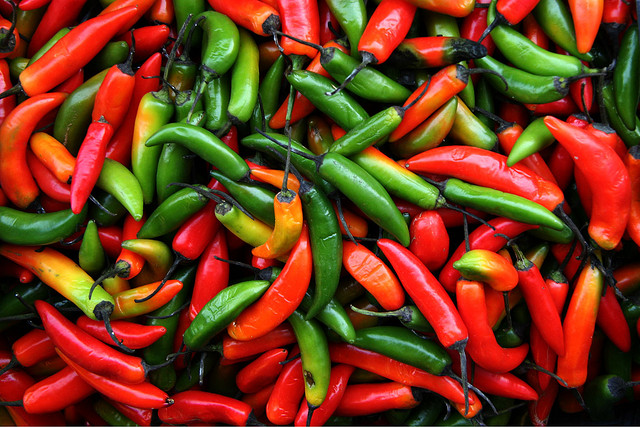
When I was a kid, I’d watch in awe as my dad ate dinner. It wasn’t just the heaps of food piled on his plate that impressed me. (The words “portion control” had yet to enter the public lexicon.) What always made me shake my head in disbelief was his curious habit of alternating bites of his meal with bites off a jalapeno pepper. To save time, he’d simply hold the pepper in one hand and his utensil in the other. I should also mention that my heritage is Indian, and that my mom served up traditional spicy dishes on a nightly basis. But it was never spicy enough for Dad.
I’d always assumed that he’d just burned all the taste buds off his tongue, leaving him desensitized to the pain I felt if a raw pepper came anywhere near mine. But the science of spicy food liking and intake — there’s a whole body of research dating back at least to the 1980s on this — shows there’s more to it than just increased tolerance with repeated exposure. Personality, researchers say, is also a factor in whether a person enjoys spicy meals and how often he or she eats them. The question is, how much of a factor?
Over the past few decades, culinary psychologists and other food researchers have proposed several cultural and biological reasons why we eat spices that may elicit pain, such as early learning, prior exposure, societal norms and physiological differences in taste and oral anatomy. Although desensitization to capsaicin, the plant chemical that gives peppers their burn, is well documented, there’s also evidence that the effect is surprisingly small.
“This suggests chili liking is not merely a case of increased tolerance with repeated exposure, but rather that there is an affective shift towards a preference for oral burn that is not found in chili dislikers,” write Nadia Byrnes and John Hayes, researchers at Pennsylvania State University’s College of Agricultural Sciences, in a new study on spicy food consumption.
UPenn researchers have previously linked chili liking to thrill seeking, specifically an affinity for amusement park rides and gambling. Later, SUNY Stony Brook investigators found a relationship between chili liking and sensation seeking when using a more formal measure of personality called Zuckerman’s Sensation Seeking Scale. In both cases, however, the associations were fairly weak, and neither study looked at intake — how often a person eats spicy foods, versus how much a person likes spice.

As part of a larger study on how the capsaicin receptor, TRPV1, influences oral sensations, Byrnes and Hayes decided to take another look at the psychology of so-called chili-heads. They used an updated measure of sensation seeking that avoided gender- and age-biased questions, as well as dated references (questions like “I would like to make friends in some of the ‘far-out’ groups like artists or ‘hippies'” were replaced with prompts like “I would have enjoyed being one of the first explorers of an unknown land”). They also introduced a four-point scale for responses, allowing for more nuance than the older yes/no response method.
Ninety-seven male and female participants ranging in age from 18 to 45 filled out a food-liking questionnaire and rated the intensity of sensations after sampling six stimuli, including capsaicin mixed in water. Later they took an online survey that included personality measures and asked how often they consume foods containing chili peppers.
Sensation seeking emerged as a much stronger predictor of spicy food liking than in the previous studies, and it also predicted how often a person ate chili-laden meals. The personality trait, however, was not associated with high liking of non-spicy foods, which reduced the possibility that thrill seekers are just crazy about food in general.
Surprisingly, frequent chili eaters didn’t feel the burn from the capsaicin sample any less than people who ate peppers less often. The study group may not have been large enough to show a desensitization effect, Hayes explains, or there may have been a disconnect between reported frequency of intake and actual dose. Someone who says he eats spicy foods twice a day may still be eating small amounts, for example. “No one knows the capsaicin dose or dosing frequency required in the diet to induce desensitization,” Hayes says.
Still, the lack of evidence for desensitization in the study boosts the argument for personality as an important factor. “That is, chili-heads like the burn more, not just perceive it less,” Hayes says. He can’t yet say exactly why sensation seekers chase the pain of peppers, but a follow-up study in the works that breaks up the personality trait into two sub scales, intensity seeking and novelty seeking, may help to answer that.
Ultimately, a combination of factors influences who goes for the mild wings on Super Bowl Sunday and who reaches for hot. “Certainly, prior experience, childhood exposure and learning all play a critical role in liking for spicy foods,” Hayes says, “however, there are also individuals who acquired an entirely [new] set of food preferences as adults once they moved away from home. It seems plausible that personality differences may be a major factor in this sort of exploration and learning.”
So what about my dad, who grew up on spicy foods? Had he eaten enough jalapenos, serranos and other spicy little beasties over the years to blast his taste buds off the Scoville scale? When I asked him why he used to chomp on a chili alongside his already-spiced meal (a habit that he shed as he aged, by the way), his response surprised me: “A chili is a chili,” he said. “It was always uncomfortable. I think I did it for the excitement.”
Jennifer Abbasi is a science and health writer and editor living in Portland, OR, and PopSci’s Sex Files columnist. Follow Jen on Twitter (@jenabbasi ).
