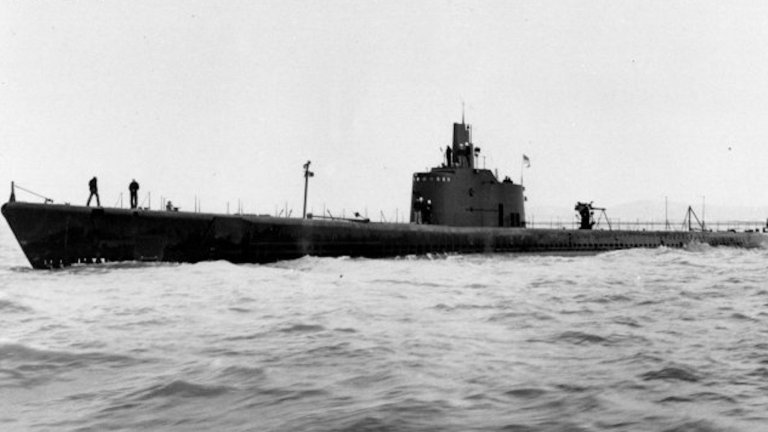
Today marks 60 years since U.S. scientists detonated the world's first thermonuclear weapon on the Enewetak Atoll in the Pacific. The hydrogen bomb, powered by nuclear fusion rather than fission, was hundreds of times more potent than the atomic bomb that devastated Hiroshima in 1945.
In August 1955, Popular Science published 10 photographs that together tell the dramatic story of "10 years of progress in harnessing the mighty atom," from the uranium rush to the first atomic hospitals. We also carefully illustrated and annotated our vision of an atomic spaceship (one day!) Check out the gallery for some of the biggest moments in atomic history.
See the gallery.The incredible innovations, like drone swarms and perpetual flight, bringing aviation into the world of tomorrow. Plus: today's greatest sci-fi writers predict the future, the science behind the summer's biggest blockbusters, a Doctor Who-themed DIY 'bot, the organs you can do without, and much more.


Online Content Director: Suzanne LaBarre | Email
Senior Editor: Paul Adams | Email
Associate Editor: Dan Nosowitz | Email
Assistant Editor: Colin Lecher | Email
Assistant Editor: Rose Pastore | Email
Contributing Writers:
Kelsey D. Atherton | Email
Francie Diep | Email
Shaunacy Ferro | Email
People often say that the bombing of Hiroshima was an example of science gone wrong. It really wasn't though. Americans said "how to we vaporize 1,000 japanese people instantly?" and it worked really well.
It is amazing how far science progressed during wwii. Im always amazed at how we came to harness the power of the atom, and am scared at what power we will learn next.
Miguel Aleksich Is The Name Ask Me Again And Ill Tell You The Same
I've made $64,000 so far this year working online and I'm a full time student. Im using an online business opportunity I heard about and I've made such great money. It's really user friendly and I'm just so happy that I found out about it. Heres what I do, Bat25.com -
@Blarg_King,
Coming up with the idea of making a bomb, making the bomb itself, and dropping it on others to see what damages it does; it is all science. Science is really indifferent towards a 'negative' or *positive* outcome.
I find it strange that intellectuals have become so acceptant towards nuclear research. We have all become so positive minded focusing on finding some great discovery, without considering the reality that history has showed us, namely unveiling death and destruction of matter on earth. What comes after the release of nuclear energy, what is the next step ... maybe setting off some sub-atomic combustion process; how deep can we dig a tunnel before it collapses on us?
Anyway here's an old activist poster with an interesting quote:
“Do nothing, and nuclear testing will eventually come to an end.”
http://tinyurl.com/Nuclear-Testing-Greenpeace
(The image is from the ending of the Planet of the Apes.)
@Chelle12
We could split hairs and say the atomic bomb was an engineering problem. The only science was the fundamental physics research that was necessary to make the engineering project possible. Furthermore, the act of dropping the bomb, while it provided some scientific insight, wasn't a scientific decision. I'm only making this distinction because I feel like you're indirectly assigning blame to a process that only seeks knowledge and truth. Any blame, or expectation of a moral imperative, should fall on the Interim Committee... nobody else.
Hasn't materials research and mechanical engineering provided us with all the blades, rifles, tanks, ships, planes and conventional bombs required to kill each other? I hear no call to end research in those disciplines.
Another interesting quote:
"There is no case where ignorance should be preferred to knowledge — especially if the knowledge is terrible."
- Edward Teller
"...Imagine you are a scientist. In 1958 there is a big discovery – some of the very first satellites launched by the United States discover the Van Allen radiation belts. Over the next couple of years they are further studied and characterized by more satellites.
So imagine that you are a scientist, and there are no nuclear proliferation or testing bans in place yet. What’s the next thing you would do? Perhaps you would launch a nuclear bomb into space and try blowing up the belts, just to see what would happen. That, in essence, was the Starfish Prime project, which is described in vivid detail in the following video:..."
blogs.howstuffworks.com/2010/07/02/how-the-starfish-prime-nuclear-bomb-worked-blowing-up-the-radiation-belts-for-science/
en.wikipedia.org/wiki/Starfish_Prime
If you do further research of the radiation that was left in the Van Allen radiation belts, it makes outer space lethal and impossible, to pass human through the Van Allen radiation belts. Of course, NASA and other paid USA government scientist deny this, but when you actually find out the amount of radiation that does exist in the belts and how extremely thin the skins of Apollo spacecraft, it just becomes impossible to pass through and a human to live.
@suggestivesimon,
Building a Nuclear bomb was a conscious decision made by scientist and after all a science project. Those scientists could have refused to do so, one was Lise Meitner:
- Meitner refused an offer to work on the project at Los Alamos, declaring "I will have nothing to do with a bomb!" - http://en.wikipedia.org/wiki/Lise_Meitner
Do not blame the politicians only, that is hypocritical.
After the first Atom bombs people like Oppenheimer wanted to stop making bombs because its devastating results, and it were other scientist such as Edward Teller with new ambitions wanting to make a name for themselves, that wanted to build the H-bomb, and so they did.
Like I said science is indifferent, and the drive behind it human ambition and big ego's.
Regarding blades, rifles, tanks, ships, ... the Atomic bomb is the end point of that list, and the problem is its immense destructive force and the radiation it causes, the harm it can do e.g. killing millions at ones, making Hurricane Sandy look silly, and your argument completely irrelevant.
So what does comes after the A-bomb, do we really want to know if there is an ultimate energy source that we want to discover; to do what, fly at the speed of light, discover a Wormhole to an other dimension, find pink bunnies than can cure any disease; what is it that we still want to discover beyond our current knowledge of Quarks and the HiggsField, without putting the safety of our existence at risk, when is it all enough?
There are so many fields of science that are yet uncovered, so many good things we can do for the world, but why must we keep on building bigger machines with higher energies and frequencies & densities that are 1.000.000.000 higher than cosmic rays in nature in nature. Nuclear science is puts life on earth at risk.
It's like Alice in Wonderland, how deep do we need to chase the bunny down the Rabbit Hole before we realise what this curious dream called life is about.
@Chelle12
I cannot agree with the idea you're expressing.
On the topic of the A-bomb, I kind of get what you're saying. Yes there is a human component involved. The question can be asked: why didn't the scientists involved all stop working on the A-bomb? Some of them did stop... others chose not to stop, not recognizing the intended use of their research... and others chose not to stop, arguing that they were in a race with the Soviets. It's a valid question. But the other valid question is: how many lives did the A-bomb save? Various estimates exist, but they tend to be in the millions of lives. Your argument depends on the A-bomb being a totally bad thing, but its legacy is not a black or white issue, and portraying it as such is either disingenuous or stupid.
The atomic bomb might be the end point of that list (for now), but atomic warfare has killed an estimate 250 000 people. Conventional warfare has killed hundreds of millions of people. In terms of actual impact on humanity, my argument is far more relevant.
On the broader issue of research: "So what does comes after the A-bomb, do we really want to know if there is an ultimate energy source that we want to discover..." and to the rest of your paragraph: Yes. An emphatic Yes. Capital YES!
Any discovery has the potential for misuse and harm. Where does your argument end? No more chemical research? No more biology? No more electrical engineering? You're going to say "no no no, you have it all wrong", but you can't make an exception just for nuclear. If you adopt this mindset, it ends in the stone age.
@suggestivesimon,
• "do we really want to know ... Capital YES!"
Do you really want to know what comes after the H-bomb, even if it would mean a chain-reaction that who knows might blow our blue planet to pieces. How would you be able to contain the release of some new sort of energy on a subatomic level, it is impossible. We now even get into big trouble when a reactor starts to melt down. Some realism might be in order here.
• "Where does your argument end ... you can't make an exception just for nuclear."
The exception proves the rule. Just like you can say almost anything what you want in the free world, but no racist stuff. You should be able to do almost all the scientific research you like. Setting up a few rules is not necessarily a bad thing for everyone's safety. If it wasn't for big anti-nuclear protests in the 70s and the 80s governments would still be pushing forward, it is the same as we have now with global garming, overfishing, and cutting down of the Rainforest. People these days seem to have forgotten about the dangers of the Atom bomb.
Look what I started. Mwahaha hahaha aha.
@Chelle12
"a chain-reaction that who knows might blow our blue planet to pieces"
You can replace this with "a rogue genetic mutation in genetically-modified crops that will decimate crops/livestock", or any other of a thousand worst-case scenarios related to current research.
Your position is one based on weighing the possibility of bad consequences of research to judge whether that research should take place in the first place. If you adopt that position, you can't logically single out nuclear research. That whole free speech vs racist argument is bull (and weird).
At the end of the day, besides nuclear proliferation, nuclear physics has given us 1/8th of the world's electricity, saved countless lives by diagnosing and treating various diseases, not to mention being a foundation to the rest of Physics (which has benefited humanity in so many ways). The imagined risk of some fictional doomsday scenario is a paltry excuse for halting nuclear research, especially in the face of all the known, real-world benefits of that research.
@suggestivesimon,
You make it sound like ever increasing particle colliders are a must, and without them science will come to a halt. This is absolutely not the case, there can still be so much research done without stepping beyond certain limits.
When I look at the evolution of fire and explosives, than I have my doubts about what the next great discovery might be:
Fire -> Gunpowder -> Dynamite -> Nuclear Weapons -> ?? Sub Atomic ??
This is not some Sci-F list, so what ever that possible *last* kind of hiden energy might be it might very well be a jinx.
Nuclear bombs are bad.
War is bad too.
Find a peaceful solution to life's obstacles!
Wow.... there's still people against progress? Whats next in the big boom catagory??? As far as I'm aware... nature seems to have done that and been there. And we observe whats next by looking at stars and black holes and all sortsa things but .... we kinda know whats out there and whats next. We're just trying to harness it. Event though my favorite line is "today's magic is tomorrows technology", this isnt some unknown magic we're talking about where we might cast some unknown spell and usher in some age of darkness. Poeple watch (and believe) too many doomsday movies. Chain reaction???? Yeah we seen all the chain reactions out there in the universe so far and nothing unknown is gobbling up planets. My lord. The nuclear bomb was used in one war... to stop that war... to save lives... it worked. What other single weapon in histroy has ever stopped a war? Now the technology is used for peaceful purposes and hasnt seen a battlefield in 60 years... i'd say it has a stellar record.... pun intended. And yes there are accidents.... but that dont stop you from driving your car to work everyday does it??? Let me ask this.....once we all live in utopia and all bad technology that can hurt us has been cast out and everyone lives till they're a hundred and we're all standing on eachothers heads for lack of room and eating eachothers's.... nevermind.... resources, chelle12.... if the human race is going to survive its gonna need resources. Planet earth can only support so much for so long.... and we aint gonna get more with a pony.
Today's magic is tomorrow's technology.
@chelle12,
30 years ago i could drive down any street and odds were that I'd be the only... or one of only a few cars on that road.... back then rush hour resembled a sunday today. My point? The world is getting crowded... resources becoming scarce. And the problem is growing exponentially. Took 30 years for me to notice and realize that, hey! the roads are CROWDED!!! Price of everything is sky high!!! Must mean resources are getting low... more people competing for them. What will ten more years bring? 20? 30?!!! Here's were it will all end.... either... we continue to dig deeper into that tunnel of knowledge and find a way to do more with less, find new frontiers to explore and colonize, progress...OR... there will be a mass dying off... mother nature will eradicate what it cannot support. Wars... conventional or otherwise.... famine.... disease... all these things will bring about a reduction in the population.... and equilibrium will result one way or the other. Look.... i understand your fears... back in the 40's people were afraid that the A-bomb would detonate the entire atmosphere and choke us all to death. Turn the earth into a mini-sun. But here we are, much more enlightened, i would hope. Yet people were afraid that the LHC(Large Hadron Collider)was going to set off some sort of "chain reaction" that would swallow the earth. It didnt.... and ya know why? Cuz they are dealing with just a few particles... experiments on a small scale. Even if they created a tiny black hole it wouldnt live to know it existed, let alone swallow the earth. And how do we know this? The sun and black holes and other cosmic objects and events that deal with the actual processes we are trying to understand tell us so. We have studied and seen what it actually takes to create world ending events. IMHO i just think that people need to stop the fear mongering. Lets be cautious? YES! Absolutely! But ban certain fields entirely cuz of unsubstantiated fears? No. We cant afford to leave any tunnel unexplored.
Today's magic is tomorrow's technology.
@GGenua,
• "Cuz they are dealing with just a few particles... experiments on a small scale."
That's not true.
In nature there are about a thousand cosmic-ray collisions of a few GeV’s (1 GeV= 10^9 electron Volt) per second per m^2. In LHC it are about one 1 billion per second per cm^2. That’s 1.000.000 times more for an area which is 10.000 smaller, a density & frequency difference of 10 billion.
By the end of 2012 we humans are going to generate collisions on this planet, that are even 1000 times more intense, with energies of 8 TeV (1 TeV= 10^12 eV). These collisions are in nature even less frequent per m^2 while the density & frequency at the LHC of 1 billion per cm^2 is maintained.
Here's a table of temperatures:
tinyurl.com/temperature-list
• "We have studied and seen what it actually takes to create world ending events."
Also not true.
For safety we haven't considered the risk that the now confirmed HiggsField, and/or the still mysterious DarkMatter, might act as a medium that could transfer vibrational energy from the collision-center on to the surrounding matter, disrupting the inner-dynamics and energy-exchange within the surrounding atoms, ...
A combustion process happens continuously in your car, when a couple of intense *sparks* ignited the fuel and an explosion follows; or just like the heat vibrations of a match can light a candle by weakening the wax; or how you can't light a match with a slow rub, but with enough pressure and speed, you increase the density & frequency so the sulfur can heat up and flash-over.
… and this is my point of a chain-reaction, single high-energy cosmic ray collisions will do no harm at a low density & frequency, but if you start focussing them all in one spot and keep doing this for a longer period, you create a situation that is unseen in the universe. The LHC is a giant magnifying glass, and just like the sun won't start a forest-fire, a small loop can by bundling the photons, and a combustion process follows. Basic physics.
btw the Hubble telescope has given us dozens of pictures of Supernovae, in all kinds of colors end shapes, so who knows maybe one type is manmade by a civilization that wanted to find out what is on the other side of the tunnel.
@chelle12
I know youre just kidding about the supernova thing right? To create a supernova you need a giant star and the hyper-intense energies and pressures only it can create. And did i mention the giant star? As far as i know we dont have one.
So ok you shot down some of my arguments.... but... i still think youre way too paranoid. And... your view condemns the human race to an eventual population reducing dying off of billions of people that our planet (not giant star) simply cannot support indefinately. I sure hope your points of view dont prevail.... cuz if they do I'd like my kids and grandkids to be some of the survivors. You can sacrifice yours since its your idea to stop progress in the only field of study that may eventually lead to enough energy, resources and places to live for the excessive population that this planet(not giant star) is producing.
Its ashame that your fears prevent you from truely enjoying the great accomplishments on our horizon. And BTW, if there are some great civilizations out there with the potential to blow themselves up with a supernova accident.... i hope that humans someday achieve that level of sophistication as well. Would sure be a great time to live. But i'm sure there would still be some people who feared that supernova accident. God bless ya chelle.
Today's magic is tomorrow's technology.
@GGenua,
Ha I'm not troubled by fear or paranoia preventing me to enjoy science, in fact I just like to look at the scientific possibilities of the risks that a higher energy particle collider might cause, and the ignition of a combustion process of Atoms was the foremost logic thing that came to mind, especially now it is proven that there is something filling up the space between all the Atoms, the Vacuum that was previously considered to be a empty is full of stuff.
... and sure in the case of a natural process our Sun isn't massive enough, but it still is a pretty large Gas bubble, so a sharp sting could blast it all open, instead of becoming a classic Red Giant that would simply fade out. Similar to how a tiny needle can puncture a balloon filled with gas, and cause a heavy blast, versus a balloon that otherwise would simply go flat over time.
Well its good to hear that youre enjoying the science too. Shows you have an open mind. Now if i can only make you see that we dont have the capability to create a high energy particle collider that can destroy the world as you say. Think of it this way.... the military would already have it if it were possible. Right now it would take thousands of H-bombs to completely destroy the SURFACE of the earth... and yet, the earth would still be here even if we were not when it was all said and done. I just think that if there was any chance at all that we knew how to blow up the earth in one shot, that the military would be all over a weapon like that already. I think it's safe to say that particle colliders are no threat to our existance. There's plenty more out there to worry about that can do that. And lastly,.... you can take all the planets and moons and asteroids in our solar system and slam them into the sun and the sun would hardly burp let alone burst. The highest energy beam we could ever come up with is like a sigh compared to the high energy particles the sun deals with every second. We can no more burst the sun like a balloon filled with gas than we can walk on it. Go ahead... shoot the sun with all our Thermonuclear bombs.... shoot lazers and fazer and photon torpedos at it... shoot it with all the particle beams you want.. maybe throw in a tri-cobalt weapon or twenty while your at it too. And do it till the sun finally decides in a few billion years from now to turn into a red giant and swallow the earth like a tic tac.... I doubt it will notice.
Today's magic is tomorrow's technology.
@GGenua,
You are missing something; the high density & frequency along with the high energy release of the particle collisions, would cause high energy vibrations in the Higgs Field, that would start to shake-up all matter surrounding that focus point.
So instead of just smashing protons into pieces, the continuos shaking-up of the Higgs field around the collision point, would cause the quarks in the protons of the Atoms in that area, to lose their connectivity with the Goldstone bosons, and disrupt the mechanism that gives mass to matter, this would cause the protons in those Atoms to stop functioning and break apart.
The billions of atoms surrounding that focus point, would than start to lose their composure and combust. This would cause an enormous energy release and all kinds of Sub-atomic particles would be hurdled around, and they would in return keep on shaking-up the Higgs field, and so the dynamics within the Atoms that surround that initial central Area will also be disrupted, etc. etc.
That's how you start a chain-reaction on a sub atomic level, that spreads out like how a forest fire, that can be lit by bundling the less dense light from the sun with a single loupe, and before you know it, all the atoms on our planet serve as the fuel for a global combustion process.
Thus it wouldn't be like our planet that smashes into the sun, or some kind of intense laser-beam; but our whole blue planet that would violently explode outwards from the original ignition point, generating an immense sting, similar to how an Atom bomb blasts open, but this time it would be on a Sub Atomic level.
Can you dig it this time?
No chelle.... unfortunately i cannot dig it.... youre obvioulsy better educated on this than I am. Over my head as they say. But heres two more points for you to contemplate. ONE: I am as sure as shhh... nevermind... lets just say that, I dont think any of the scientist that DO understand all this stuff your talking about, would for any god forsaken reason disregard the dangers you've mentioned and continue with this madness! That would be like me lighting a match in a dark room I KNOW is flooded with gasoline just so i can figure out where the door is! Basically, if the experiment means the end of the world, loss of all knowledge, defeating the purpose of the experiment... why would they try it? And TWO:... if you know something they dont, then first ... go get a job in weapons developement for garsh sakes! You'd be rich! And two.... PLEASE GO TELL THEM STUPID SCIENTISTS TO STOP!!!! lmao.... ok... so if you can shoot down my two points i will dig and go away.... was fun though.
Today's magic is tomorrow's technology.
@GGenua,
If you look at nature, than you'll know bees have an important role to play, who to says that we haven't got ours, well I'm not going to continue to argue with you, it's all ok,
have fun,
m.
@chelle12
Sorry.... didnt realize we were arguing.
I guess your bees analogy is your final word. And who can argue with that? I can only hope that our role is not so mindless.
Peace...
Today's magic is tomorrow's technology.
@GGenua,
"I can only hope that our role is not so mindless."
What else would our role be? We evolved from monkeys that had a thumb and who could hold a stick to hit each other on the head, to Neanderthalers that could control fire, unto the point that we now are; an intelligent species that can build a Tsar bomba, what weapons are there still left to develop others than our own final destruction? Aren't we born to die?
@chelle12
As individuals, yes i suppose we are born to die. As a species: I can only hope that our role is not so mindless. Call me an optimist but, I'd like to believe that you reach a certain intelligence level (as a species) where you can escape the "role" that was handed you and blaze your own path. Not saying we're there yet but .... experiments by our fine scientists that, I'm sure are not blindly and knowingly going to cause the sub atomic combustion of the earth, are some of our first steps towards that self-guided destiny. I guess we just have different outlooks chelle.... lets just agree to disagree like good little monkeys.
Today's magic is tomorrow's technology.
@GGenua,
I agree. Although I can also welcome your vision, who know's what positive things the future might have in store ... the great mysteries of the Universe : )
Thanks for the chat.
Your very welcome :) was my pleasure.
Today's magic is tomorrow's technology.