
The strange bright red dots are visible in nearly every image taken by the James Webb Space Telescope (JWST). However, the frequency of their cosmic cameos didn’t make them any more explicable to astronomers. But after four years of analysis, researchers now believe they know why it was so difficult to identify these mystery subjects: they’re an entirely new astrophysical source.
“Our picture of this object is evolving very rapidly,” Rohan Naidu, an astrophysicist at MIT, said in a statement.
What is a black hole star?
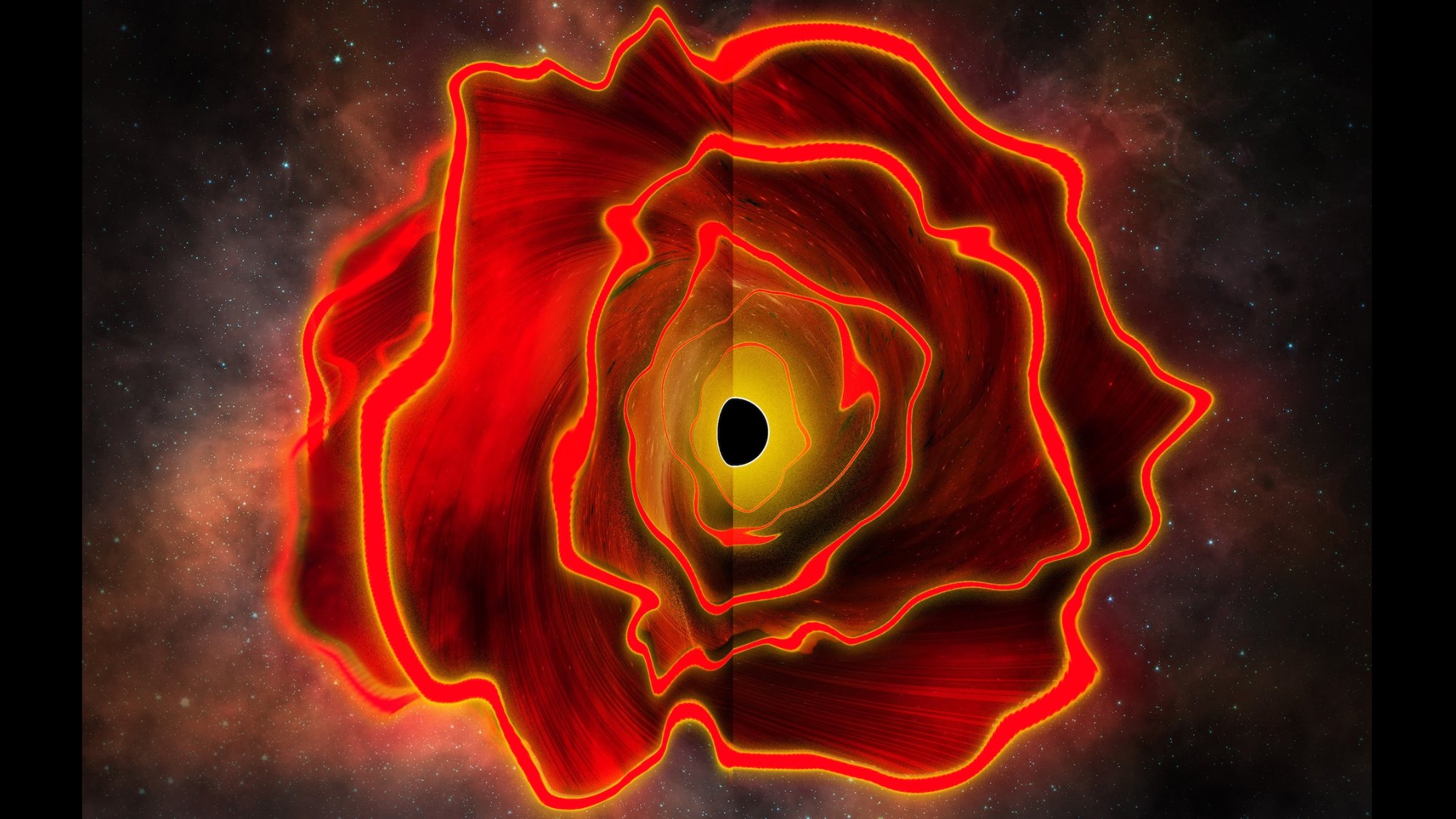
Meet black hole stars. As the name implies in a study published today in Nature, these previously unobserved entities are an amalgamation of space-time collapse and stellar forces. Picture (if you can) a gigantic, dense gas cloud fueled by a central black hole, instead of the nuclear fusion usually seen in a star. Now, increase the size you’re imagining to unfathomable proportions: the black hole itself is around 100,000 times as massive as the sun, while its star-like gas envelope is as big as the solar system.
“It’s huge,” Naidu concluded.
The potentially revolutionary discovery wasn’t intentional. Initially, Naidu and colleagues wanted to identify the furthest, oldest galaxies in the universe during a project they dubbed the Mirage or Miracle (MoM) survey. JWST is uniquely suited for such expeditions, because its sensitivity allows it to peer hundreds of millions of years into the cosmic past, deeper than any telescope before it. Even at such a relatively young age, the universe was producing strikingly bright galaxies—but some of these potential galaxies weren’t what they seemed. Hence the survey’s name.
“What we found was that what looks like an extremely bright early galaxy, aka a ‘miracle,’ in some cases actually could be a ‘mirage,’” said Naidu.
Miracle, not mirage
While perusing JWST images for MoM suspects, the team flagged one inexplicably bright red dot. In astronomy, an extremely red object frequently denotes a lot of dust, which can obscure its true nature. MIT Kavli Institute for Astrophysics and Space Research (MKI) director and study co-author Robert Simcoe likened the phenomenon to recent wildfire smoke from Canada that reddened skies over the northeast.
“Astronomical objects can also appear redder than their intrinsic color when you see them through a veil of dust,” Simcoe said.
A closer inspection didn’t align with their initial theory, however. Its light featured nearly no metal or elemental signatures apart from helium and hydrogen. And although the dot’s light was very bright at higher wavelengths, it disappeared entirely below a certain threshold. This is called a Balmer break, which generally indicates dense, photon-absorbing gas swirling in the atmospheres of ancient stars. One of the night sky’s brightest stars, Vega, is one such example. But this tiny red dot puts Vega to shame.
“The break we observed in this object is the deepest break we have ever observed in any object, ruling out ‘ordinary’ stars as the source,” explained Naidu. “It was truly singular in so many ways.”
100 billion times brighter than a star
Baffled by their observations, astronomers ran various simulations to investigate astrophysical attributes needed to create the red dot’s hue. These models ultimately revealed that, in some cases, a cosmic object could produce red light with only hydrogen and no dust.
“To our surprise, it turns out you can, if you have an extremely dense screen of hydrogen,” added Simcoe. “[It’s] so dense that it looks more like the surface of an enormous star than a wispy interstellar nebula.”
But even after settling on the hypothesis that some incredibly strong-yet-obscured source of energy, surrounded by dense hydrogen, was responsible for their red dot’s Balmer break, it still didn’t solve for a brightness that is 100 billion times the luminosity of a star. Something so bright isn’t fueled with nuclear fusion, which rules out traditional stellar objects. But there is another entity that does generate those levels of energy.
After incorporating a black hole into their simulations, astronomers compared their results with observations from JWST. Only then did they land on a scenario that could plausibly generate the red dot’s brightness: their black hole star.
‘Pure black hole light’
Researchers have named their discovery MoM-BH*-1, which references the survey that found it, its new classification, and what will likely be the first of more black hole stars to come. Many other red dots lurking in JWST models may soon be explained by the new astrophysical model, although none detected so far are nearly as bright as MoM-BH*-1.
“What is special about MoM-BH*-1 is, the black hole star is essentially completely outshining its surrounding host galaxy, such that we’re seeing pure black hole star light,” said Naidu.
The groundbreaking realization and newest addition to the cosmic catalogue wouldn’t have been possible without the JWST, whose smallest discoveries have massive ramifications. Even something as tiny as a 100-million-year-old red dot.
“It made us wonder if we were seeing a new kind of ‘stellar atmosphere,’ but on a spectacular scale,” recalled Naidu.
