
Now that our European friends are oh-so-close to finding the elusive Higgs boson, what’s an American accelerator facility to do? Go into the private sector. It’s the American way.
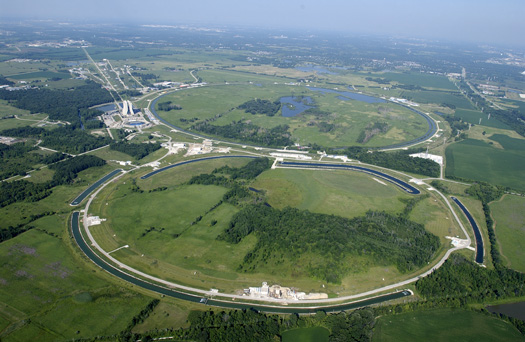
Researchers at Fermilab just broke ground on a new research and industrialization facility called the Illinois Accelerator Research Center. When it’s finished sometime in 2013, scientists and private businesses will use the new 42,000-square-foot building to develop new accelerator technology that can be used for industry, medicine and national security purposes. In addition to a new building, the project will use space once dedicated to the now-silent Tevatron.
Scientists from Fermilab and the Argonne National Laboratory will use the facility for research, but Fermilab says a major focus will be developing partnerships with private industry. Although we usually think of the Tevatron and the Large Hadron Collider, there are something like 30,000 other accelerators around the world, working on projects from paleontology and biology to food packaging. Accelerator-related industries are worth an estimated $500 billion a year, Fermilab says.
“However, the nation lacks enough training centers for accelerator scientists to feed this growing segment of the economy,” as Fermilab Today points out. And the country’s accelerator leadership is under fire. The new research center will address this problem. The facility will have space for test accelerators, cryogenics infrastructure, temperature-controlled workspaces, high-capacity electrical power systems and more.
Meanwhile, the scientists at Fermilab are still planning major new facilities and new experiments to follow on the heels of the storied Tevatron. A proposed new high-intensity proton accelerator, awesomely called Project X, would spark the development of new accelerator tech, which could also feed into the IARC. A new neutrino project called LBNE would use the world’s highest-intensity neutrino beam to determine why matter prevails over antimatter in the universe, and a new muon experiment called Mu2e will study whether muons can change into electrons, the way quarks and neutrinos can switch teams.
The IARC will help spur new advances in all these areas, Fermilab says. Plus maybe provide a kick in the pants to American industry.
[via Chicago Sun-Times]
