Biostorage: Storing Bytes in Bacteria Just one gram of bacteria could store as much information as 450 2,000-gigabyte hard drives in its DNA, a Hong Kong research team says.

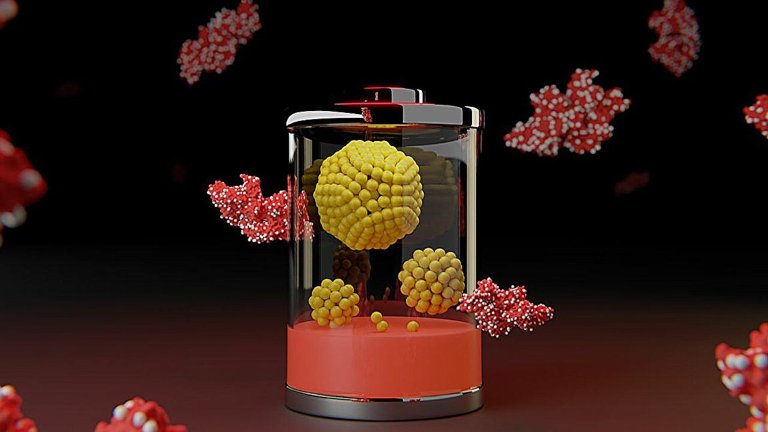
E. coli gets a bad rap – probably due to the violent illness it induces – but a group of Chinese University students in Hong Kong have found a novel and potentially reputation-changing use for the bacteria: data storage. The team has devised a way to encrypt and store information in the DNA of bacteria to such an effective degree that they say just one gram of E. coli could store the same amount of data as 450 two-terabyte hard drives.

Biostorage, or the storing of data in living things, is nascent but not new, having been around for about a decade. But earlier efforts at encoding data into DNA have been incremental – for instance, a few years back a team of Japanese researchers encoded Einstein’s relativity equation into the DNA of bacteria, demonstrating that it was possible but otherwise not pushing the field forward.

Three years later the strides taken by the Hong Kong team are far more significant, showing that not only text but also images, music, and video can be stored within cells. The team devised a means of compressing data into chunks that can be placed in different cells and mapped so that it can be easily located later, much as CPUs chop and store data in fragments. They’ve even developed a three-tier security system that allows them to encrypt the data in an unhackable way, making data stored on their bacterial systems impervious to cyber threats.

In theory, bacterial biostorage systems could hold vast amounts of data in very small spaces, and since the bacteria keep replicating they could feasibly store data reliably for millennia. But the applications don’t end there; the team is exploring ways their techniques could be used to encode extra information into organisms like genetically modified crops to create a sort of “bio barcode” that would identify the provenance of a certain strain of GM vegetable or help track the spread of certain GM crops designs.

[Discovery News]

16 Comments

storing data in cells... like how we store memory in our brain cells?

I wonder two things:
1. How fast is data I/O?
2. What happens if the bacteria escape the confines of the drive?

@Septimus Prime: I can see it now...

I was told I should defrag my bacteria but when I came back it escaped and it killed my cat... again :(

@ -my name here- : No, not at all like brain cells. DNA stores all the information that makes up an organism, and this is just a way of hacking that storage potential for other purposes.

A brain cell is essentially a networked microprocessor and stores its information via the connections across the network itself. It doesn't store much of anything by itself, and it's not in a readable format, nor is it compatible with digital information, because it's purely analog. DNA information is digital and stored in a much, much, *much* smaller form. Individual molecules make up the 1s, 0s, 2s, and 3s of its storage medium. That's not to say that it's *better* than the brain, because only the brain can process information in the way that it does. DNA is just a very thrifty way of *storing* information.

@ Septimus - E. coli actually only has a few strains that are damaging, so there's no risk of contamination here - there's a beneficial strain of E. coli involved in human digestion that you couldn't live without. With that said, I don't think we're talking about a drive, here. I think the idea is to create an archive of stored information that would have to be maintained and retrieved in laboratory conditions.

why do they claim it can hold 450 two-terabytes hard drives of info? why not just 900 terabyte drives?

Because the comparison exists to make it sound impressive, else they'd simply say "900 terabytes," so they went with the most impressive-sounding drive to start with. = )

Wow,
This is going to set off a new breed of hacker-geeks who are going to nano-engineer real viruses and kill us all.
(Kidding)

Am I going to loose all my data If I spill a bottle of anti-biotics on it?

What about genetic mutations? Is my data really going to evolve in actual sense?

Is our cellular genetic content filled with similar information encoded by alien progenitors?

Does my storage device run on milk?

(@ home) Will I be incubating viral vectors with encoded data in a humidified incubator overnight & sort my cells
to actually store my data on a hard-drive? and PCR, western blots to read them?

If I store a file in one bacteria and it replicates, am I going have redundant data?
.. Interesting though!

@ Septimus... lol... So if the bacteria escape, kill the cat. Any infected humans will have 2 terabytes worth of porn to populate their dreams with... Provided someone can install/ infect the necessary drivers required to decode the data :P

o.o they look like gummi worms

That's a thought... if we can decrypt data stored in DNA, how long is it going to be before we can do the same for humans. Via some mechanical / viral implant...

Give us cognitive access to the "notepad" files of our own DNA. Preferably translated from the raw bases into programmable /editable code.

Humans are basically machines after all; "the sum of their experience" is my understanding of our soul, free will and all that bollocks. So not all that far away from Human-HTML I reckon.

So is it applicable, how long does it take to print the data on the bacteria and how long does it take to read the data?

@extremechiton, that would be bad if you ate your homework.

I wish I could understand how did they do it. But this was simply amazing!!

My question would be:
Since data stored(configured) in a bacteria's DNA. Will there be like a genetic mutation? What if that bacteria died? Where will we store this bacteria? I mean disks can be found in Hard Disks.. and Bacterias could be stored in..? What type of room/environment condition for the bacteria live in a very long life? Will these bacteria live if they are exposed in sunlight? Will these bacteria live in 32-38 degrees c?

The real message of this technology is the durability of the organisms. Living fish the coelacanth and its DNA have out lasted two Pangaea already. The continents have separated and come together twice and this fish has outlasted all the mountain ranges. The point is this data, as of today, is the ultimate Seti project, because using the magnetic field of Jupiter we can send the bacteria light years away with encrypted messages to either seed life, and or encrypt a message to the location of knowledge. Perhaps we will find messages in basic life forms on earth that can be decoded. Maybe it will have physical formulas of how to tap entanglement communications via particles from the oldest stars, to virtually join an entire community of alien life.

science.discovery.com/videos/sci-fi-science-ii-approach-light-speed

Reminds me of Greg Bear's Blood Music.

If E. Coli dies, when does it die, under what conditions does it deteriorate and what precautions could be taken to prevent data loss?

@vophsi E.Coli dies dies within a minute or so but before that the bacteria multiplies and divides several times(reproduction) creating several more bacteria with the same DNA content hence the data stored in the DNA remains protected.


July 2013: The Future Of Flight

The incredible innovations, like drone swarms and perpetual flight, bringing aviation into the world of tomorrow. Plus: today's greatest sci-fi writers predict the future, the science behind the summer's biggest blockbusters, a Doctor Who-themed DIY 'bot, the organs you can do without, and much more.


Online Content Director: Suzanne LaBarre | Email
Senior Editor: Paul Adams | Email
Associate Editor: Dan Nosowitz | Email
Assistant Editor: Colin Lecher | Email
Assistant Editor: Rose Pastore | Email

Contributing Writers:

Kelsey D. Atherton | Email
Francie Diep | Email
Shaunacy Ferro | Email

circ-top-header.gif
circ-cover.gif
bmxmag-ps