Jellyfish Hodgers via Wikimedia

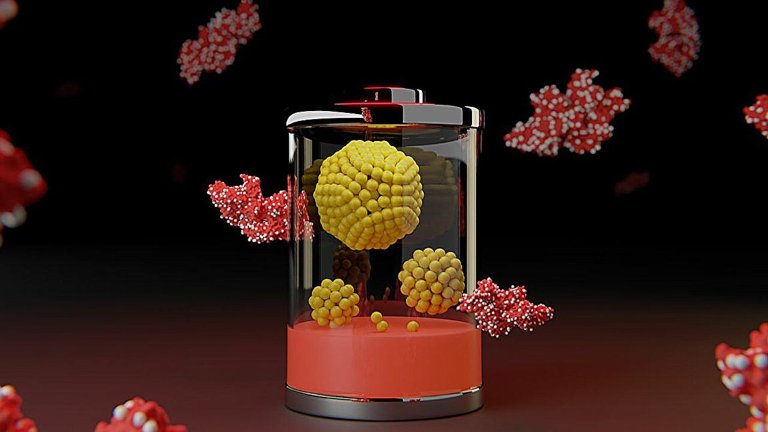
A group of Swedish researchers are looking beyond plants for living models upon which to base their solar harvesting tech, turning instead to the photovoltaic prowess of the jellyfish. Tapping a protein in the jellyfish Aequorea victoria known as green fluorescent protein (GFP), the team has assembled a device that converts ultraviolet light into free electrons using a drop of green goo.

The team assembled its cell from two simple aluminum electrodes separated by a small gap atop a silicon dioxide substrate. The GFP is placed between the two electrodes where it assembles itself into strands connecting the electrodes. When introduced to UV light, the GFP gobbles up photons, producing electrons that enter the circuit as electricity.

Why GFP? For one, it’s inexpensive. It doesn’t require expensive additives or costly processing, but can go directly onto the substrate where it starts cranking out juice. Further, it can be integrated into a self-contained fuel cell that requires no outside light source. Photons would instead be generated within the fuel cell by enzymes like the ones found in natural light-producers, like fireflies or sea pansies. Such a power source could be miniaturized to power tiny nano-devices.

Not to mention, jellyfish are in great supply. Populations are booming in some areas, leading inexplicably to massive jellyfish swarms (the Gulf oil disaster could lead to a spike in jellyfish numbers in those waters). If researchers can harvest something good from all that extra GFP in the water, more power to them.

[New Scientist]

6 Comments

small nano devices. like what??? the smallest device i have is my electric toothbrush. if it can't power that then I don't care.

@drinny26
Dude, if you are going to make a joke, make it funny, if you are being serious, then stop blogging on any site that has science in its name. Futhermore, get a vasectomy and save the world.

It's funny how popular science never gives the full story, but just enough to tease you with. It's almost as if the popsci people just want you to get your hopes up about something and forget about the real problems involved.

Too bad the website they get many stories from gives you it all. The bad news as well, that they've only managed to get .1 percent efficiency out of some photovoltaic algae cells, and don't expect to get better than conventional cells which is at 15-20%. But possibly just cheaper.

Doesn't sound nearly as promising as it's made out to be.

I think it's brilliant. If I were to look for innovation that could take solar or protein energy production to the next level, it would be fluid based voltaics. I've long thought it would be possible to take what is currently a two dimensional PV cell and add a third dimension - not unlike layered transparent cells - If we're getting 15% efficiency from the top layer, the nex layer might generate 13% efficiency, and so on until it's not useful - ultimately generating more power in less surface area.

Now take this idea a step further and introduce an electron generating fluid - "green goo" - and you have a dynamic PV solution that can be pumped, transported, moved..through transparent membranes like windows, pipes, channels, holding ponds, etc. It's fascinating - maybe even mash the technology from those self-organizing network devices and marry that to a small "ball" of green goo and now you can monitor and maximize wattage generation.

This science is on the cutting edge of what's possible. We need those who criticize and raise objections to continue doing so because they provide the negative energy needed to help spur those who create new ideas and solve problems.

@ FriedGuy
"Futhermore, get a vasectomy and save the world."
Nicely played Sir. Nicely Played

Sound like a good idea but i don't think it will be used for power generation, the cost of harvesting the green goo only to power nano devices is something that seems economically unviable. Possibly will have a use in light detection circuits/receivers depending on its sensitivity and the gain it can provide.


June 2013: American Energy Independence

Five amazing, clean technologies that will set us free, in this month's energy-focused issue. Also: how to build a better bomb detector, the robotic toys that are raising your children, a human catapult, the world's smallest arcade, and much more.


Online Content Director: Suzanne LaBarre | Email
Senior Editor: Paul Adams | Email
Associate Editor: Dan Nosowitz | Email
Assistant Editor: Colin Lecher | Email
Assistant Editor: Rose Pastore | Email

Contributing Writers:
Rebecca Boyle | Email
Kelsey D. Atherton | Email
Francie Diep | Email
Shaunacy Ferro | Email

circ-top-header.gif
circ-cover.gif