
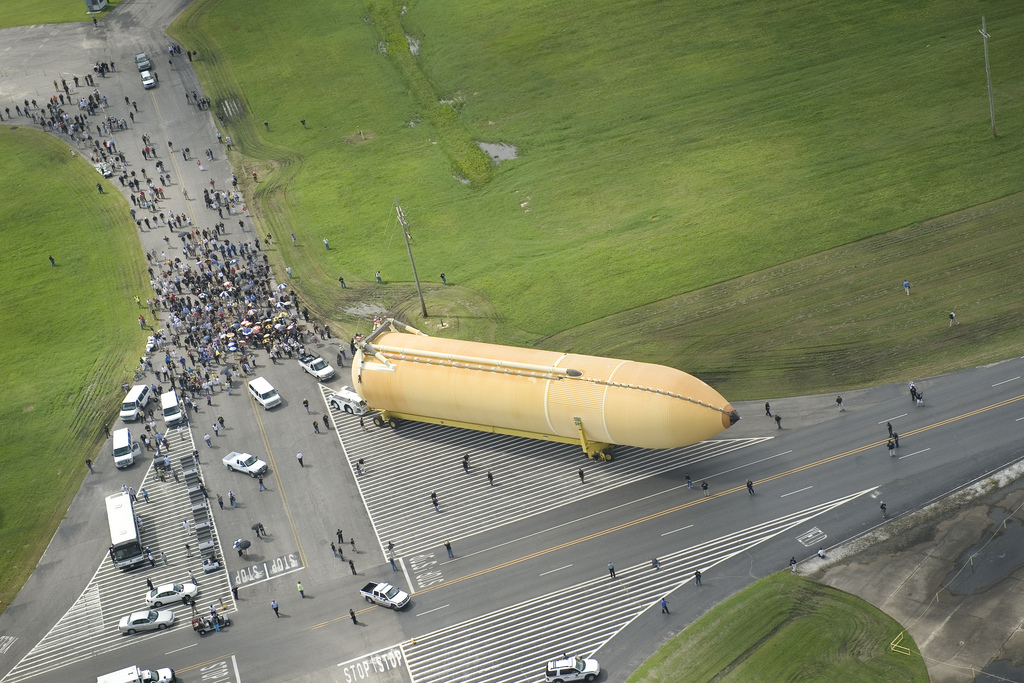
Final Tank Rolls Out The (perhaps) final space shuttle external fuel tank rolls out of Michoud Assembly Facility near New Orleans on Thursday. The Senate is working on a bill that would roll back some of President Obama's plans for NASA while adding an extra shuttle flight before the fleet is retired next year. NASA

The space shuttle program ain't over till Congress says it's over. A Senate committee is working on a bill that would add an extra shuttle flight next year, as well as defy some of President Obama's scaled-down NASA plans, the New York Times reports today.

The bill would continue plans to develop the Ares heavy-lift rocket and a program to build a spacecraft that could go beyond low-Earth orbit, the Times reports, quoting David Vitter, R-La., the ranking Republican on the Senate space subcommittee. It could also hamper the growth of the commercial space industry by requiring companies to demonstrate their abilities before they could get delivery contracts.

Like all politics, this is local -- the main architects of the pumped-up NASA plans hail from states where space-technology facilities are located. The bill is the result of negotiations among Sens. John D. Rockefeller, D-West Virginia; Kay Bailey Hutchison, R-Texas; Bill Nelson, D-Fla., who flew on the shuttle; and Vitter, whose state is home to a Lockheed facility that manufactures the space shuttles' orange external tanks.

Under Obama's proposal, announced in February, NASA would cancel its plans to go back to the moon and instead focus on developing new technologies. The agency would design plans to fly humans to an asteroid around 2025 and Mars 10 years later, and rely on private industry to fly astronauts and cargo to the International Space Station.

Many critics have said the plan leaves NASA bereft of vision, which has long driven the agency's greatest accomplishments. But there wasn't much love for the Constellation moon-return/Mars program, either.

After initially canceling it, Obama agreed to keep the Orion crew capsule as a possible escape module for the space station. But the Times reports the Senate bill would restore the program to developing a deep-space vehicle.

The Senate committee will take up the bill next Thursday, the Times says.

[New York Times]

24 Comments

NASA should definitely be focusing on new technologies and deep space travel. For the next decade though I think they should stick with what they've been doing. If you're worried about money please understand that we spend more per year on recycling subsidies (9 billion dollars) then we will be spending on NASA for the next five years. So in all honesty I think we should be funding NASA more heavily. Not less.

Since humans refuse to voluntarily reduce their growth there will come a time when the Earth’s resources will not support us. Even with new technology resources are limited, baby diapers can only grow so much food. Space exploration is essential to the future of the human race.

“They’re making more people everyday – but they ain’t making any more dirt.” – Will Rogers

I believe we should go back to the moon for its Helium 3.

Fusion energy has always been a scientist dream but the
Tokamak with its Deuterium/Tritium fuel is too difficult
to control. 20 years 30 countries, 60 $ billion and over 200 PhD's have been unable to sustain a reaction greater
that 5 nanoseconds.

Helium 3 is much easier for fusion with lower temps and
no energic particles emitted.

This is probably why the Russians, Chinese, Indians, and
others were jumping up and down with joy when NASA was
prohibited from completed their Moon exploration.

We need to goto the Moon and then Mars.

You guys are smart.

NASA was the first to the Moon, it should be the first to go back to the Moon, as well as the first in whatever NASA wants to be first in, and restricting funding to recycle or for any other reason is not the way to be first.

I love the moon and want us to go back and stay there; but constellation is the wrong way to do it. We need to cut this cancer out, yes it will be painful but it is a necessary procedure.

The New York Times article doesn't say anything about Ares V.

I do not understand why NASA has not decided to privatize. They would be moving at faster paste on traveling to the moon and Mars and beyond. They need to function more like a corporation then a government lending organization. This way they have their own say on how things are done, and are no way dependent on congress, the president, or any other governmental figure.

aerosphere,

And how do you propose that a government agency privatize? It isn't like anyone working at NASA has such a choice, only congress could make it private, and even if it did where would it get its funding?

@tcolguin,

Privatization is simple...the government sells its NASA assets to the highest bidder under whatever terms/conditions. Whoever wins will run it just like any other business. It's a bad idea of course, at this point. Even with visionaries like Elon Musk at the helm, the private sector will be unwilling to swallow NASA whole, because there is no profit motive other than space tourism. The government should only think of privatization when it has found a new home for humans, or when the space industry has matured into a space faring paradigm. At the moment, NASA will have to maintain its mandate of spearheading space exploration for humanity's sake, and let the private sector follow in its wake.

Space Tourism is not the only way for NASA to get it's funding. If someone offered to buy NASA, then all of the patents that are in NASA's name would then belong to that person. The money from those patents, instead of going back into the US treasury, could be used to run NASA, at which point it would have about 3 times the operating budget it has now. People complain about NASA being expensive to run, but in fact it is making much more money off of old patents from the Apollo days (computing and comunications technology, mostly - every cell phone, computer, or other personal technological device pays out to NASA for the use of the technologies they developed).

@ areosphere, maybe they could do that, but the private sector is probably not as careful as the government agency which already has the nation's top minds employed there. Accidents would likely become more common and more catastrophic.

I imagine NASA has some super secret patents that are a matter of national security (well, the technology to build it)

@Greatusername

Yeah, we should not have the private sector ever make rockets into outerspace. In fact, we should shut down our airports and trains since they have accidents too. The best way is to just have one team build spaceships. That way ... we'll just have only a small amount of people going to space. Bah.

There will be accidents ... there have been accidents, but we have to branch out eventually. We need to have alternatives. We can't just stay on this planet because we need a back up plan. And not every smart person works for NASA.

If we are going to go back to the moon, we better have a moon base on there. The best way to do that is to have robots build it. In the meantime, there is so much more out there that we should learn about. I, personally, would rather see an asteroid landing than a moon landing.

Okay. Let's review:

1. There is currently no "private" space industry. Those who are flying to orbit are doing so based on government contracts on systems developed by government $. This does not include so-called "sub-orbital" amusement park rides such as Virgin Galactic.
2. The difference between the current mode of operations and co-called "commercial" operation is that a company provides the transportation as a "service" contract rather than the government operating the system directly. This has been going on with NASA and USAF programs for many years.
3. Patents and space tourism will not fund the development of systems to take the US to LEO and beyond. There just aren't enough billionauts.
4. Governments will continue to be the primary investors in space infrastructure for the intermediate future. There is too much risk and too little immediate return to justify the huge capital investment required. Governemnts financed the canals, highways, airways, etc. that enabled transport of goods and services. The country as a whole reaped the returns. That is a proper role for government investment.
5. The government has not yet issued certification standards for human spaceflight. No private company can currently claim to be ready for human spaceflight since the qualification process is TBD.
6. NASA continuously develops new technology. These efforts may result in Technology Demonstrations, of which NASA has dozens in work at any time. These do not result in operational flight systems.
7. Obama is cancelling Constellation, a sequence of full scale development programs for operational systems, in favor of an undefined collection of tech demos. The two are not the same. No operational missions will be accomplished.
8. It is fine to talk about developing "advanced technologies". It sounds really cool and is vague enough that you can avoid having to provide any pesky details. But "Helium 3 fusion" is not going to be taking anyone anywhere in the next 30 years. In the meantime, those who actually know how to design/build/operate actual manned spacecraft are being laid off, never to return.
9. The annual NASA budget for human spaceflight is about 0.003 of the federal budget. This is about 6 weeks expenditure in Iraq and Afghanistan. The Augustine Commission report that is cited as justification for cancelling Constellation stated that for an additional $3B/yr. Constellation could instead accomplish all of its goals.

The President's space plan makes no sense. It is a plan without a plan.

Meanwhile, America's strategic human spacefilght capability is being destroyed.

ObamaTrek: "To Boldenly Go ... nowhere."

@mrtritanium I didn't mean to insinuate that we should stop recycling (although I have my problems with how that system is ran currently, along with a multitude of others. If we were having a debate on politics I would love to go into the topic with you) I mainly wanted to imply that NASA is worth spending our money on. Most of our concerns on these topics will be rendered moot in about 19 years though. Energy production and space travel techniques are on the cusp of reaching something truly great and century defining. That maybe one of the reasons why we (our government) are cutting NASA funding right now. Those in the know see the light on the horizon. Will all our problems be solved? No. Will space travel become way easier? Yes. Bonus question. Who here knows what is projected to happen in 19 years?

I'm confused by some of the comments here.

1) Privatization - that is to some extent already underway by some of the many companies all trying to get vehicles in space. There are numerous sats in space that are not owned by the US government but instead owned by US companies. Both communication and imaging. @spacedengr - you are being sarcastic right?

2) We are laying off teachers by the thousands so that we can go to the moon on government dollars. If some investor wants to go to the moon - go for it. We won't stop you.

3) Obama wants to go to Mars...you got that part right? He wants to go to Mars? No one cares about the Moon. Been there done that. Yes I know they want to go there so that they can stage a moon base. Great...unfortunately we lost a trillion in Iraq and we can't go there now.

Simple fact is that Constellation has been kept alive for government contracts and for Florida to keep buying votes. This is a political decision, not a strategic one. Sad really.

Privatize Space just like we did for the Oceans.

They use to talk about bringing back a asteroid back from the asteroid field that they said could be worth 10 to 100 Trillion dollars in high grade ore and 100+ years to mine.

buckrodgers
We should have NASA working on cutting edge technologies in partnership with private enterprise to develop the needed innovations to develop and safely maintain a continuous presence away from near earth orbit. We have the space station for near earth orbit research. We need to develop equipment,manpower and methods to affordably visit other celestial targets that have scientific as well as monetary value to make the goals sustainable. As we delve to go further into the cosmos the cost in research, development and deployment will exponentially excelerate. Without the private sector and governments getting involed in an Apollo type conentrated endeavor together to reach into deeper space we may mever get there. We need the resources of our whole planet working together to get to where space commerce will be self sustaining. We are currenty not and may never be politically able to do this. Until that day arrives the US space program can take small steps to help acheive this goal which can have great benefits for our society. Our current administation has set unachievable goals due to our current financial situation. Laying off 1000 experienced people is not a visionary way to deep space only to the unemployment line. We need leadership. NOT Idealogy. Where in this whole process is a credible, sustainable pathway to the future of manned presence in space?? Is our technological prowess the true target of this new vision? Sharing the technologial wealth? We need to stop this insane assult on the technological - industrial dominace of our society which has already cost us millions of jobs and trillions of dollars.

@Beantown you are being very narrow minded and obtuse if you think we are firing teachers to go to the moon. I suggest you look into the matter of our tax/government spending system a little more thoroughly before you make wild assumptions like that. You'd be better off getting rid of the ESA before cutting funding for NASA. I know that sounds terrible but again you need to look into what the ESA actually does and not just what it says it does. All in all we need a massive reduction in government spending and involvement with it's people. Less taxes, simple goals and leave the states alone. Who here would like to help the poor in our country? Who here doesn't because the government already takes money from you saying they will give it to the poor? Who here thinks they could help their neighbor better than the government can? Who here understands what I'm getting at?

Ehem sorry... EPA not ESA... I hate acronyms >.<

-> beantown179 - Teachers are employed by local governments, not the federal government. Increasing funding for NASA has nothing to do with reducing funding for teachers.

Besides, Obama is re-purposing NASA for Muslim relations.

It seems everyone has an interesting perspective about the idea of NASA privatizing. Thanks for your input.

Here's how I think NASA would get money and run their company once privatized.

I believe that NASA could get there money from donations, still from museums, setting up stores to buy items like computers, cell phones, space food, etc, and could even make their own theme park (if they really wanted to).

They could have previous leaders within their organization become corporate leaders, and bosses of their bussiness. They could have employees under engineer, scientist, computer programmer, and all previous job positions. They could have various departments working on different space missions, and have staffs set up at the museums(which they already do) and stores.

@ captainkidd: um... that was a book by Ben Bova. People also talk about capturing a white dwarf for its power, but its not going to happen in a long long time. We cant even build a space station with out problem, you think we are going to the asteroid belt any time soon to return with an asteroid. They will probably screw up and it will land on your great great great great great great great great great great grandsons house.


June 2013: American Energy Independence

Five amazing, clean technologies that will set us free, in this month's energy-focused issue. Also: how to build a better bomb detector, the robotic toys that are raising your children, a human catapult, the world's smallest arcade, and much more.


Online Content Director: Suzanne LaBarre | Email
Senior Editor: Paul Adams | Email
Associate Editor: Dan Nosowitz | Email
Assistant Editor: Colin Lecher | Email
Assistant Editor: Rose Pastore | Email

Contributing Writers:
Rebecca Boyle | Email
Kelsey D. Atherton | Email
Francie Diep | Email
Shaunacy Ferro | Email

circ-top-header.gif
circ-cover.gif
bmxmag-ps