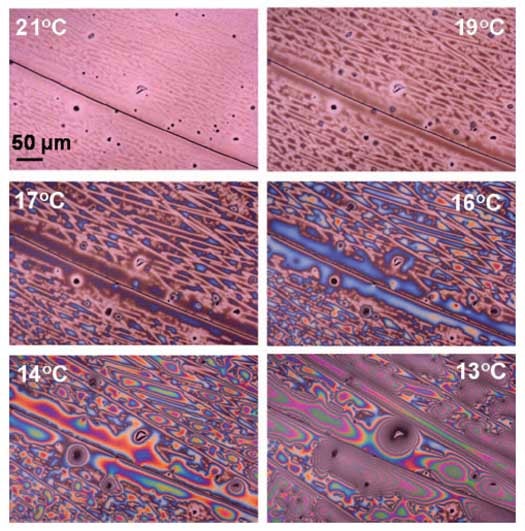
In a breakthrough so hot it's cool, Spanish researchers have figured out how to make water freeze at room temperature. By artificially manipulating the mechanisms by which water condenses in the atmosphere, the researchers found a means to trigger ice formation at far higher temperatures than water's usual freezing point, a development that could lead to better artificial snowmaking, more efficient ice skating rinks, and better freezer technology.
The prevalent school of thought regarding ice formation used to dictate that hexagonal structures similar to that of natural snow and ice were the best candidates to induce freezing or to trigger rain. The research team at Spain's Centre d'Investigació en Nanociència i Nanotecnologia decided to test this theory on a mineral named "Frankdicksonite," or barium fluoride (BaF2).
Frankdicksonite has the desired hexagonal structure, but the Spanish team found it to be a less-than-ideal ice-nucleating material. Except for when its structure has imperfections. When BaF2 has surface defects, its ability to spur condensation greatly improves. At the point of the surface defects, water tends to form tiny two-dimensional icy patches even under normal ambient conditions.The finding could swing open the door for a new kind of synthetic, environmentally friendly material that spurs ice formation at higher temperatures. The team is currently working on just such a material, with hopes of later creating what they call "intelligent surfaces" that can manipulate water in specific ways.
138 years of Popular Science at your fingertips.
Each issue has been completely reimagined for your iPad. See our amazing new vision for magazines that goes far beyond the printed page
Stay up to date on the latest news of the future of science and technology from your iPhone or Android phone with full articles, images and offline viewing
Featuring every article from the magazine and website, plus links from around the Web. Also see our PopSci DIY feed
The first issue of 2012 is a great one: we've got stories on how to make planes, tanks, subs, and soldiers invisible. Also, how the U.S. is reengineering homeland security at the southern border, inside the deepest mine in the world, and our predictions for the year to come.
ice-9! were all dead!!!!
Now we can reverse the effects of horrible man-made global warming! Al Gore would be proud of us.
I think this idea could drastically reduce losses in superconductors
Well it would be better if they figure out how to make room temperature superconductive cable. Then the world will never be the same as you could have the power plants thousands of miles away from the end use. And then power plants thousands of miles away could share power in times of need. Ergo, a whole new world.
this could lead to better and efficient cooling technology
Keep in mind that this ice is room temperature. Its not making anything colder. Its making ice warmer.
ice-9 anyone?
haha. Ice-9 is the first thing I thought of when I saw this. So awesome that other people did the same. :D
Ice-9, of course... haha this thing is pretty funny :)
www.saine-alimentation.com
@ohiojones
is the specific heat the same? does it take the same amount of energy to "freeze" it as it does to "melt" it at these higher temperatures?
if it does take the same amount of energy i dont see the value in regards to temperature, maybe only to solid and liquid states... you could have a real life Mr. Freeze :)
@freddy - That's exactly what I mean. This is great for manipulating water molecules from liquid to solid without having to actually lower them to zero degrees centigrade. Hence the comment in the article about ice rinks. Imagine going to an outdoor ice hockey game in July!
But it doesn't mean it makes it any easier to lower the temperature itself. The cooling technology and global warming comments just don't seem very well thought-out.