
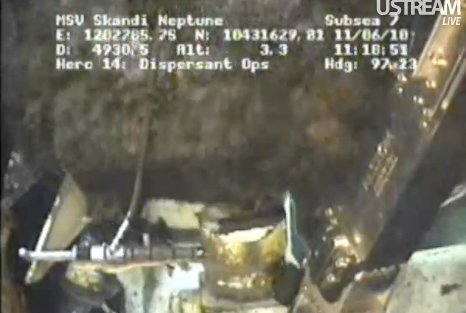
As oil spill estimates continue to worsen, frustration in the Gulf Coast is reaching a boiling point. But one possible reason people may feel like nothing is happening because people are not doing the bulk of the work -- robots are.
Remotely operated robots are shooting video, carrying equipment, drilling pieces into place, and monitoring the flow of oil. BP has contracted with at least four robotics companies, including Oceaneering International Inc., Subsea 7 and C-Innovation, to do the work, according to NPR.
Initially, the undersea robots were unimpressive, failing to activate a valve that could have sealed the well from the surface. But since then, they cut the broken riser pipe and placed both containment domes over the spewing well. They’ve also provided the live video streaming across millions of TV screens.
Teams of humans on boats are controlling the robots, which have names like Maxximum, Hercules and Skandi Neptune. The human operators -- two for each robot -- drive using joysticks, but they can’t see where their undersea avatars are going. Even with headlights, the robots’ environment is almost completely dark, so they use sonar to gauge their proximity to objects.The ROVs range in size from that of a small car to a big truck, although most of their bulk consists of foam intended to protect them from the intense pressures found at 5,000 feet below the surface. They remain connected to fiber-optic or copper tethers that enable communications, but sometimes ocean currents tangle or even break those lifelines.
The spill has shown the world how much hinges on the work of a team of robots, according to John Mair, global technology manager for the Scottish firm Subsea 7.
Here’s hoping they (and their human drivers) can handle the pressure.
The incredible innovations, like drone swarms and perpetual flight, bringing aviation into the world of tomorrow. Plus: today's greatest sci-fi writers predict the future, the science behind the summer's biggest blockbusters, a Doctor Who-themed DIY 'bot, the organs you can do without, and much more.


Online Content Director: Suzanne LaBarre | Email
Senior Editor: Paul Adams | Email
Associate Editor: Dan Nosowitz | Email
Assistant Editor: Colin Lecher | Email
Assistant Editor: Rose Pastore | Email
Contributing Writers:
Kelsey D. Atherton | Email
Francie Diep | Email
Shaunacy Ferro | Email
There is a solution.
A headless screw or threaded tapered rod(tap).
A turbine will turn in any of one of two directions along its axis. That depends on the orientation of the fins along its axis. The faster the flow of gas or fluid along the turbines' axis and fins, the faster the turbines' rotation about it's axis.
The fins of a turbine are analogous to the treads of a tapered threaded rod. (Engineers call them reverse- threaded 'taps')The faster the flow of gas or fluid along the axis of the rod, the faster the rods' spin about its' own axis - a rod; cylindrical, conically shaped with stumped ends; a reverse-threaded cylindrical tap.
The faster the rate of flow about the threads of the rod(tap), the greater the force exerted on the rod(tap) itself to move in the direction mandated by the rods'(taps') thread orientation.
I'm sorry I took so long. It is not to shine bad light on anyone. The manufacture of this is problematic. You need internal gyros analogous to those use to keep rockets and missiles on trajectory. I don't have clearance. And there is no time. A future solution for failed 'fail-safe' BOPs.
Doh! Why didn't I think of that...
I get the feeling that the Federal Government is deflecting all the blame for this incident to BP. Isn’t it the responsibility of our government to provide, as best as it can, for a secure and safe society for all the citizens? Yet there are reports that the Federal Government inspectors who were supposed to be inspecting these oil drilling operations, backup disaster plans, etc have been receiving gifts, sporting tickets, and more from the oil companies! And what are the upper managers of these inspectors doing if not inspecting their inspectors? Is the corruption all over our society? Does making a few free extra dollars win over our religious teachings, morals, and ethics? I hope the failure analysis of why this disaster occurred goes way beyond just looking at why the pipe broke or a mine collapsed.
Solution to stop leaking from well bore:
Connect underwater robot arm (use remotely operated vehicle ROV) and ship with strong plastic tube. Inner diameter of tube is about half inch. Then put inside in order 2 or 3 plastic balls and after that strongest Neodymium( NdFeB) or other kind magnet and again and again... Fill tube all way from robot to ship.
Use ROV to close end of tube (robot arm) to well bore installation on seabed. Cover outside installation about two or three meters from the leaking hole with lot of magnets (in many layers - about 20 cm thickness). Then put inside robot arm in leaking hole about three meters and shot magnets from tube. NdFeB magnets will stick for pipe installation inside and stick for each other with strong forces. And make some kind of magnetic mass shutter. Then cover it with iron dust to fill gaps between magnets. And leaking will be 100% stopped. This process will close up leaking pipe slowly and it is important to prevent so called hidro(oil) dynamic shock which probably can blow up installation from seabed. Well bore installation is very heavy and magnets are, too. If it not enough weight to keep well bore installation on seabed, it is easy to cover it with more magnets and iron parts (junk).
Plastic balls are imported to keep distance between magnets on way from ship down to robot and end of tube. They will flow away with oil when they go out from tube.
Magnets not needed to be ball shape; important is to easy go down through tube. Few tones of magnets is needed to fill pipe inside and outside and make flange.
If somebody likes my idea and want more details for technology, please ask!
BP primary objective is to save the well, not plug it.
www.reuters.com/article/idUSTRE65A5IA20100611?loomia_ow=t0:s0:a49:g43:r1:c0.166667:b34830366:z0
As an expert in oilfields in the Middle East, I’ve already offered BP the following simple technique that can instantly plug the well. Though BP admitted it can work, it wouldn’t implement it because it will kill the Well.
Plugging BP Well by a String of Cement-Filled Casing Pipes:
{BP has to lower down the wellbore through the Riser Pipe Stub and the Blowout Preventer a string of 16″- 18″ Casing Pipes connected together about 500-1000 ft long after being filled with cement. The wild well will instantly be plugged and there will be no need for the Relief Wells. The annulus space between the Casing Pipe String and the well walls can be filled by pumping cement. The whole operation will take a couple of hours- finito!}
PLEASE ASK YOUR SENATORS & CONGRESSMEN TO INVITE ME to face Tony Hayward during his hearing this week to expose the real BP for US officials and citizens, then implement this solution.
Eng. Hodieb Khalifa
Cairo – Egypt
hodieb_khalifa yahoo
I think some BP execs are going to get assasinated over this whole issue. If they plugged/pinched the well on day 1 they would have lost millions because they'd have to drill another well (oh wait, aren't they doing that already?)... what's the gulf coast of mexico when you stand to make Billions on a single well. Greed at it's finest.
Plugging the well with cement filled pipes? That would be like trying to plug your urethera with a slender twig from 5' away - while taking a piss. Right diameter, right hardness, but impossible to hit at that distance. ON a surface well, sure, but this is not a surface well. The physics are different.
Remember what things actually weigh at that depth (water pressure increases buyouncy - remember the sub in the soda bottle toy from your childhood?).
That said, let BP pump. The faster BP sucks up that little straw of theirs, the less spills out of the sides. In theory, with enough draw, you would begin to pull sea water into the tube to suck up with the oil. At that point, surrounding the area with sealant drawn towards the pipe would bind the seam (and let the pipe work indefinately).
