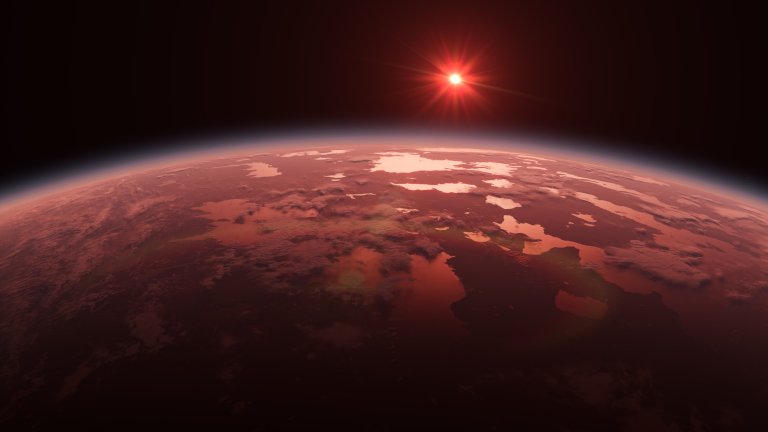
An Artist's Impression of the Martian Ocean 3.5 Billion Years Ago University of Colorado

It took NASA a few decades, several probes, and a whole lot of money to find hard evidence for the existence of water on the surface of Mars. But timing is everything. Had the agency been looking for water on the Red Planet a few billion years earlier, all they would've needed was a telescope. A new CU-Boulder analysis of the Martian surface has concluded that a massive ocean covered as much as a third of the planet around 3.5 billion years ago.

The CU researchers are by no means the first to suggest that Mars was once home to large oceans, but their research does lend a lot of credence to earlier assertions to that effect, assertions that have been challenged repeatedly over the years. The study is the first to mash up a huge body of data collected by NASA and ESA missions over the last decade. That data suggests Mars at one point had a hydrological cycle not too different from our own, including cloud formation, groundwater accumulation, and precipitation.

The ocean -- which likely covered about 36 percent of the planet and contained 30 million cubic miles of water, about ten times less than Earth's oceans -- was fed by at least 52 river deltas which were in turn fed by countless river valleys and tributaries. Half of those deltas were at similar elevations, most likely marking the ocean's boundaries.

Those deltas, identified by various orbiting missions analyzing the Martian surface, are more than just boundary markers for an ancient ocean. On earth, river deltas are fantastic preservers of the evidence of past life, and researchers think that if there's a good place to uncover microbial evidence of past life on Mars, those deltas are prime candidates.

Of course, if the researchers really have answered the question of Mars' oceanographic past, they've asked several more, most notably: where did all that water go? The Mars Atmosphere and Volatile Evolution Mission (MAVEN), quarterbacked by CU-Boulder researchers, will launch in 2013 to try and answer those questions.

[Science Daily]

14 Comments

Its hard to believe that if there was an ocean this big that there was no life. Mars was probably teeming with life. But it probably died out 3.5 billion years ago with the ocean. Does anyone know if we have found fossilized life on earth that is dated that old? If we have trouble finding it here I would imagine it would be even harder with the limits of the few robots we send.

According to wikipedia life first formed on Earth 4.5 billion years ago.

@ wowlife
there IS economic incentive to colonize both the moon and mars; untapped reserves of raw materials. Helium-3 for the moon and elements that we are depleting on earth, there was a chart here on popsci or in the magazine; I forget which but it turns out in a few years electronic device speed may stagnate or get slower due to depletion of a certain mineral. In addition, it would really suck if right after we got all of earth's problems solved, some meteor came and wiped out all humans because we didn't have a population in space or infrastructure up there to deal with the meteor. Also.. there's no ecosystem to screw up on mars without creating one, and even then we can start from scratch.There is no reason whatsoever that we can't deal with our problems on earth without ditching space, and by extension the long term future of terran life. In fact, certain resources we can only find in significant quantities in space like helium 3 can power clean, fusion power plants. And as for your last comment.. religion itself isn't evil; humans are evil. If there was no religion, people would just find something else to fight over.

@wowlife:

1. Ocean exploration is great, but it doesn't diversify our species as well to protect against the destruction of Earth's ecosystem you are concerned about.

2. What duty do we owe to Mars' environment? Are you assuming life? If so, that's fine, but let's be clear about whether we owe a duty to rocks in space.

3. Spending money to eliminate poverty doesn't reduce poverty. Look at the percent of people living in poverty before and after the New Deal, the War on Poverty or welfare reform in the '90s and you won't see much difference. Social spending doesn't improve peoples' lives, improved technology does. Sergey Brin has done more than LBJ.

4. Why attack religion in a post about Mars' oceans? If you're wanting money to fight hunger, wouldn't you get just as far using the money spent on cigarettes, gambling or pornography? Looking at it that way, maybe we need more religion.

If oceans existed on Mars 3.5 billion years ago and life started on earth 4.5 billion years ago that supports the theory that live from Mars seeded life on earth. I'm just sayin...

While water is requisite for life here on Earth, it is a huge assumption that water anywhere = life. If one believes that life evolved here, then one must also recognize the tremendous odds against that happening even once, let alone a second time on a neighboring planet. It's admittedly intriguing to consider the possibility of life existing elsewhere, and probably worth exploring extra-terrestrial systems in an attempt to settle the question, but we should not be at all surprised when we ultimately find that Earth is indeed unique.

The single most important task of the human race is to spread to other places in the universe.

It's the truth.

There's going to come a time when that's the only way the human race will be able to survive, and we better be very good at it when the time comes. The earth won't last forever, and there are far too many things that could wipe out the human race, or at the very least devastate our civilization. Asteroids, comets, climate change, etc. are all waiting to happen, it's a matter of when not if. Researching colonization technologies is, in a big picture sense, the most important thing we could be doing.

That being said, short term survival is still paramount. If we don't change what we're doing we won't live long enough to spread to other places in the universe.

I'm not so sure that mars once had liquid water. It's current atmosphere can not support liquid water. It has to either be ice or vapor. All they have come up with is by looking at pictures of the turrain and say hey it looks like water made those ruts. Other liquids could have made that turrain that looks like that. Also what about the wind that is on mars. I think they are jumping at water on mars cause it gets everbody interested in mars. In spending money on investigating it. And allow some scientist to keep their jobs.

You earthlings are so behind the times.
Here is the story. Mars actually had a lot more resources, oceans as far as you can see shiney things everywhere. Well we decided to head to the stars, Sol was getting crowded with the earthlings and all, so we took most of the water with us as well as everything else we needed. We did leave some cool things for you to discover, but if I told you that was be giving away the where is marty game we left behind.

Here's the deal guys: we are not "jumping at the water idea". We have already discovered frozen water at the poles. In fact, the Phoenix Mars lander found frozen water directly beneath the surface of Mars late 2008. As subscribers to this magazine and website how could you not know this? After much research and further exploration scientists have concluded that there is most likely still liquid water deep beneath the surface. That was over a year ago guys. Sacridias was right to say you are beind the times.

@wowlife

While I tend to agree on the whole religious thing, why do you act as if space has no importance? MArs is another world out there, so why not explore it? I'm not saying that we shouldn't explore our oceans, but what's wrong with moving out a little? Besides, all the planets in our Solar system formed from space, including Earth. And NASA has done far more for the U.S that people give it credit for. There's NASA technology in your friggin microwave, dude!


June 2013: American Energy Independence

Five amazing, clean technologies that will set us free, in this month's energy-focused issue. Also: how to build a better bomb detector, the robotic toys that are raising your children, a human catapult, the world's smallest arcade, and much more.


Online Content Director: Suzanne LaBarre | Email
Senior Editor: Paul Adams | Email
Associate Editor: Dan Nosowitz | Email
Assistant Editor: Colin Lecher | Email
Assistant Editor: Rose Pastore | Email

Contributing Writers:

Kelsey D. Atherton | Email
Francie Diep | Email
Shaunacy Ferro | Email

circ-top-header.gif
circ-cover.gif