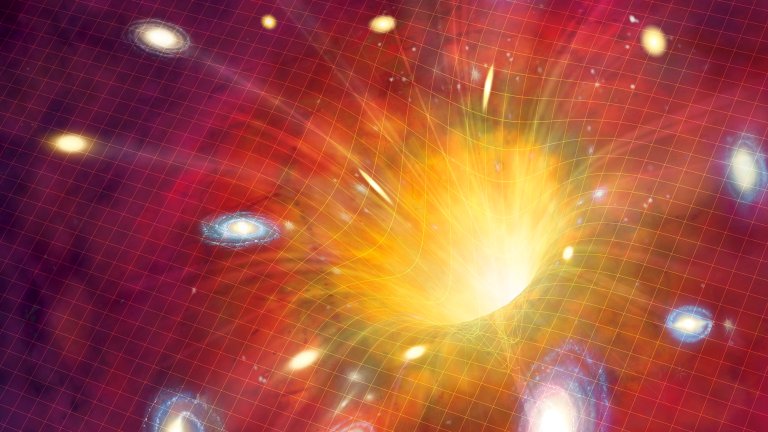
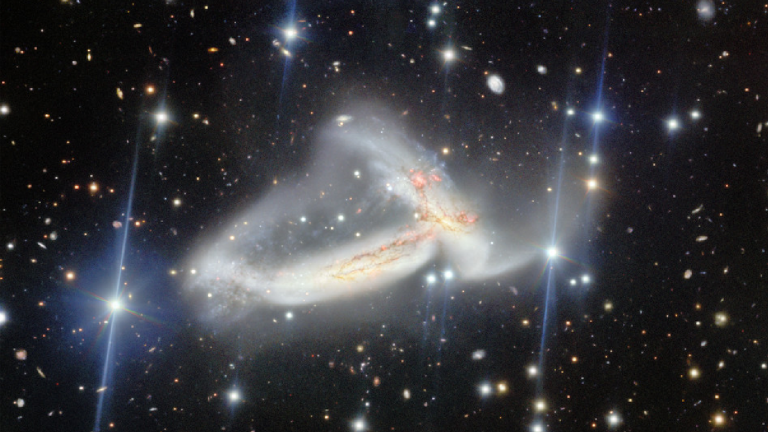
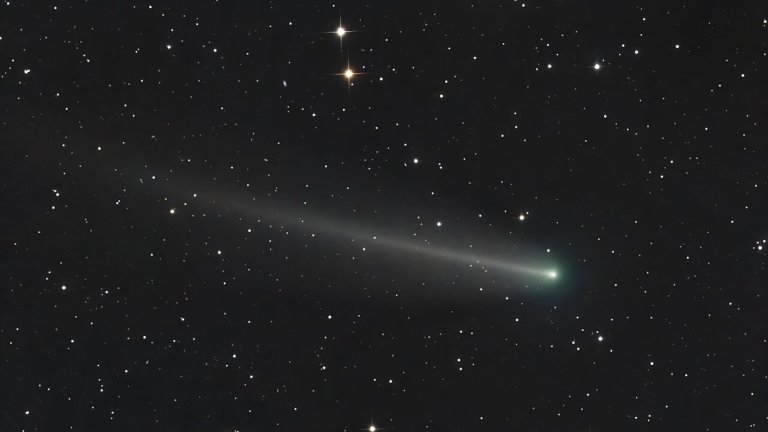
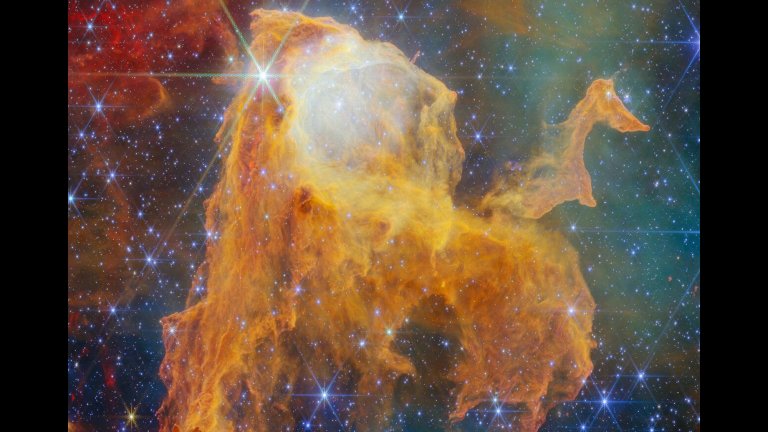
The Coma Galaxy Cluster The Coma Galaxy Cluster, which dark flow is tugging towards the edge of the universe. via National Geographic

First came dark matter, the gravitational source from within our galaxy that astronomers couldn't see. Then came dark energy, the undetectable force pushing the expansion of the universe. Now, NASA scientists believe they have confirmed a new player, dubbed "dark flow," that is dragging hundreds of galaxies along the same path. Even stranger, the researchers believe that dark flow is actually the gravitational pull from matter beyond the edge of the known universe.

The NASA scientists first discovered dark flow in 2008, when they observed numerous galaxy clusters speeding off at 2.2 million miles per hour in the same direction. The results were controversial, so the researchers spent another two years collecting data. The new observations further codified the discovery. According to the new study, which looked at 1,400 galaxy clusters, the pull of dark flow extends out from Earth at least 2.5 billion light years.

What exactly is pulling these galaxies remains to be seen, but the NASA team believes that dark flow is actually the gravitational pull of massive objects beyond the edge of the known universe. Interestingly, the idea of matter beyond the edge of the universe doesn't violate any laws of physics. According to physicist Leonard Susskind, who was not involved with this study, the boundary of the known universe is not a wall past which nothing can exist, but simply the farthest point from which light has reached Earth. Past that, there may very well be massive objects. But since the universe is expanding, their light will never reach us, and thus we cannot observe them along the electromagnetic spectrum.

Of course, how the gravitational pull of these objects expands past that range remains to be seen. In fact, the NASA scientists aren't even sure how far the power of dark flow extends, with some postulating that the power of dark flow might extend through the entire known universe.

[National Geographic]

29 Comments

The pull of the dark side is indeed powerful!

My theory is that dark matter is actually matter that instead of having a gravitational pull, it has a gravitational push against regular matter but dark matter can only pull other dark matter and the bigger it gets, the stronger it's gravitational push is on regular matter and the stronger the pull is on regular matter. Throughout the billions of years dark matter has separated itself from regular matter and is mostly gathered on the farthest regions of space, (the edge of the universe)sort of into a wall type thing. "Dark flow" might be an opening in such wall where a giant quasar or black hole might be pulling in galaxies. Just a thought, eh?

Let's say there's a galaxy a million light years from Earth. By the reasoning above, would the edge of the universe be a million light years further away for them than it is for us, and perhaps a million light years closer for them int he direction of earth. By that logic, doesn't that make the actual universe infinite in size and unbounded?

P.S. Dark matter black holes might push regular matter into further regions of space just as a regular matter black hole will pull them in. This might explain dark flow also.

What confuses me is that they talk about things moving at 2.2 million miles an hour away from earth, but relatively speaking, are they really moving in terms of space. Is there really any way to tell how fast something is moving. There is no standard of what is not moving. Maybe we are the ones moving at 2.2 million miles an hour. Maybe we are the ones getting pulled by dark flow.

kenstandre

From my understanding, if you look at the most distant star in the sky, that is the edge of the known universe ( along one axis) from the perspective of earth. Likewise, if you lived on that star earth would be edge of the known universe from the star's perspective. Therefore, light from the star has travelled a full "radius of the universe" further along that same axis (heading 180 degrees away from earth). However, since we only live on earth, we can only prove that light has travelled to this point. We can not prove or disprove anything about the size of the actual universe beyond this point. However, from this article it seems we can prove there is 'something of mass' beyond our known universe. we just don't know how much or how far. Perhaps a seperate big bang very far away?

"Do not underestimate the POWERRR of the dark side!"

@kenstandre: you are absolutely right. Wherever you are in the universe it looks like you are at the center of a bubble with the edge of the universe 13 billion light years from you in every direction. It could be that somewhere the universe ends and there is nothing more to see, but we would never know it from here.

Im just your average bored guy who likes space..

But this doesnt really fly with me:

If space is infinite, and the observable universe is just a bubble of light from our own perspective, -and there is a distinct possibility that there are massive objects past that bubble which we will never be able to see because of the expanding universe: Couldnt then the space outside our bubble have the same properties as our universe, -and couldnt there be light sources from other directions than the one we are trapped in? And shouldnt we then be able to observe those lights, since they should in fact be older than our own light?

I dont believe in anything "dark", it goes against the simple logic of natural / cosmological process. I think a "universe" is everything that gets sucked into a black hole, and the evidence we take for an expanding universe with an explosive beginning is actually just the expansion on the "other side" of the black hole´s intake. This process continues throughout every universe, with black holes cleaning and creating new universes inside each other. This makes more sense to me than "dark" whatever.

Oh and Kin-Dza-Dza is the best sci-fi movie ever.

About Universe's infinity: while it is very difficult for anyone, not just scientists, to imagine the infinity of the universe, it is possible that the U. simply doesn't have a beginning and the end, just like a donut or any spherical surface, thus we get infinity.

I wonder what kind of practical benefit does this new knowledge offers?

Go back and read your physics textbooks. All electromagnetic forces and even gravitational forces can only travel at the speed of light. Therefore, if another big bang went of outside of our known universe and it was having effects upon the Earth, we would be able to see such things. This isn't saying that such a big bang outside our known universe hasn't happened (such things are completely speculative), but if it had an effect on Earth we could see the light emitted. That could mean 2 things.

A. A big bang outside our known universe has happened and it affects other galaxies/solar system, but the light cannot be seen and therefore the gravity does not affects us. (The article doesn't necessarily imply that we are affect.)

B. This dark flow is some sort of matter which we have no encountered before and does not emit light, therefore we cannot see it but it can still have effects upon us.

As to the whole dark matter push/pull argument. Half the reason our galaxy and universe doesn't completely fall apart (fall apart = matter expaning outward in a way that doesn't form galaxies) is because dark matter pulls us together.

Dark flow is the reason that some months my wife is crankier than others...

eyewoo if my understanding of m theory is right the answer should be no you wouldn't be able to see light from beyond our universe.

Our universe is not infinite; it's a just one of many two or more dimensional "bubbles" or "brains" inside of an infinite 11 dimensional space. Almost everything we know about in this brain is what you can call an open loop string that can never leave the brain it's on. That being said light is also an open loop which means it shouldn't matter how close we are to another brain we could never see it anyway because the light on that brain can not travel to our brain.

Gravity (as far as I know) is the only closed loop string.

Meaning its not locked onto the 3 dimensional space we call home, it can travel freely in the full 11 dimensional space our little bubble lives in. (which is the reason gravity seems so weak)

I mean this is just me but what’s interesting is this dark flow my not even be something our universe. It might a completely different universe, a neighbor in if you will, which has nothing to do with this the big bang that made everything in this universe.

meh that's just my two scents anyway.

The Universe is supposedly expanding faster than the speed of light; therefore light emanating from objects beyond a certain distance will never reach us. Nor can we ever find out what is beyond that distance until we find some way to break the light barrier and/or 'cheat' round it. Scientists seem to believe whatever these high mass objects are, they’re beyond ‘our’ local lights reach.

Becoming aware of all this for me is like becoming aware that Christmas will always be two days away unless St. Nick can somehow find a way to make reindeer fly.

In any case this dark flow business is a fantastic mystery, and I’m pretty sure scientists will eventually find some fancy new ‘quantum tricks’ to help us solve it.

...or maybe Earth is being ejected from the universe, like some kind of societal pariah....

So many crazy sounding conflicting theories, it makes me really think all these scientists have something very fundamental completely wrong. From what I understand all this theorizing stems from the idea of the big bang, and what evidence for the big bang's existence is there really? The observation of a redshift in faraway galaxies? And so much science takes for granted that it must be true, although the theory does not ever try to explain itself into existence, it only explains how the universe evolved since then. Personally I can imagine many explanations for a redshift that don't require the big bang to have occurred (and thus I don't necessarily believe in the infinite expansion of the universe, dark matter, energy or flows, because all any of this does is try to fit into our explanation-less theory of the big bang)

First time post... what up.

I agree with beardedmonkey's statement. If susskind is correct and matter outside of our visible universe is invisible to us then it could simply be a result of said objects speeding away too fast for light (em radiation) to reach us. Be that the case, their respective warping of the space-time fabric would not influence us either, ie no gravitational effects.

However, if the galaxies nasa are observing are sufficiently close to the 'edge' of the universe, then maybe yes, dark flow is the result of gravitational pull from bodies outside of our universe.

One other oddity of this finding, is the fact that specific galaxies are 'flowing' in a certain direction, this would imply force vectors differing from those typically observed as a result of gravity.

Just an idea: maybe dark flow can provide 'an observable effect' of matter outside our universe, on our universe and possibly provide a corellary between the quantum (many) universes theories and those pertaining to the effects of forces traversing multiple dimensions (strings).

... the universe is flat ... those galaxies are going to dark flow off the eddge and into the unknown ...

Thanks dex draco, I kind of understand what you mean. :)

But I still dont get this light thing, and it being an absolute maximum speed, when every day I read about things expanding or rotating or exploding in speeds that surpass the speed of light.

Also, if we are going to use metaphores:

If I have a unusually long truck, traveling on a straight road at the speed of light, and on that truck I place a race car that has a maximum speed of 500 km/h, wouldnt the race car go faster than the speed of light the nanosecond after the driver pushes the pedal? And wouldnt you theoretically be able to stack cars on each other forever? Isnt speed something relative, just as everything else?

Have I grasped some of you wrong if you mean to say light is something that resembles a wall that keeps expanding, thus pushing everything outside that wall away. And outside our wall is another wall, expanding from the opposite direction. Everything swelling. But why would the walls cancel each other out?

If youve ever taken a photo of someone taking a photo of you, you would notice that you get each others flashes in the stills.

Ehmm, my theory on the section:
"Even stranger, the researchers believe that dark flow is actually the gravitational pull from matter beyond the edge of the known universe."

In my eyes, the big bang was one of an infinite amount, what accounts for the GIGANTIC gravity needed for such a change. Our sun, is classified as a dwarf star, what if our "universe" is just average, while some are thousands of times larger? Would it not exert forces that are "pulling" ours? Their photons not reaching us, but the gravity of the supergiant universe would.

Or could this immense gravity overcome any influence of "dark matter" and collapse in on itself forming an Uber black hole,
1) its light either didn’t reach us,
2) or was sucked back in before reaching us,
3) or the light band between its birth and collapse already passed Earth, thus unobservable.

To put it in easier perspective, stars when they die, either diffuse their matter and spray it all over the place leaving the heaviest elements in place. Bigger ones, spray less star stuff, without nuclear reactions keeping it inflated, it literally deflates and forms a super concentrated ball, a neutron star. The REALLY big ones deflate so fast and hard that they form the anomaly known as, black holes.

This perfectly models my multi, err "universe" theory. Our universe isn’t large enough to withstand the diffusing force of dark matter, so it gets larger and larger and larger. A "neutron" universe would, respectively become an extremely scaled up version of a neutron star. The "black hole" universes would form the "REALLY REALLY big one" that pulls at our universe over who-knows-what-distances.

beardedmonkey0

Perhaps you can explain "All electromagnetic forces and even gravitational forces can only travel at the speed of light." since light cannot excape a black hole but gravity does then gravity must be able to exceed (or is independant of) the speed of light.

nicht wahr?

ok which bastard pulled the cosmic plughole beyond the edge of the known universe... uncool.

larrynavery; The speed was measured by physicist Sergei Kopeikin by watching how light from a distant quasar was bent by Jupiter's gravity. Variations in how the image of the quasar was bent accounted for this speed of gravity... You need to rephrase your comment... gravity does not "escape" a black hole but is the consiquence of... if gravity was "escaping" a black hole then light would not be "sucked" in, rather it would be "pushed" away. We've measured the rate of the propagation of gravity to an accuracy of 20% and we've concluded that the "speed" of gravity cannot exceed that of the speed of light... furthur more Einstein.. as well as every other physicist i know believes strongly that Gravitational wave propagation is equal to that of the speed of light.

Interesting info. These are all mysteries that will take many years to be resolved and after that new mysteries will be infront of us..

Imran
make money online

Uhm, I'm not a religious guy, but the bible contains a pretty good description of what could be pulling these objects outward - it's called the void.

If the big bang did happen in a complete void (i.e. nothing, null, no space at all), then that void would constitute a vacuum. If our universe was exploded into a complete vacuum, then indeed we would find objects being pulled outward, as it is the nature of vacuums to pull stuff into them in an attempt to stabilize.

And this explanation not only would produce the observed effect, but it doesn't require any new "dark" whatever particles/energy/etc.

If this is correct, then we should see not only objects being pulled outward, but also these objects should be undergoing continual acceleration (i.e. they will get faster and faster over time.)

Regards,

Rodney Barbati

Here is a thought on the speed of light.

Apparently, the faster one moves, the slower that time passes for that individual.

I say that if you could attain light speed, time actually stops. AND there is experimental proof that this is exactly what happens.

Light will hit you at 186,000 miles/second no matter how fast you are traveling nor in what direction you are traveling. For example, if you started running at half light speed in a given direction, and I turned on a spotlight behind you, the light would hit you at full light speed, even though you might think it would hit you at half light speed.

The reason for this is because at light speed, time stops. If you were able to travel only through time, you would see the planets and move in their orbits. If you travel only through space, and not through time, no objects will be moving. Therefore, because time stops at light speed, light will always hit you at light speed because from the perspective of the light, nothing is moving.

This also means that light does not age (at all). Light does not experience the passage of time.

Now one question this brings up is, if you were to travel faster than light speed, would time actually begin to go in reverse? I don't know.

Basically, light speed is the clock speed of the universe, situated at the exact 0 point.

Also, if you flew at light speed away from the earth for 1 hour (timed externally of course), and then returned to the earth at light speed, the earth would be exactly 2 hours older, not thousands of years older. You, however, would not experience those two hours.

Regards,

Rodney Barbati

The easiest way to create an infinite universe in the smallest space possible, is to turn it inside out.

Picture an inflated balloon. It has a specific amount of space inside of it. Now turn the balloon inside out - now the balloon contains the entire universe, including you.

Rodney Barbati

I do not understand why the search continues for the graviton...

Gravity is not a particle - it is the effect of warped space. Warped space is not transmitted across distance, it is the distance.

Admit I am still confused myself if Gravity can go faster than light. If so there should be time lag of gravity effects for orbiting bodies though.

I am not quite sure if they are stating that the gravity has reached us already. If they are then they are suggesting that gravity is faster than light. Because the gravitational object is beyond light.

If they are not stating the gravity of this object has reached us then they its likely that one explanation could be that is because gravity has not had time to reach us.

Interesting thought because if it were that long ago that we are seeing these objects being affected by gravity I wonder where they are presently.

The answer question about how they know that we are not being attracted rather than other objects being attracted might be determined by a radial distribution of movement. If the force is all pointing at a certain point then that would indicate the location of that force. Hard to say if they have determined that or not from this article. Would be nice if they would cite further articles to look up for a more in depth study.


June 2013: American Energy Independence

Five amazing, clean technologies that will set us free, in this month's energy-focused issue. Also: how to build a better bomb detector, the robotic toys that are raising your children, a human catapult, the world's smallest arcade, and much more.


Online Content Director: Suzanne LaBarre | Email
Senior Editor: Paul Adams | Email
Associate Editor: Dan Nosowitz | Email
Assistant Editor: Colin Lecher | Email
Assistant Editor: Rose Pastore | Email

Contributing Writers:

Kelsey D. Atherton | Email
Francie Diep | Email
Shaunacy Ferro | Email

circ-top-header.gif
circ-cover.gif
bmxmag-ps